
Choose grow bag sizes for vegetables by checking usable growing-medium depth, filled volume and planting area together. As a practical first setup, use a broad 10–20 litre container for a small batch of leafy greens, a deeper container with about 30 cm or more of usable mix for suitable carrot varieties, and roughly 20–40 litres for one pepper, brinjal or compact tomato plant. Match the variety before buying: long mooli and vigorous vining tomatoes can need more space.
A label such as “12 × 12” is not enough on its own. Ask which measurement is the diameter, which is the height, and whether the dimensions describe the bag when filled. This guide helps Indian balcony and terrace gardeners turn bag labels into a workable crop plan.
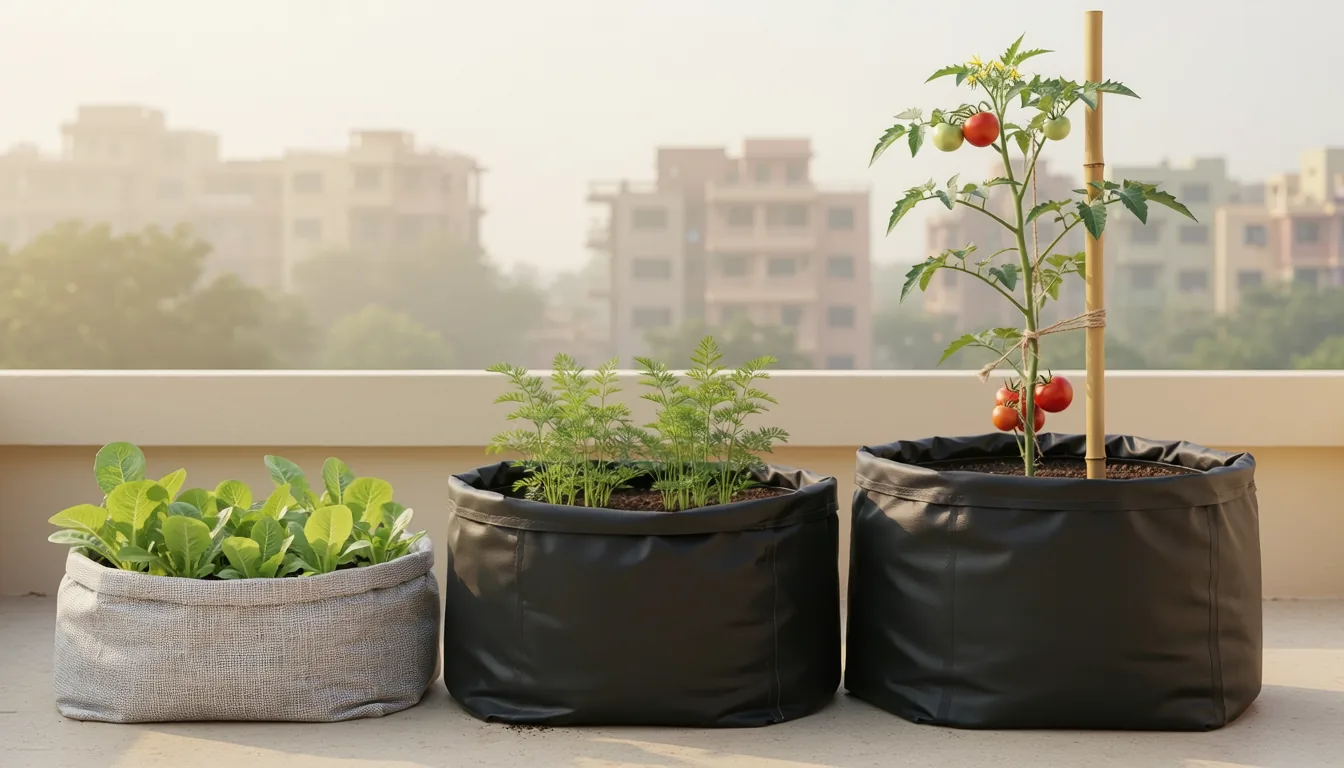
Grow bag size chart for common vegetables
These are practical planning ranges for a manageable first container garden, not universal minimums or results from a Surekha growing trial. The suggested volumes leave more room than some published minimums. Choose a bag that satisfies both the depth and volume columns, then check the variety’s mature size and spacing.
| Crop or use | Planning volume | Usable depth to plan for | Planting decision |
|---|---|---|---|
| Leaf lettuce or a small palak batch | 10–20 L | About 20–25 cm | Prefer width; follow packet spacing. |
| Coriander for leaves | 8–20 L | About 20–25 cm | Sow a small, labelled batch. |
| Shorter carrot varieties | 15–25 L | At least about 30 cm | Check mature root length. |
| Long mooli | 20–30 L or more | About 35–40 cm, or deeper | Match depth to the actual variety. |
| Chilli or capsicum | 20–30 L | About 30–35 cm | Start with one plant. |
| Brinjal | 25–40 L | About 35–40 cm | Start with one plant. |
| Compact or bush tomato | 25–40 L | About 35–40 cm | One plant with suitable support. |
For context, University of Maryland Extension lists minimum volumes of 2 US gallons for carrots, 5 for peppers, eggplant and standard tomatoes, and 2–5 for small herbs including coriander. Rounded metric equivalents are about 8 L and 19 L respectively. Minimum volume does not establish root depth or the number of plants a bag can support. Source: Maryland Extension container-size guidance.
Oregon State University recommends at least 12 inches—about 30 cm—of depth for shorter carrot varieties. Its guidance also favours container-adapted tomatoes. These crop distinctions inform the chart; its wider planning ranges are our editorial choices rather than a claim that one exact size is mandatory. Source: OSU container gardening basics.
For radish, check more carefully: RHS notes that some long-rooted mooli types exceed 30 cm in length. A shallow bag that suits small salad radishes may be unsuitable for that crop. Source: RHS radish root-size guidance. Our mooli growing guide covers sowing and care after container selection.
Depth, diameter and litres answer different questions
Usable depth: how much room is below the soil surface?
Measure from the inside base to the intended top of the growing medium. A bag’s advertised height includes any empty space at the rim. Folding the top down also reduces the available height. For a root crop, compare its expected root length with this usable depth rather than the bag’s outside measurement.
Width: how much planting area is available?
A broad bag gives you more surface area for rows, but seedlings still need their own spacing. Draw the proposed rows on paper using the packet’s instructions before sowing. The number of seeds in a packet is not the number of mature plants you should keep in one bag.
Volume: how much mix will you fill and maintain?
Litres help you budget for growing medium and compare differently shaped containers. Two bags can hold similar volumes while offering very different depths. University of Maryland stresses considering depth and volume together; a wider container can also be more stable than a tall, narrow one of equal volume. Source: Maryland Extension on container shape.
Ask the seller for the filled diameter or length and width, full height, stated capacity and material. Confirm whether the bag is supplied empty or with growing medium. Do not assume that a flat width measurement is a round bag’s diameter.
How to estimate grow bag volume in litres
For an approximately cylindrical filled bag, use:
Litres ≈ 3.14 × radius² × filled depth ÷ 1,000, with all measurements in centimetres.
For a rectangular planter, use length × width × filled depth ÷ 1,000. These are geometric estimates, not a guarantee of a soft bag’s actual capacity. Rounded sides, taper, seams and the fill level change the result.
| Diameter × full height | Approximate metric dimensions | Estimated filled volume |
|---|---|---|
| 12 × 12 inches | 30.5 cm diameter; 28 cm filled depth | About 20 L |
| 12 × 15 inches | 30.5 cm diameter; 35.6 cm filled depth | About 26 L |
| 15 × 12 inches | 38.1 cm diameter; 28 cm filled depth | About 32 L |
| 18 × 12 inches | 45.7 cm diameter; 28 cm filled depth | About 46 L |
Notice the difference between the middle two examples. The 15 × 12 bag holds more mix, yet the 12 × 15 bag is deeper. If the chosen carrot needs more than 28 cm of root-zone depth, buying a wider bag alone does not solve the problem.
These examples assume the first figure is diameter and the second is height. If the seller uses a different convention, calculate from the confirmed dimensions instead.
How many plants should you keep in one grow bag?
For a beginner, one chilli, capsicum, brinjal or tomato per appropriately sized bag makes watering, support and observation straightforward. Oregon State University describes a 5-US-gallon container—about 19 L—as suitable for a single pepper plant, with drainage and a well-draining mix. Source: OSU pepper container guidance.
Leafy and root crops can be grown as several plants in a broad container, with spacing determined by the variety and intended harvest. Measure the space between the plants you plan to retain. Thin or separate the sowing plan rather than treating every germinated seed as a permanent occupant.
Tomato fruit size is not a reliable shortcut for plant size. Check whether the variety is compact, bush or a vigorous vine. RHS distinguishes compact bush types from cordon tomatoes and recommends large containers and suitable support. For a first small balcony setup, select a container-adapted variety instead of forcing a large vine into the chart’s compact-tomato range. Source: RHS tomato container guidance.
Adjust the setup for your part of India
Container size is only one part of the decision. The following are inspection prompts for your actual balcony, not national sowing dates or a forecast.
- North Indian plains as autumn cools: observe how much direct light reaches the proposed position now. Check the crop’s local seasonal suitability before filling several bags.
- Warm coastal and southern locations: compare morning and afternoon conditions. Test one container’s drying pattern before copying the setup across the terrace.
- Rain-exposed or humid gardens: check where surplus water can escape and whether rain repeatedly saturates the bag.
- Hill locations with cold nights: check local frost guidance and whether the selected crop can be grown in your available conditions.
RHS notes that smaller containers can run short of moisture and nutrients and that prolonged waterlogging should be avoided. A larger bag can ease some maintenance demands, but it does not replace checking the growing medium. Source: RHS container care guidance.
Prepare the bag before sowing
- Choose its final position. Allow room to reach the plants, water them and install any support. Account for the filled container rather than only the empty bag.
- Inspect drainage and seams. Follow the manufacturer’s instructions and keep outlets unobstructed.
- Use a suitable container growing medium. Check its label for edible crops and any included nutrients. Avoid an improvised dense fill simply to make the bag cheaper.
- Leave watering space at the top. TNAU’s roof-gardening guidance recommends about one inch, roughly 2.5 cm, of headroom after the medium settles. Recheck usable depth at this fill level. Source: TNAU container setup guidance.
- Label and plant a manageable batch. Keep the variety, sowing date and spacing instructions together.
Oregon State recommends commercial potting medium rather than soil dug straight from the ground for its beginner container method. The aim is a root zone that drains and stays usable, not a particular ingredient ratio copied without checking your materials. Source: OSU growing-medium guidance.
A small three-container winter garden
Choose the crops first, then choose their containers. One practical plan is a broad bag for a modest leafy-green sowing, a separate coriander container, and a deeper bag for a suitable carrot or radish variety. Check the root crop’s packet before buying the third bag.
Read our guides to palak in pots and coriander in pots for crop-specific routines. Start with the number of containers you can reliably inspect and water.
Surekha Agro’s Winter Salad and Root Vegetable Seeds Combo contains separately packed carrot, radish, lettuce, spinach and coriander seeds. Select the varieties that fit your space and local conditions, and sow each in an appropriate container. A seed collection is not a recommendation to grow all five crops in one bag.
Frequently asked questions
Is a 12 × 12 grow bag enough for vegetables?
It depends on the measurements and crop. If that means a round bag 12 inches in diameter and height, leaving 2.5 cm at the rim gives roughly 20 L of filled volume and 28 cm of usable depth. Check both figures against the variety; a long root crop may need more depth.
Is a bigger grow bag always better?
More root space can help, but a larger container also uses more mix and occupies more room. Choose a manageable size that fits the plant and the site rather than buying the largest bag without a crop plan.
Can I fill the bottom with stones to use less potting mix?
Do not use stones as a drainage fix. Maryland Extension explains that a gravel layer can raise the water table in the container and worsen waterlogging. It also removes usable root-zone space. Select an appropriately sized bag and a suitable medium instead. Source: Maryland Extension drainage advice.
Should I choose fabric or a plastic grow bag?
Compare the specific product’s drainage, filled shape, material, outdoor-use instructions and maintenance requirements. The crop still needs the right depth, volume and position whichever material you choose.
Before you buy: write down the crop and variety, required depth, intended spacing and confirmed bag dimensions. That short list is more useful than choosing by a size label alone.
[…] sure what size to buy? Our guide to grow bag sizes for vegetables in India lists suitable depths for leafy […]
[…] quality seeds. Browse the Surekha Agro Products shop for available gardening supplies, and use our grow-bag size guide when choosing a container for leafy […]
[…] display, compare the tropical flowering plant combo. Choose a pot with drainage and use the container size guide for general sizing […]
[…] plants will not solve every problem. If the container is too shallow for your root crop, use the grow bag size guide to plan the next […]
[…] for one tomato plant; larger is better for vining types. Containers must drain freely. Our guide to grow bag sizes for vegetables in India compares common […]
[…] Make sure there are drainage holes, because chilli roots rot quickly in wet soil. See our guide to grow bag sizes for vegetables in India for common […]
[…] container depth with our grow bag size guide. Allow room for an existing root ball and a watering gap below the rim. For coir bricks, compare […]
[…] container safely inside the balcony and consider its weight once the growing mix is wet. Use our grow bag size guide when comparing container […]