
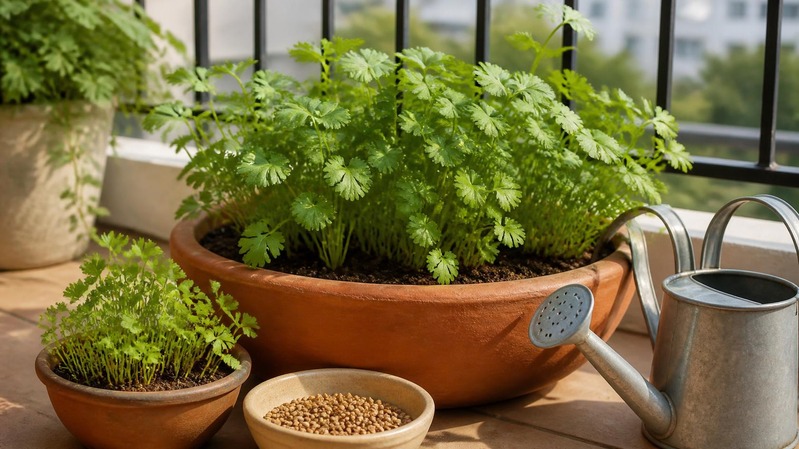
To grow coriander in pots in India, sow seeds directly into a draining container of loose potting mix, choose a mild-weather position with good light, and keep the seedbed moist without making it soggy. Start with one small batch of dhaniya rather than sowing the entire packet. Your first goal is a useful handful of leaves for the kitchen, followed by a second sowing that keeps the garden going.
When should you grow coriander in India?
Think in terms of the conditions on your balcony rather than one national planting date. Tamil Nadu Agricultural University describes a cool, relatively dry, frost-free climate and a temperature range of 20–25°C as suitable for coriander. Its regional crop guidance lists June–July and October–November sowing windows; these are not a calendar for every Indian city. Source: TNAU coriander guidance.
The following choices are practical adaptations of that climate preference. Check your actual exposure: an enclosed west-facing balcony can behave differently from an open east-facing balcony in the same building.
| Growing situation | Practical starting decision |
|---|---|
| North Indian plains as autumn cools | Try a small sowing when the balcony feels milder; reassess the position as winter light changes. |
| Warm coastal or southern city | Choose the cooler available exposure. If afternoons remain intense, test one pot before committing more seed. |
| Humid or rain-exposed balcony | Make drainage and protection from repeated heavy rain the first checks. |
| Cold hill location | Use local frost guidance and a sheltered trial. Do not assume that an October date means suitable temperatures. |
Planning other crops too? Our winter vegetables to grow in pots in India guide helps you choose a broader kitchen garden. This article focuses on getting one coriander crop started and keeping it useful.
Choose the container before opening the seed packet
A broad planter makes it easy to spread out a leafy crop. For a manageable first attempt, consider a container around 30 cm wide and 20–25 cm deep with several unobstructed drainage holes. This is a practical starter size, not a universal minimum. You can use a trough or grow bag if it holds a comparable amount of mix and sits securely.
University of Maryland Extension lists coriander among small herbs suited to roughly 2–5 US gallon pots. It stresses drainage, growing-medium aeration and matching container volume to the crop. Gravel at the bottom does not fix poor drainage; use proper outlets and a mix that drains instead. Source: University of Maryland container gardening guide.
Choose a potting mix intended for containers and edible plants. Before sowing, water a small sample: does surplus water escape, and does the mix stay loose rather than becoming a solid lump? Correct the setup now. Keep the packet, container and watering tool together so starting the next batch is a simple repeatable job.
How to prepare and sow coriander seeds
1. Check whether the seeds are whole or already split
The round units commonly sold as coriander seed can be separated into halves. TNAU recommends splitting before sowing and describes a 12-hour water soak. If you have whole clusters, gently separate them without grinding them into powder. Already split seed needs no further crushing. Follow the packet’s preparation advice where provided. Source: TNAU seed preparation guidance.
For an optional soak, use a clean bowl and sow after draining. Keep the unsown portion dry and labelled. Avoid turning preparation into a complicated ritual: make a note of what you did so that you can compare the next sowing.
2. Sow in the final pot
Use a shallow covering, about 0.6–1.2 cm of mix, unless your seed packet directs otherwise. For leafy production, leave approximately 5 cm between seedlings after thinning. Utah State University Extension gives this depth range and distinguishes close leaf-crop spacing from wider seed-production spacing. Its US planting months should not be copied into an Indian calendar. Source: USU coriander growing guide.
Sow directly where the plants will remain. Coriander dislikes root disturbance; the RHS recommends direct sowing. Gently water, then label the pot with the date. RHS guidance gives outdoor germination of around one to three weeks, depending on temperature. Source: RHS coriander guide.
3. Give seedlings room
A seed packet is a supply for several attempts, not a target for one crowded pot. Once you can see the seedlings clearly, compare the result with your intended spacing. University of Minnesota Extension warns that crowding herbs reduces airflow and produces weak growth. Source: UMN herb-growing guidance.
Manage light and water with a short daily check
A sunny or lightly shaded position can work; in hot conditions, protect a leaf crop from the strongest midday sun. Keep the mix just moist and avoid persistent saturation. These principles come from the RHS coriander guide, rather than its UK seasonal dates. Source: RHS growing and watering advice.
Make your check specific: look at the seedlings, touch the growing mix and check the drainage outlet. A dry-looking surface alone is not a complete diagnosis. Note whether the pot has received rain since your last visit. You will learn more from these observations than from setting an unchanging instruction to water every morning.
For general home-gardening context, see our watering guide for Indian weather. Apply its observation habit to your coriander pot rather than treating houseplant watering intervals as coriander instructions.
Do not respond to every slow-growing seedling by adding fertiliser. UMN notes that herbs need drainage and moderate fertility, and insufficient light can produce thin, stretched growth. Check the position and mix first; use any feed according to the product label for edible container crops. Source: UMN light and fertility guidance.
Harvest a little, then start the next batch
When plants are about 10–15 cm tall, take a few leaves from each rather than stripping a single plant. Give them time to recover. Coriander is an annual: it eventually flowers and sets seed, so one pot is not an indefinite supply. Sow small batches every few weeks for overlapping harvests. Source: RHS harvesting and succession advice.
A simple two-pot routine keeps the decision easy. Label the first pot “A” and the second “B.” Start A, observe its establishment, then sow B a few weeks later if conditions remain suitable. Put the sowing dates on both labels. At harvest time, choose the pot that can spare leaves rather than cutting both heavily on the same day.
Do not promise yourself a fixed harvest day. Weather, seed and growing conditions change the pace. Review the crop itself before planning a meal around it.
Troubleshooting: decide what to check next
| What you notice | Useful next check |
|---|---|
| An apparently empty pot | Read your sowing label and packet. Review seed depth, moisture history and temperature before disturbing the whole pot. |
| Thin, stretched seedlings | Compare the pot’s actual light with your intended position; also review crowding. |
| Wet mix and declining growth | Check the drainage holes and whether repeated watering or rain is keeping the pot saturated. |
| Flower stems appearing early | Review heat and drying. Consider a cooler position and a fresh small sowing for leaves. |
These are starting checks, not diagnoses from a photograph. Hot, dry conditions encourage early flowering; choosing a leaf variety described as slow-bolting can help, but does not remove the need for suitable weather. Source: USU variety and climate guidance.
Frequently asked questions
Can I grow dhaniya from kitchen coriander seeds?
You can try a small comparison pot with whole, unroasted seeds. Spice packets may not provide sowing or viability information. For a planned crop, choose gardening seed with clear instructions; do not expect ground or roasted coriander to work.
Does coriander need full sun all day?
No fixed all-day rule fits every Indian balcony. Start with the position described above, then review heat, light and the crop’s response.
How much coriander should I sow the first time?
Enough to populate one container at your planned spacing. Keep some seed for a second batch instead of sowing the whole packet at once.
Can I grow coriander indoors?
Try only where you can provide suitable light and a draining pot. A bright-looking room is not automatically a good growing position. USU notes that indoor growing needs a sufficiently deep container. Source: USU indoor-growing FAQ.
Start with one pot of fresh dhaniya
Choose the position first, prepare the container, then sow a modest batch. Keep a simple record of sowing, emergence and your first picking. That record becomes a useful guide for the next pot in your own home.
Explore Surekha Agro coriander seeds for home gardening. The current listing describes two separately packed 20 g sachets, which lets you set aside a portion for later sowings. Check the current product details and packet guidance before use; growth and harvest depend on your conditions.
[…] can apply the same kitchen-garden approach to quick crops such as radish in pots, palak in pots, coriander and […]
[…] Coriander (dhaniya) in pots […]
[…] drainage and a light, well-aerated mix from the Surekha Agro Products shop. You can also read our container growing guide for the same moisture-check habit used with edible […]