
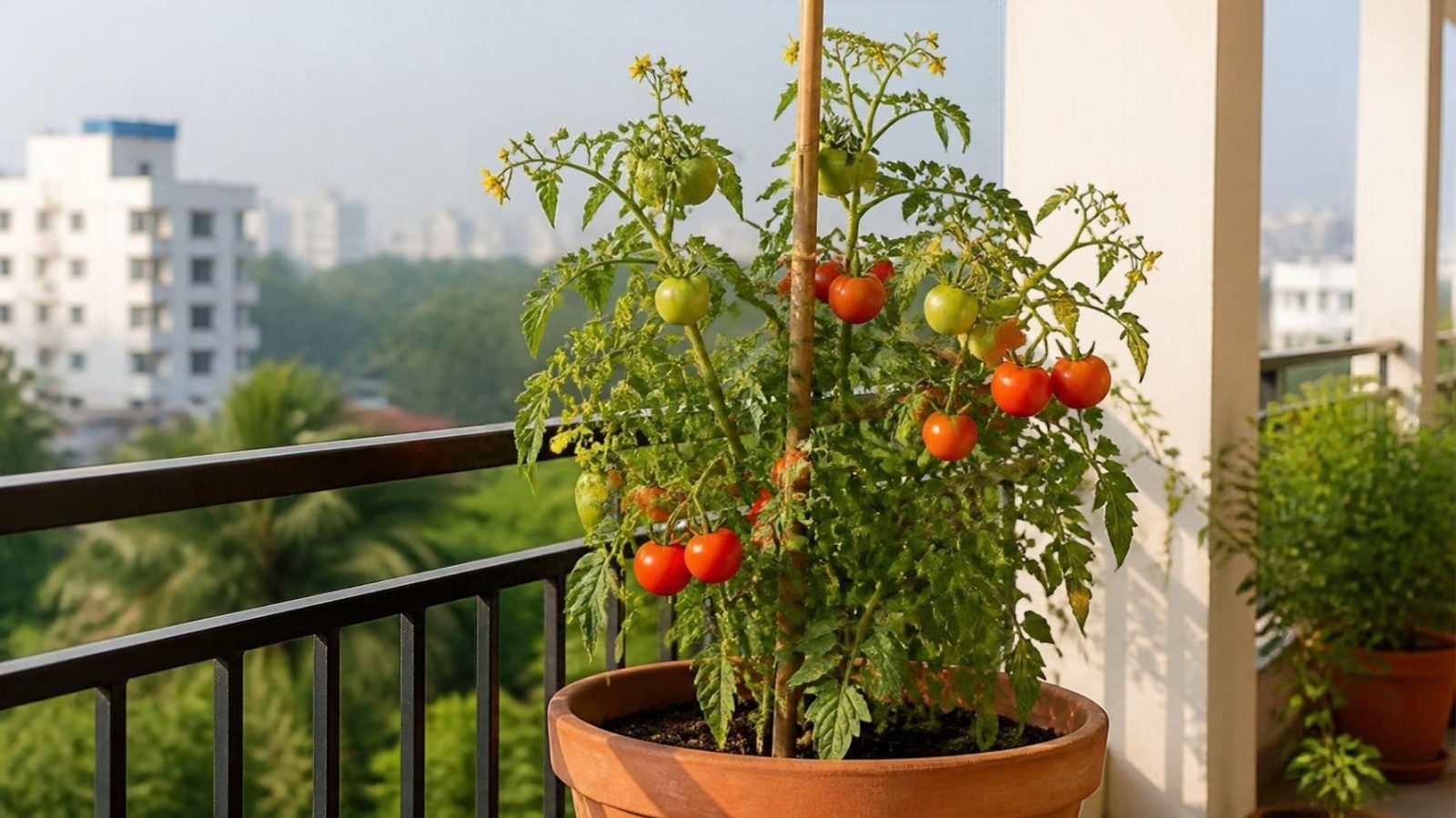
Learning how to grow tomatoes at home is one of the best ways to start a kitchen garden. A single healthy plant in a large pot can keep a family supplied with fresh fruit for weeks, and tomatoes grow well on Indian balconies, terraces and rooftops as long as they get enough sun.
Quick answer: Raise seedlings in a tray, then move each one to its own pot or grow bag about 30–45 cm deep at 25–30 days old. Use loose, compost-rich soil, give at least 6 hours of direct sun and stake the plant within a month. Water deeply and evenly, and pick fruits as they colour. Most plants keep fruiting for several weeks.
This guide covers the right sowing time for your region, container size, soil, seedlings, staking, watering, feeding, harvesting and the most common tomato problems in Indian homes.
Tomato growing guide at a glance
| Requirement | Practical target |
|---|---|
| Temperature | Warm but not extreme; about 20–30°C suits the crop |
| Container | One plant per pot or grow bag, about 30–45 cm deep |
| Sunlight | At least 6 hours of direct sun |
| Soil | Well-drained loam or sandy loam; pH about 6.5–7.5 |
| Raising plants | Sow in a tray; transplant seedlings at 25–30 days |
| Support | Stake within about 30 days of transplanting |
| Water | Deep and regular; never let pots swing between soaked and bone-dry |
| Harvest | Picking continues over several weeks; ICAR-IIVR gives 90–120 days after transplanting for harvesting |
When is the best time to grow tomatoes in India?
Tomatoes like warm days but suffer in frost and in extreme heat. ICAR-Indian Institute of Vegetable Research (IIVR) describes a warm-weather crop that grows best at 20–30°C and is sensitive to frost. It lists three sowing windows: September for the rabi crop, June–July for kharif and January for summer.
The Tamil Nadu Agricultural University (TNAU) Agritech Portal gives May–June and December–January as tomato seasons for Tamil Nadu. Because winters differ so much across India, match your sowing to local temperatures.
| Region | Suggested sowing for pots | What to watch |
|---|---|---|
| North and Central plains | September for a winter crop; otherwise raise seedlings in the cool months and transplant once frost risk has passed | Frost in December–January can damage plants; move pots to a sheltered spot |
| East India (West Bengal, Odisha, Bihar, Assam) | September–November, once heavy rain ends | Humid spells encourage leaf blights |
| West India (Maharashtra, Gujarat) | September–December for the main winter crop | Dry heat from March reduces fruit set |
| South India and coastal cities | December–January or May–June, following TNAU’s seasons | Hot afternoons; give light shade during heatwaves |
If you have missed the ideal window, you can still grow tomatoes, but expect fewer fruits when temperatures swing far outside the comfortable range.
Which tomato type suits pots?
| Type | Growth habit | Best for |
|---|---|---|
| Determinate (bush) | Stops growing at a set height and ripens most fruit over a shorter period | Smaller pots, windy terraces and beginners |
| Indeterminate (vining) | Keeps growing and fruiting for longer | Large grow bags with tall stakes or a trellis |
| Cherry tomatoes | Small fruits, often on vigorous vines | Snacking, salads and quick harvests |
| Hybrid varieties | Bred for traits such as yield or uniformity | Gardeners who want predictable plants; buy fresh seed each season |
Check your seed packet for the variety’s habit before you choose a pot and a support.
What you need to grow tomatoes in pots
Container
Give each plant its own container. A pot or grow bag about 30–45 cm deep and wide is a practical size for one tomato plant; larger is better for vining types. Containers must drain freely. Our guide to grow bag sizes for vegetables in India compares common sizes.
Soil mix
ICAR-IIVR recommends well-drained loam or sandy loam soil with a pH of about 6.5–7.5. In a container, plenty of compost keeps the mix fertile and moisture-retentive. A simple container mix is:
- 2 parts garden soil
- 1 part well-rotted compost or vermicompost
- 1 part cocopeat or coarse sand for drainage
Sunlight
Tomatoes need at least 6 hours of direct sun to flower and fruit well. Plants in shade grow tall and leafy with few fruits.
Support
Keep a bamboo stake ready; TNAU recommends stakes 1–1.5 m tall. Vining varieties also do well on a small trellis. Push the stake in at transplanting so you do not damage roots later.
How to grow tomatoes at home: step-by-step
- Sow in a seedling tray. Fill a tray or small cups with fine, moist seed-starting mix and sow seeds about 0.5 cm deep. Cover lightly and keep warm and just moist.
- Give light as soon as they sprout. Move seedlings into bright light immediately, or they stretch and become weak.
- Keep only the strongest seedling. If two seeds sprout in one cell, snip the weaker one at soil level. Our guide on how to thin vegetable seedlings explains why.
- Transplant at 25–30 days. TNAU transplants tomato seedlings at about 25 days and ICAR-IIVR at 25–30 days. Water the tray first, lift each seedling with its root ball and plant it slightly deeper than it sat in the tray.
- Water in well. Water thoroughly after planting and keep the pot in light shade for a day or two while the plant settles.
- Stake and tie. TNAU recommends staking about 30 days after planting. Tie the stem loosely to the stake with soft twine as it grows.
- Clear the lower stem. TNAU advises removing side branches up to about 20 cm from the ground. This keeps leaves off the soil and improves air flow.
Watering and feeding tomatoes
Water deeply whenever the top 2–3 cm of soil feels dry, and let excess water drain away. ICAR-IIVR advises regular irrigation. Pots dry much faster than field soil, so many containers need water every one to two days in warm weather. Irregular watering, such as letting the pot dry out completely and then flooding it, often leads to cracked fruit and blossom-end rot.
Tomatoes are hungry plants. Mix compost into the soil before planting and add a thin layer of compost around the plant every few weeks once flowering starts. Too much nitrogen produces lush leaves and few fruits, so avoid heavy nitrogen feeding after the plant begins to flower. If you use a potassium fertiliser such as our water-soluble potash during flowering and fruiting, follow the dose on the label.
A mulch of dry leaves or straw on the soil surface helps keep moisture even and reduces soil splashing onto leaves.
How and when to harvest tomatoes
ICAR-IIVR gives 90–120 days after transplanting for harvesting, and picking continues over several weeks rather than all at once. Pick fruits when they show full colour and still feel firm. In very hot weather you can pick at the first blush of colour and let them finish ripening indoors at room temperature.
- Twist and lift the fruit gently, or cut the stalk with scissors.
- Pick every two or three days during peak season.
- Do not store ripe tomatoes in the fridge if you want the best flavour; use them within a few days.
Common tomato problems and how to fix them
ICAR-IIVR lists late blight, early blight, bacterial wilt and leaf curl virus among the main tomato diseases, and fruit borer, whitefly, aphids, thrips and leaf miner among the main pests. These are the problems home gardeners notice most.
| Problem | Likely cause | What to do |
|---|---|---|
| Leaves curl, crinkle and turn small | Leaf curl virus, spread by whitefly | Remove badly affected plants early; use yellow sticky traps to monitor whitefly |
| Brown spots with rings on older leaves | Early blight | Remove spotted leaves, keep foliage dry and stake for air flow |
| Holes in fruit | Fruit borer | Pick and destroy damaged fruit as soon as you see it |
| Black, sunken patch at the base of the fruit | Blossom-end rot from uneven watering | Water deeply and regularly; mulch the pot |
| Fruit cracks after rain or heavy watering | Sudden swings in moisture | Keep watering consistent; pick ripening fruit before heavy rain |
| Flowers drop without setting fruit | Very hot or cold weather, or too little sun | Grow in the recommended season and give full sun |
| Plant wilts suddenly although soil is moist | Wilt disease or waterlogged roots | Check drainage; remove the plant and use fresh soil for the next crop |
| Wiggly white lines in leaves | Leaf miner | Pick off affected leaves |
For persistent problems, your nearest Krishi Vigyan Kendra or state agricultural university can recommend treatments suited to your area.
Seeds to get started
Our Tomato F1 Hybrid Seeds are packed for home gardeners. If you also want chilli, brinjal, okra and capsicum, the Indian Kitchen Garden 5 Vegetable Seeds Combo includes tomato alongside them. Chilli follows a very similar routine; see our guide on how to grow chilli at home in pots.
Frequently asked questions
How long does a tomato plant take to give fruit?
Seedlings are transplanted at about 25–30 days. ICAR-IIVR gives 90–120 days after transplanting for harvesting, and picking continues over several weeks. Timing varies with the variety and the weather.
Can I grow tomatoes from a store-bought tomato?
Seeds from a ripe market tomato often germinate, but if the fruit came from a hybrid the plants may not resemble the parent. Seed saved this way is also untested. Packed seed gives more predictable results.
How many tomato plants can I grow in one grow bag?
Grow one plant per pot or grow bag of about 30–45 cm. Crowding two plants into one container reduces air flow and fruiting, and makes disease more likely.
Why are my tomato flowers falling off?
Flower drop is most often caused by temperatures outside the comfortable range, too little sun or irregular watering. Grow in the recommended season, give full sun and water evenly.
Should I remove side shoots from tomato plants?
TNAU recommends removing side branches up to about 20 cm from the ground. Above that, determinate varieties need little pruning, while vining types are easier to manage if you remove some side shoots and train one or two main stems up the stake.
Can tomatoes grow on a balcony with only morning sun?
They can grow, but fruiting suffers with less than about 6 hours of direct sun. Choose the sunniest corner available, and consider cherry or bush types, which are more forgiving.
Plant your first tomato this season
A sunny spot, a deep pot, compost-rich soil, a stake and steady watering are all a tomato plant needs. Sow in the season that suits your region, transplant sturdy seedlings at about four weeks and pick fruit as it colours. For more crops to grow alongside, see our list of the best winter vegetables to grow in pots in India.