
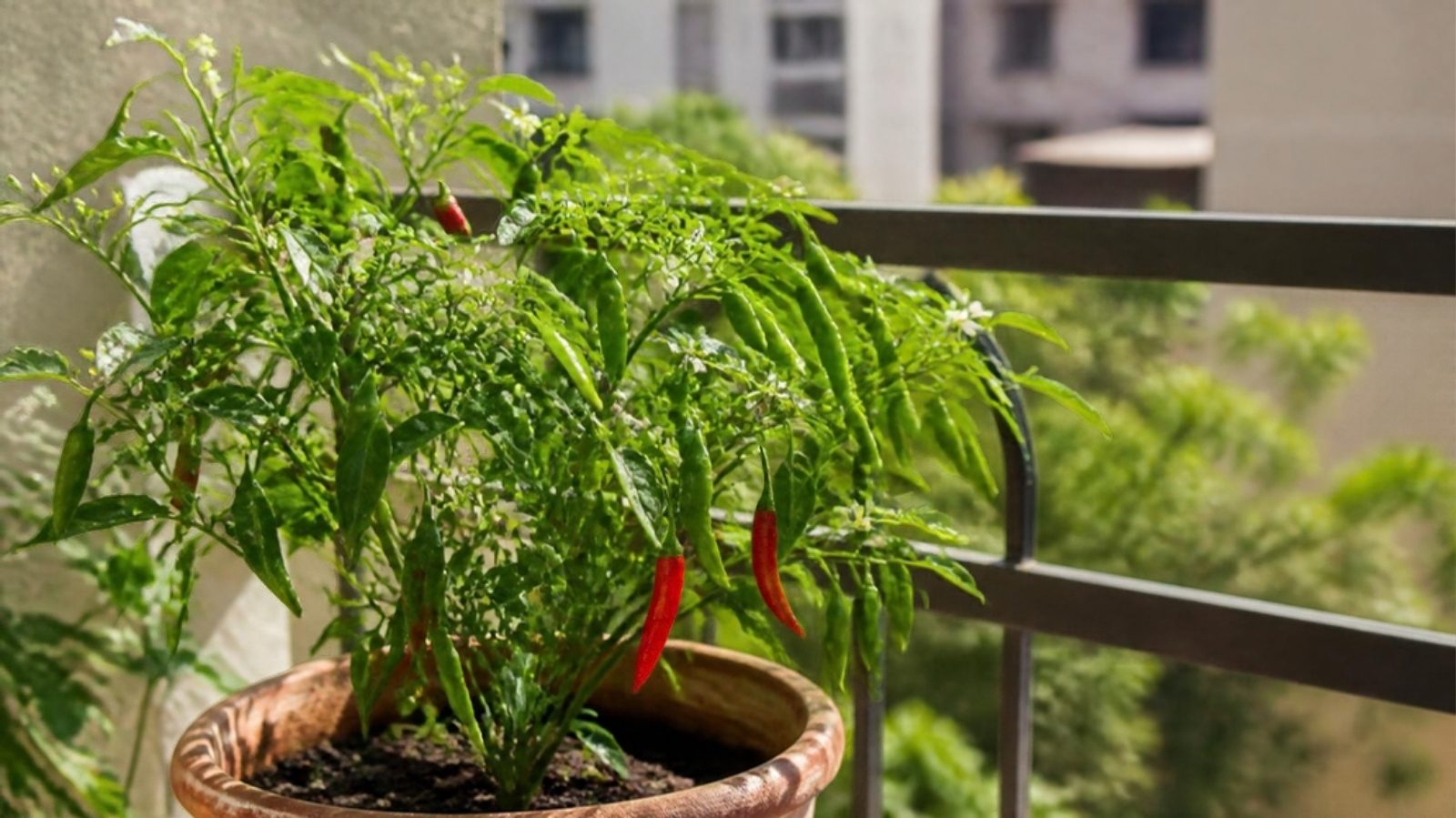
Want to know how to grow chilli at home? Hari mirch is one of the most productive plants you can keep on an Indian balcony or terrace. A single healthy plant in a good-sized pot can fruit for months, giving you fresh green chillies for daily cooking and red ones for drying.
Quick answer: Raise seedlings in a tray and transplant one strong seedling per pot when it is about 30–35 days old. Use a pot or grow bag 25–30 cm deep with well-draining, compost-rich soil. Give at least 6 hours of sun, water regularly during flowering and fruiting, and start picking green chillies roughly two months after transplanting.
This guide covers sowing seasons by region, pot size, soil, raising seedlings, watering, feeding, harvesting and the problems chilli growers meet most often in India.
Chilli growing guide at a glance
| Requirement | Practical target |
|---|---|
| Temperature | Warm; about 20–30°C, and sensitive to frost |
| Container | One plant per pot or grow bag, about 25–30 cm deep or more |
| Sunlight | At least 6 hours of direct sun |
| Soil | Well-drained loam or sandy loam with plenty of organic matter |
| Raising plants | Sow in a tray; transplant at about 30–35 days |
| Water | Regular, with extra care during flowering and fruiting |
| First harvest | Roughly 50–60 days after transplanting |
| Fruiting period | Can continue for months with regular picking |
When is the best time to grow chilli in India?
ICAR-Indian Institute of Vegetable Research (IIVR) describes chilli as a warm-climate crop that grows best at 20–30°C and is sensitive to frost. It gives two sowing windows: October–November for the rabi crop and June–July for kharif.
The Tamil Nadu Agricultural University (TNAU) Agritech Portal lists three seasons for Tamil Nadu: January–February, June–July and September–October. In practice, chilli can be started at several points in the year as long as young plants avoid frost and extreme heat.
| Region | Suggested sowing for pots | What to watch |
|---|---|---|
| North and Central plains | June–July, or October–November if you can protect plants from frost | Frost in December–January can kill young plants; keep pots against a warm wall |
| East India (West Bengal, Odisha, Bihar, Assam) | June–July or October–November | Waterlogging in the monsoon causes root rot; use free-draining pots |
| West India (Maharashtra, Gujarat) | June–July or October–November | Hot, dry April–May causes flower drop; give afternoon shade |
| South India and coastal cities | Any of TNAU’s seasons: January–February, June–July or September–October | Mites and thrips thrive in hot, dry weather |
What you need to grow chilli in pots
Container
Grow one chilli plant per container. A pot or grow bag about 25–30 cm deep and wide suits most green chilli varieties; larger, bushier types do better in bigger bags. Make sure there are drainage holes, because chilli roots rot quickly in wet soil. See our guide to grow bag sizes for vegetables in India for common sizes.
Soil mix
ICAR-IIVR recommends well-drained sandy loam with a pH of 5.5–6.8, while TNAU gives well-drained loam rich in organic matter with a pH of 6.5–7.5. Aiming for a slightly acidic to neutral mix, around pH 6–7, covers both. A simple container mix is:
- 2 parts garden soil
- 1 part well-rotted compost or vermicompost
- 1 part cocopeat or coarse sand for drainage
Sunlight
Chillies need at least 6 hours of direct sun. In shade the plants grow tall and sparse, flower poorly and drop fruit.
How to grow chilli at home: step-by-step
- Sow in a seedling tray. Fill a tray or small cups with fine, moist seed-starting mix. Sow seeds about 0.5 cm deep and cover lightly.
- Keep warm and moist. A loose plastic cover or a damp cloth over the tray holds in moisture; remove it as soon as shoots appear. Germination is faster in warm weather.
- Move to bright light. Give seedlings full light immediately after sprouting so they stay short and sturdy.
- Keep one seedling per cell. Snip extra seedlings at soil level. Our guide on how to thin vegetable seedlings explains how.
- Transplant at the right age. ICAR-IIVR recommends transplanting 30–35-day-old seedlings. Move them when they have several true leaves and a firm stem.
- Plant and water in. Set each seedling at the same depth it grew in the tray, firm the soil and water well. Keep the pot in light shade for a day or two.
- Add light support. A short bamboo stick tied loosely to the main stem stops heavily laden plants from leaning or snapping in wind.
Watering and feeding chilli
Water when the top 2–3 cm of soil feels dry, and let excess water drain. ICAR-IIVR stresses regular irrigation, especially during flowering and fruiting. Pots in summer may need water daily; in cooler months every two to three days is often enough. Both waterlogging and severe drying cause flower and fruit drop.
Mix compost into the soil before planting, then add a thin layer of compost around the plant every three to four weeks once it starts flowering. Avoid heavy nitrogen feeding, which produces leaves at the expense of flowers. If you use a potassium fertiliser such as our water-soluble potash during fruiting, follow the dose on the label.
How and when to harvest chillies
ICAR-IIVR gives 50–60 days after transplanting for harvesting to begin. Early pickings are usually green; chillies left longer on the plant turn red. A healthy plant keeps producing for months.
- Pick green chillies when they reach full size and feel firm.
- Leave some to turn red if you want to dry them or save the heat for later.
- Cut the stalk with scissors rather than pulling, so you do not break branches.
- Pick regularly. Leaving many fruits on the plant slows new flowering.
Common chilli problems and how to fix them
ICAR-IIVR lists thrips, aphids, fruit borer and mites as the main pests, and anthracnose, powdery mildew, leaf curl virus and wilt as the main diseases. TNAU also recommends protecting nursery seedlings against damping off.
| Problem | Likely cause | What to do |
|---|---|---|
| Leaves curl upward and become thick and crinkled | Thrips or mites | Check leaf undersides; wash off with a firm water spray and remove badly affected leaves |
| Leaves curl downward, plant stunted | Leaf curl virus, often spread by whitefly | Remove infected plants early; control whitefly with yellow sticky traps |
| Seedlings collapse at soil level | Damping off from wet, crowded nursery trays | Use fresh seed-starting mix, avoid overwatering and give air flow |
| Flowers and small fruits drop | Heat, cold, drought or waterlogging | Keep watering steady and give afternoon shade in heatwaves |
| Dark sunken spots on fruit; tips of branches dry back | Anthracnose or die-back | Remove affected fruits and twigs; avoid wetting the foliage |
| White powdery patches on leaves | Powdery mildew | Remove affected leaves and improve air flow |
| Clusters of small insects on new growth | Aphids | Wash off with water; check every few days |
| Holes in fruit | Fruit borer | Pick and destroy damaged fruit |
For a problem that keeps returning, your nearest Krishi Vigyan Kendra or state agricultural university can recommend treatments suited to your area.
Seeds to get started
Chilli seeds are included in our Indian Kitchen Garden 5 Vegetable Seeds Combo, together with tomato, brinjal, okra and capsicum, and in our larger 18 Variety Vegetable Seeds Combo. Tomato follows a very similar nursery routine; see our guide on how to grow tomatoes at home in pots.
Frequently asked questions
How many days does chilli take to grow from seed?
ICAR-IIVR recommends transplanting seedlings at 30–35 days and gives 50–60 days after transplanting for harvesting to begin. That puts the first green chillies at roughly three months from sowing.
Can I grow chilli from the seeds of a dried red chilli?
Seeds from dried red chillies sometimes germinate, but they are often old, may have been heat-dried and come from unknown varieties. Results vary a lot. Packed sowing seed is more reliable.
How long does a chilli plant keep producing?
A healthy plant can fruit for several months. Regular picking, steady watering and light feeding help keep it productive.
Why are my chilli flowers falling off?
Flower drop usually comes from temperature stress, uneven watering or too little sun. Keep the soil evenly moist, give at least 6 hours of sun and provide light shade during extreme heat.
Why are my chilli leaves curling?
Upward curling with thickened leaves usually points to thrips or mites, while downward curling with stunted growth often indicates leaf curl virus. Inspect the undersides of leaves and act early.
Can chilli grow indoors?
Only in a very sunny spot. Chillies need at least 6 hours of direct sun to fruit well, so a balcony or terrace is usually far more productive than a windowsill indoors.
Start your chilli plant this season
A sunny spot, a well-drained pot, compost-rich soil and steady watering are the essentials. Raise sturdy seedlings, transplant one per pot and keep picking, and a single plant can supply your kitchen for months. For more crops to sow this season, see our list of the best winter vegetables to grow in pots in India.