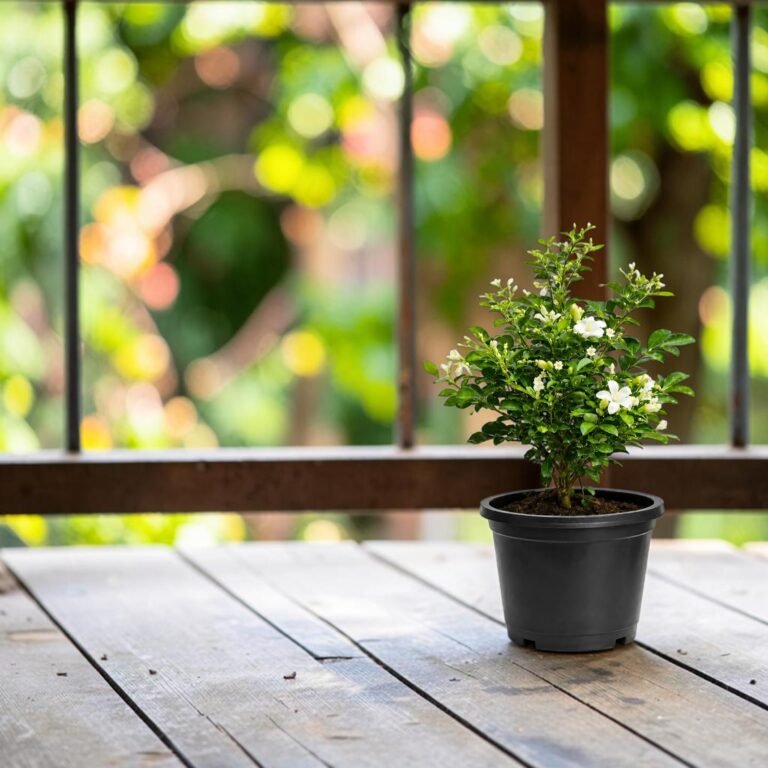
Madhu Kamini plant care comes down to four things: at least half a day of direct sun, a free-draining pot that is watered only when the top few centimetres dry, light feeding during active growth, and pruning only after a flowering flush. Done this way, this evergreen shrub stays bushy and keeps producing its sweet-scented white flowers in warm Indian weather.
Madhu Kamini, also sold as Kamini, orange jasmine or orange jessamine, is Murraya paniculata, a member of the citrus family (Rutaceae) and a close relative of curry leaf (Murraya koenigii). It is not a true jasmine. The University of Kerala’s Digital Garden lists it as a shrub or small tree with leaves of 3 to 7 leaflets, white five-petalled flowers and red berries, and records a flowering period of March to September in Kerala (University of Kerala Digital Garden). This guide is the everyday care plan. If your plant is healthy but refuses to bloom, go straight to our Madhu Kamini not flowering guide.
Madhu Kamini plant care at a glance
| Need | What works in Indian homes | Skip this |
|---|---|---|
| Light | Full sun or at least 4–6 hours of direct sun; east or south-facing balcony, terrace or garden bed | Keeping it indoors away from a window for weeks |
| Pot | Move from a 4–5 inch nursery pot to one about 2 inches wider, with drainage holes; grow up to a 12–14 inch pot or the ground | Jumping straight into a huge tub of wet soil |
| Soil | Garden soil, compost and cocopeat or sand for drainage | Heavy clay alone, or a saucer that stays full |
| Water | When the top 2–3 cm of mix is dry; more often in April–June, much less in the monsoon and winter | Daily watering by habit |
| Feeding | Compost or a balanced organic feed during active growth, following the pack label | Repeated high-nitrogen feeds that give leaves but few buds |
| Pruning | Light shaping just after a flowering flush ends | Clipping the new tips again and again |
| Watch for | Psyllids, aphids, scale and mealybugs on soft new shoots | Spraying without first identifying the pest |
Pot sizes and the watering test above are practical starting points, not fixed rules. Adjust them to your actual sun, wind and pot material.
How to identify a Madhu Kamini plant
Buyers often confuse Madhu Kamini with mogra, chameli or curry leaf. These features help you tell them apart:
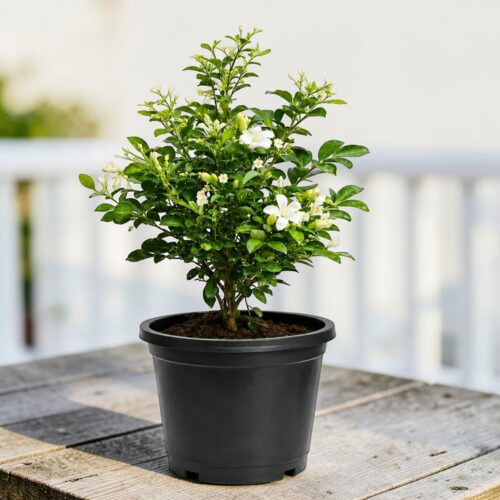
- Leaves: glossy, dark green and compound, with several oval leaflets arranged along one stalk. Crush one and it smells faintly citrusy, not like curry leaf.
- Flowers: small, white, five-petalled and bell- to star-shaped, in clusters at the branch tips. The fragrance is usually strongest in the evening.
- Fruit: small oval berries that turn red when ripe.
- Habit: a woody, bushy shrub. In the ground it can become a large hedge; the Botanic Gardens of South Australia’s Plant Selector lists 2–4 m height and spread (Plant Selector+). In a pot it stays much smaller.
Madhu Kamini vs Table Kamini
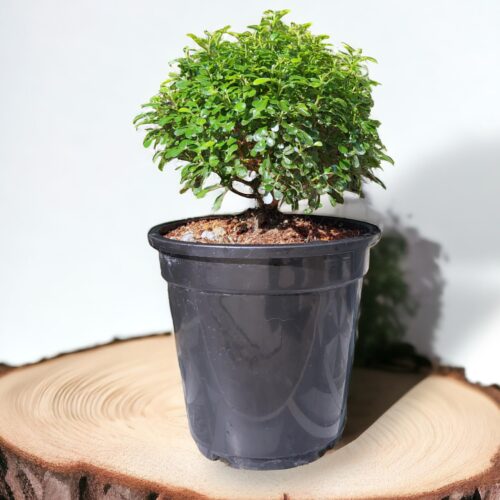
Both are sold as Murraya paniculata. Madhu Kamini is the regular form with larger leaflets that grows into a tall flowering shrub or hedge. Table Kamini is a dwarf, tight-growing form with tiny leaves, chosen mostly for its neat shape. Care is similar, but Table Kamini sits in smaller pots, so it dries out faster and needs closer watching in summer. If fragrance and flowers are your main goal, choose the regular Madhu Kamini plant; for a compact desk or tabletop shape, choose Table Kamini.
Where to keep a Madhu Kamini plant
Give it the sunniest spot you have. Madhu Kamini is a full-sun shrub. On a balcony, an east- or south-facing position with at least four to six hours of direct sun is a good start. A north-facing flat with only bright shade will usually keep it green but give few flowers.
Indoors it can sit near a bright window for a few days, for example when guests visit, but it should spend most of its time outside. In north Indian summers, a west-facing terrace in May and June can scorch young plants in small black pots. Light afternoon shade or a slightly bigger pot helps there. In winter, move it to the warmest, sunniest corner, out of cold night wind.
Best pot and soil mix for Madhu Kamini
Most Madhu Kamini plants arrive from nurseries in small 4–5 inch pots. At Surekha Agro Products our plants ship in nursery pots inside 7-layer protective packaging, so the first job after delivery is to let the plant settle, not to repot at once.
- Wait about a week. Keep the new plant in bright light with some afternoon shade and water only when the top of the mix dries.
- Choose the next pot. Go about 2 inches wider than the nursery pot, with clear drainage holes. Clay, plastic and grow bags all work; clay dries fastest.
- Mix the soil. A practical blend is roughly equal parts garden soil, well-rotted compost and cocopeat or coarse sand. Our DIY potting mix guide explains how to adjust the ratio, and the cocopeat block guide shows how to prepare cocopeat.
- Plant at the same depth. Keep the top of the root ball level with the new soil. Do not bury the stem.
- Water once thoroughly until water runs out of the drainage holes, then empty the saucer.
Sign it worked: new shoots and fresh glossy leaves within a few weeks. Move up one pot size at a time as roots fill the pot. A mature plant is happiest in a 12–14 inch pot, a large grow bag or the ground.
How often to water Madhu Kamini
Water when the top 2–3 cm of the mix feels dry, not on a fixed schedule. Push a finger into the soil before watering. Then adjust by season:
- Summer (March–June): small pots on a sunny terrace may need water daily or even twice on the hottest days. Larger pots usually need it every one to two days.
- Monsoon (June–September): rain may do the work. Check that pots are not standing in water, and lift them onto bricks or pot feet if needed.
- Winter (November–February): growth slows, so the mix stays wet longer. Water less often, especially in north India.
Constantly wet roots cause yellow leaves and leaf drop just as surely as drought does. If leaves droop while the soil is still wet, stop watering and check the drainage holes before you do anything else.
Fertiliser for Madhu Kamini
Madhu Kamini is not a heavy feeder. During active growth in spring, summer and early autumn, a handful of compost or vermicompost worked into the top of the pot every month or so is usually enough for a potted plant. You can also use a balanced organic fertiliser, following the dose on its pack.
- A phosphorus-rich organic input such as bone meal can be mixed in when repotting. Our bone meal guide for pots covers how much to use and why to go easy.
- Avoid repeated urea or other high-nitrogen feeds. They push soft leafy growth that attracts sap-sucking pests and can delay buds.
- Do not feed a plant that is wilting, waterlogged or freshly repotted. Fix the stress first.
- Feed less in winter, when the plant is barely growing.
How to prune Madhu Kamini for a bushy plant
Prune just after a flowering flush ends, as the South Australian Plant Selector also advises for Murraya paniculata (source). Flowers form at the tips of new shoots, so constant clipping removes the very growth that would have bloomed.
- Remove spent flower clusters and any berries you do not want to keep.
- Trim long shoots by a third or less, cutting just above a leaf. This makes the plant branch.
- Thin out crossing or weak inner twigs so light and air reach the centre.
- Then leave it alone. Let the new shoots grow and form buds before shaping again.
For a hedge, one firm trim after the main flowering and a light tidy later is enough. Heavy pruning in winter tends to give a slow, sparse recovery.
Madhu Kamini in different Indian regions
- Kerala, Tamil Nadu, coastal Karnataka and other warm humid areas: Madhu Kamini grows nearly year-round. Focus on drainage in the monsoon and on full sun.
- Maharashtra, Telangana, Gujarat and other hot dry areas: watch watering closely in April–May; mulch the pot surface and avoid tiny black pots on hot tiles.
- Delhi, Punjab, UP and the north: expect slow growth and some leaf drop in December–January. Keep pots in the sunniest spot, reduce water, and save pruning and repotting for warm weather (February–March onwards).
- Hill areas: grow it in a pot that can be moved into a bright, frost-free place in winter.
Flowering timing also varies. Kerala records March–September, but many plants bloom in several flushes, and each pot behaves a little differently.
Common Madhu Kamini problems and fixes
| What you see | Likely cause to check first | First action |
|---|---|---|
| Healthy leaves, no flowers | Too little direct sun, frequent tip pruning, between flushes | See the not flowering checklist |
| Yellow leaves, soil stays wet | Poor drainage or overwatering | Pause watering, clear drainage holes, empty the saucer |
| Leaf drop after delivery or repotting | Transplant stress | Bright light with afternoon shade, steady watering, no feeding for a few weeks |
| Crisp brown edges, very fast drying | Heat, hot wind, pot too small | Water deeply, move to a bigger pot, add mulch |
| White cottony clusters on stems | Mealybugs | Wipe off and follow our mealybug guide |
| Curled new shoots, sticky leaves, black sooty film | Aphids, psyllids or scale feeding on new growth | Inspect shoot tips with a magnifier; prune off heavily infested tips |
Why check Madhu Kamini for citrus psyllids?
Because Murraya paniculata belongs to the citrus family, it is one of the preferred hosts of the Asian citrus psyllid (Diaphorina citri), the insect that spreads citrus greening disease. A University of California publication notes that the pest was first found in Florida on backyard orange jasmine, spread partly through infested nursery plants, and is most common on the soft new flush (UC ANR Publication 8205). If you also grow lemon, kagzi nimbu or orange trees, inspect new Madhu Kamini shoots for tiny jumping insects, yellow-orange eggs and nymphs, and white waxy threads. Prune off infested tips and bag them. For any spray, use a product whose Indian label covers the pest and plant, and follow its directions.
How to propagate Madhu Kamini
- Seeds: sow fresh seeds from fully red, ripe berries after removing the pulp. Old, dried seeds germinate poorly. Seedlings take a few years to flower.
- Semi-hardwood cuttings: take 10–15 cm pieces of firm current-season growth in warm, humid weather, remove the lower leaves and root them in a moist, airy mix in bright shade. Rooting is slow, so expect some cuttings to fail.
- Air layering: useful on a large garden shrub when you want a bigger plant quickly.
Most home gardeners find a nursery plant the faster route to flowers.
Is Madhu Kamini safe for pets and children?
We could not find Murraya paniculata on the ASPCA’s toxic and non-toxic plant list, so its safety for cats and dogs is not established there. Treat it like any ornamental shrub: keep pets and small children from chewing leaves or berries, and do not confuse it with curry leaf in the kitchen. Call a vet if a pet eats a large amount and seems unwell.
Grow Madhu Kamini with other flowering shrubs
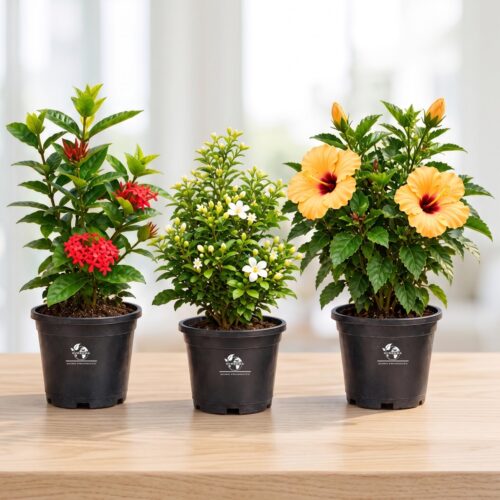
Madhu Kamini pairs well with hibiscus and ixora, which like similar sun and pot conditions. Our tropical flowering plant combo includes all three. For the hibiscus, follow our hibiscus plant care guide, and for more ideas see winter flowering plants for pots.
Madhu Kamini plant care FAQs
How do you take care of a Madhu Kamini plant in a pot?
Keep it in at least four to six hours of direct sun, use a pot with drainage holes and a free-draining mix, water when the top 2–3 cm dries, feed lightly during warm months and prune only after flowering.
Does Madhu Kamini need full sun?
Yes. It grows in partial shade but flowers best in full sun. Young plants in small black pots may need light afternoon shade during peak north Indian summer.
Can Madhu Kamini be grown indoors?
Only for short periods near a very bright window. Long-term indoor growing usually leads to weak shoots and few flowers, so keep it on a sunny balcony, terrace or garden.
When does Madhu Kamini flower in India?
It flowers in flushes in the warm months. The University of Kerala records March to September, and timing varies with region, sun and plant age. Each flush is followed by red berries if the flowers are left.
How fast does Madhu Kamini grow?
It is a moderate grower. A small nursery plant fills out over a season or two in a sunny spot with regular care, and growth slows sharply in winter.
Is Madhu Kamini the same as Kamini or orange jasmine?
Yes, these are common names for Murraya paniculata. Table Kamini is a dwarf, small-leaved form of the same species. It is not related to mogra or chameli, which are true jasmines.
Why are my Madhu Kamini leaves turning yellow?
The most common reason is soil that stays wet. Check drainage first. Old lower leaves also yellow and drop naturally, and winter cold can cause some leaf fall in north India.
Next step
Give your Madhu Kamini the sunniest spot you have, settle it into a slightly larger pot with good drainage, and let it grow without clipping until it flowers. If a healthy plant still has no buds after a full warm season, work through the Madhu Kamini not flowering guide.
Written by the Surekha Agro Products plant care team. Last updated 15 November 2026.
Sources
- University of Kerala Digital Garden: Murraya paniculata (botanical description, flowering period)
- Botanic Gardens and State Herbarium, South Australia, Plant Selector+: Murraya paniculata (size, sun, pruning after flowering)
- University of California ANR Publication 8205: Asian Citrus Psyllid (orange jasmine as a host)
- ASPCA Toxic and Non-Toxic Plant List (checked; Murraya paniculata not listed)