
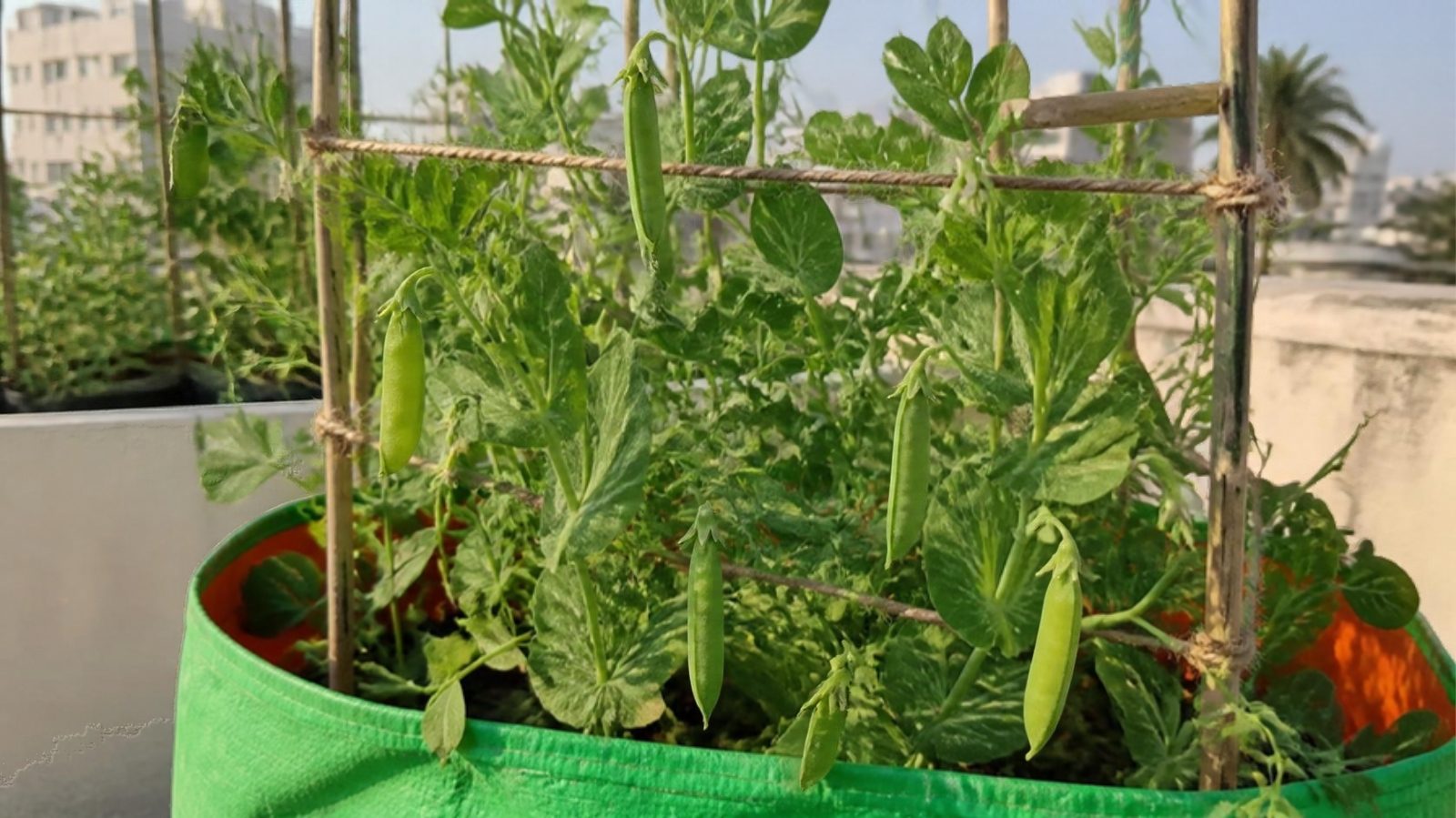
Want to know how to grow peas at home when all you have is a balcony or terrace? Matar is one of the most rewarding winter crops for Indian container gardens. The seeds are large and easy to handle, the plants climb neatly upward, and freshly picked pods taste far sweeter than shop-bought ones.
Quick answer: Sow pea seeds 3–5 cm deep in a pot or grow bag at least 25–30 cm deep, filled with loose, well-draining soil. Start in the cool season, usually October–November in the plains. Give the plants 5–6 hours of sun, steady moisture and a support to climb. Early varieties are usually ready to pick in about 65–75 days.
This guide explains the right sowing time for your region, pot size, soil mix, sowing steps, support, watering, harvesting and the problems you are most likely to meet.
Pea growing guide at a glance
| Requirement | Practical target |
|---|---|
| Best season | Cool months; October–November sowing in most plains |
| Ideal temperature | About 10–18°C for healthy growth |
| Container | 25–30 cm deep or more, with drainage holes |
| Sunlight | About 5–6 hours of direct sun |
| Soil | Loose, well-draining loam; pH about 6.0–7.5 |
| Sowing depth | 3–5 cm, directly in the final pot |
| Plant spacing | About 8–10 cm between seeds |
| Support | Needed from about one month after sowing |
| First harvest | Roughly 65–75 days for early types; later types take up to 110 days |
When is the best time to grow peas in India?
Peas are a cool-season crop. ICAR-Indian Institute of Vegetable Research (IIVR) gives an optimal temperature of 10–18°C and recommends winter sowing in October–November. The Tamil Nadu Agricultural University (TNAU) Agritech Portal lists February–March and October–November as sowing seasons in the plains, and notes that 12–15°C is ideal for flowering and pod development.
In practice, that means you should wait until the monsoon heat has eased. Seeds sown into hot, wet soil often rot, and plants that flower in warm weather set few pods.
| Region | Suggested sowing window in pots | What to watch |
|---|---|---|
| North and Central plains | Mid-October to mid-November | Late sowings may flower in severe cold or run into spring heat |
| East India (West Bengal, Odisha, Bihar, Assam) | Late October to November, once humidity drops | Damp, warm soil at sowing; powdery mildew later in the season |
| West India (Maharashtra, Gujarat) | Late October to November | A short cool season, so choose early varieties |
| South Indian plains and coastal cities | October–November, in the coolest spot you have | Warm winters limit pod set; expect a lighter crop |
| Hill regions | Varies with altitude | Follow your state agricultural university’s calendar |
India’s climates vary widely, so treat these windows as a starting point and adjust to your local temperatures. For more crops that share this season, see our list of the best winter vegetables to grow in pots in India.
Which type of pea should you grow in pots?
Garden peas differ mainly in height and in how quickly they mature. Both matter in a container.
| Type | What it is | Best for |
|---|---|---|
| Dwarf or bush peas | Shorter plants that need only light support | Small balconies, windy terraces and beginners |
| Tall or climbing peas | Longer vines that need a proper trellis | Gardeners with vertical space who want a longer picking period |
| Early varieties | Pods mature in roughly 65–70 days | Regions with short, mild winters |
| Mid and late varieties | Harvest at about 80–95 days or later | North Indian winters with a long cool spell |
The maturity ranges above follow ICAR-IIVR’s descriptions of its own varieties: early Kashi Purvi reaches pod maturity in 65–70 days, mid-season Kashi Tripti in 80–85 days and late Kashi Samridhi in 90–95 days. Check your seed packet for the variety’s height and maturity before you plan the support.
What you need to grow peas in pots
Container
Choose a pot, tub or grow bag that is at least 25–30 cm deep. Width decides how many plants you can grow, so a wide rectangular planter or a large round grow bag is more useful than a tall narrow pot. Drainage holes are essential, because pea roots rot quickly in standing water.
If you are unsure what to buy, our guide to grow bag sizes for vegetables in India compares common depths and volumes.
Soil mix
Both TNAU and ICAR-IIVR recommend well-drained loamy soil with a pH of about 6.0–7.5. A simple container mix that comes close is:
- 2 parts garden soil
- 1 part well-rotted compost or vermicompost
- 1 part cocopeat or coarse sand for drainage
Mix thoroughly, remove stones and fill the container to within 3–4 cm of the rim.
Sunlight
Give peas about 5–6 hours of direct winter sun. Plants in shade grow tall and thin and produce few flowers. A south- or west-facing balcony usually works best in the cool season.
Support
Arrange the support before or soon after sowing so you do not disturb the roots later. Three or four bamboo sticks tied at the top, a length of nylon or jute netting, or strings run up to a balcony railing all work well.
How to grow peas at home: step-by-step
- Soak the seeds (optional). Many gardeners soak pea seeds in water for 6–8 hours to speed up sprouting. Do not soak for longer, as the seeds can split or rot.
- Moisten the soil. Water the filled container and let it drain. The mix should be damp, not soggy.
- Sow at the right depth. ICAR-IIVR recommends sowing 3–5 cm deep. Push each seed into the soil and cover it firmly.
- Space the seeds. Leave about 8–10 cm between seeds. A grow bag 40 cm across comfortably holds 8–10 plants around a central support.
- Water lightly. Keep the surface just moist until the seedlings appear, usually within one to two weeks in cool weather.
- Protect young shoots. Birds and squirrels like pea seedlings. A loose net over the pot for the first two weeks helps.
- Guide the vines. TNAU advises providing support by the 30th day after sowing. Gently lead the first tendrils to the trellis; the plant will climb unaided after that.
Watering and feeding peas
Check the top 2–3 cm of soil with a finger and water when it feels dry. TNAU suggests irrigating about once a week in the field, but pots dry faster, so most containers need water every two to four days in winter. ICAR-IIVR highlights flowering and pod filling as the stages when moisture matters most.
Water the soil, not the leaves, and do it in the morning. Wet foliage in the evening encourages fungal disease.
Peas are legumes. Bacteria in their root nodules fix nitrogen from the air, which is why TNAU recommends treating seed with Rhizobium culture. For home pots, compost in the soil mix is usually enough. Add a handful of compost when flowering begins, and avoid nitrogen-heavy fertilisers, which push leafy growth at the expense of pods.
How and when to harvest peas
TNAU states that harvest can begin about 75 days after sowing, while ICAR-IIVR gives 65–70 days for its earliest variety and 90–110 days for the crop in general. Your own timing will depend on the variety and how cool the weather is.
Pick pods when they are bright green, well filled and still smooth. Pods that turn dull, pale or wrinkled are past their best, and the peas inside become starchy.
- Hold the vine with one hand and pull the pod with the other, or use scissors, so you do not tear the stem.
- Pick every few days. Regular picking encourages the plant to keep flowering.
- Shell and cook soon after harvest, because the sugars in peas start converting to starch once picked.
When the plants finish, cut them at soil level and leave the roots in the pot. The root nodules add nitrogen to the mix for your next crop.
Common pea problems and how to fix them
ICAR-IIVR lists powdery mildew, rust, wilt and downy mildew as the main diseases of pea, and pod borer, aphids, thrips and cutworms as the main pests. These are the symptoms home gardeners see most often.
| Problem | Likely cause | What to do |
|---|---|---|
| Seeds rot or do not sprout | Soil too wet or too warm; old seed | Sow later in the season, improve drainage and use fresh seed |
| Seedlings eaten overnight | Birds, squirrels or cutworms | Cover with netting; check the soil surface after dark |
| White powdery coating on leaves | Powdery mildew | Remove affected leaves, space pots for air flow and keep foliage dry |
| Plants wilt although soil is moist | Root rot or wilt from waterlogging | Reduce watering; do not reuse the same soil for peas next season |
| Flowers but few pods | Warm weather, low light or excess nitrogen | Move to a sunnier spot and stop nitrogen feeding |
| Small holes in pods | Pod borer | Pick off and destroy damaged pods; a neem-based spray can help |
| Clusters of small insects on shoot tips | Aphids | Wash off with a firm spray of water |
| Yellowing lower leaves | Overwatering or natural ageing late in the crop | Let the top layer dry between waterings |
If a problem persists, your nearest Krishi Vigyan Kendra or state agricultural university can advise on treatments suited to your area.
What to grow alongside peas
Peas grow upward, which leaves the rest of your balcony free for low, quick crops that enjoy the same cool weather. Good neighbours in separate pots include:
- Spinach (palak) in pots
- Coriander (dhaniya) in pots
- Radish (mooli) in pots
- Methi (fenugreek) in pots
Ready to sow? Our Peas Sweet Matar Seeds are packed for home gardeners, and you can browse the rest of our winter vegetable seeds to fill the other pots.
Frequently asked questions
How many days do peas take to grow at home?
Early varieties are usually ready in about 65–75 days from sowing, and mid or late varieties take roughly 80–110 days. ICAR-IIVR and TNAU both report figures in this range. Cooler weather slows growth, so winter crops in North India often take longer.
Can I grow peas from the dried or fresh peas in my kitchen?
Whole dried peas sometimes sprout, but they are not tested for germination and the variety is unknown. Fresh green peas from pods are immature and rarely grow. Frozen and split peas will not grow at all. Packed sowing seed is more reliable.
Do pea plants need support in pots?
Yes. Even dwarf varieties stay healthier with a short support, and tall varieties cannot crop well without one. TNAU recommends staking by about 30 days after sowing. Bamboo sticks, netting or strings are all suitable.
How many pea plants can I grow in one grow bag?
At 8–10 cm spacing, a grow bag about 40 cm wide holds roughly 8–10 plants. A 60 cm rectangular planter takes a single row of 6–7 plants, or two rows if it is at least 25 cm wide.
Can peas grow in summer in India?
Not in the plains. Peas need cool conditions, ideally 10–18°C, and stop setting pods in heat. Summer crops are only practical in the hills. In the plains, sow in October–November.
Why are my pea plants flowering but not forming pods?
The usual causes are warm days, too little sun or too much nitrogen. Move the pot to a brighter position, keep watering steady during flowering and stop any nitrogen-rich feeding.
Sow your first pot this season
Peas need little more than a deep container, loose soil, winter sun and something to climb. Sow in the cool weeks of October or November, keep the soil evenly moist and pick the pods while they are young. If this is your first season, pair the pot with carrots in pots for a classic winter gajar-matar harvest.