
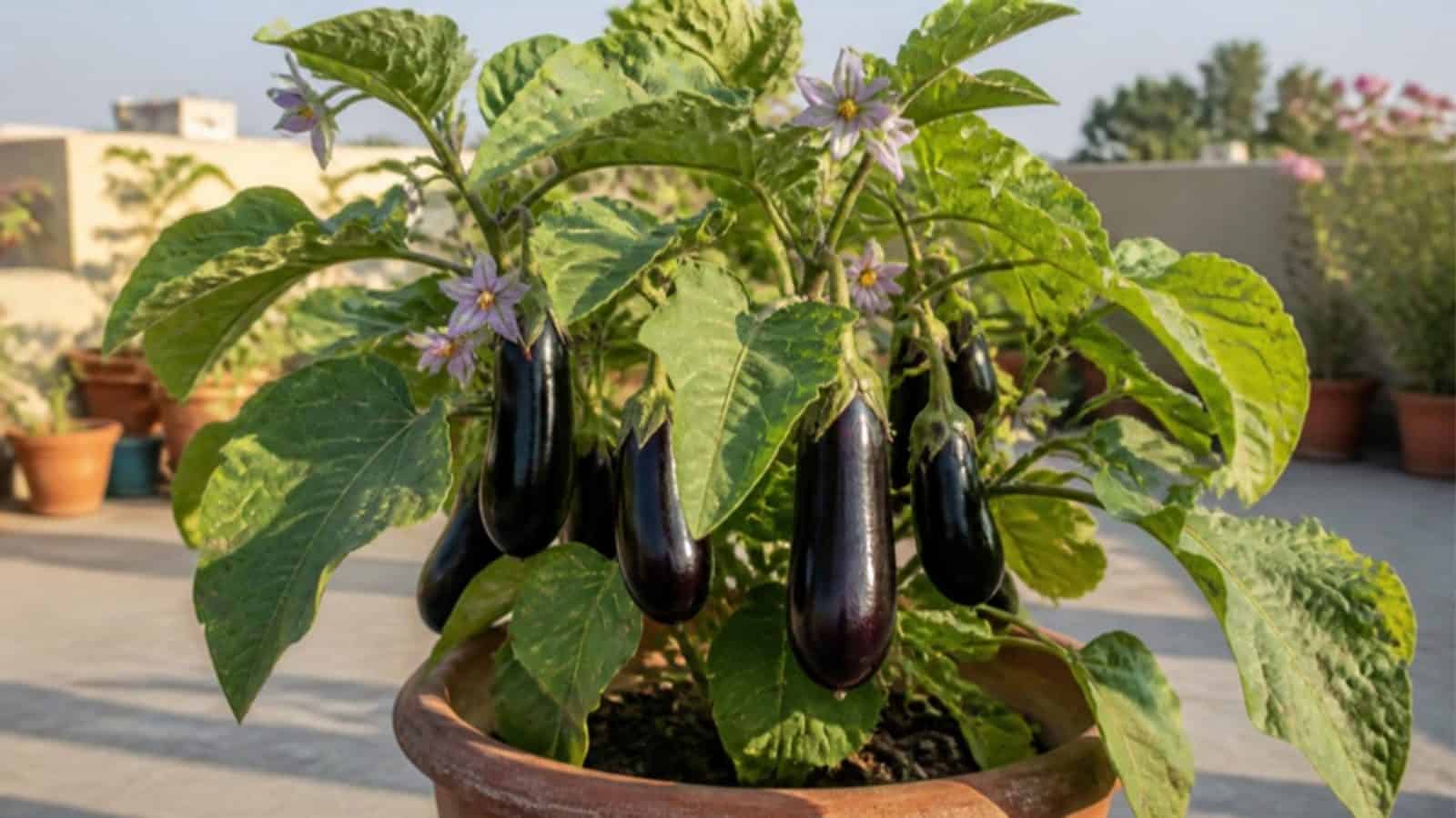
Few vegetables turn up in Indian kitchens as often as baingan, from bharta and begun bhaja to sambar and stuffed brinjal. It is also one of the more forgiving fruiting crops for a terrace. If you want to know how to grow brinjal at home, the short version is that a single plant needs one large pot, plenty of sun and patience: brinjal is slow to start but keeps bearing for months once it gets going.
Quick answer: Raise seedlings in a tray and plant one per container, about 35–45 cm across, when they are roughly a month old. Place the pot in full sun, keep the soil evenly moist, stake the plant as fruits form and pick brinjals while their skin is still shiny and the flesh is tender. Check shoot tips regularly for borer damage.
This guide follows the plant from seed to harvest, with sowing times for different regions, container care, picking tips and a troubleshooting section for the problems Indian growers report most.
Brinjal at a glance
| Topic | For a home container |
|---|---|
| Climate | Warm weather suits it; frost damages the plant |
| Main sowing windows | October–November and May–June across much of India |
| Container | One plant in a pot or grow bag roughly 35–45 cm wide and deep |
| Soil | Free-draining sandy loam; pH about 6.0–7.5 |
| Seedling age at transplanting | About 25–35 days |
| Sun | Full sun, ideally most of the day |
| Harvest window | Several weeks of picking; ICAR-IIVR gives 120–150 days after transplanting |
| Main worry | Shoot and fruit borer |
When to sow brinjal in India
ICAR-Indian Institute of Vegetable Research (IIVR) describes brinjal as a warm-climate crop that grows best at 25–30°C and is sensitive to frost. It lists two sowing seasons: October–November for the rabi crop and May–June for kharif.
Because brinjal dislikes frost, the winter crop works best where winters stay mild. In colder parts of the north, many gardeners prefer to start seedlings in late winter or early summer so plants grow through the warm months.
| Region | Good time to start seeds | Note |
|---|---|---|
| North and Central plains | May–June; an October sowing only where pots can be sheltered from frost | Growth stalls in cold, foggy weeks |
| East India (West Bengal, Odisha, Bihar, Assam) | October–November or May–June | Heavy rain can waterlog pots; keep drainage open |
| West India (Maharashtra, Gujarat) | October–November or May–June | Very hot, dry weeks reduce flowering |
| South India and coastal cities | Both seasons; mild winters suit an October–November start | Pest pressure builds in warm, humid weather |
Choosing a variety for pots
Brinjals come in long, round, oval and small cluster-bearing types, in purple, green, white and striped skins. For a container, compact or medium-sized plants are easier to manage than tall, sprawling ones. Small-fruited or cluster types also give earlier, more frequent pickings from a single plant. Check the seed packet for plant habit before choosing your pot size.
How to grow brinjal at home: from seed to transplant
- Use a light starting mix. Fill a seedling tray or a few cups with moist cocopeat or fine seed-starting mix rather than heavy garden soil.
- Sow shallowly. Place two seeds per cell about half a centimetre deep and cover lightly.
- Keep the tray warm. Brinjal seed tends to sprout slowly in cool conditions, so a warm, sheltered spot helps.
- Move into light at once. As soon as seedlings break the surface, give them bright light so the stems stay short and sturdy.
- Thin to one per cell. Snip the weaker seedling at soil level. Our guide to thinning vegetable seedlings explains why cutting beats pulling.
- Transplant at about a month. ICAR-IIVR recommends transplanting 25–30-day-old seedlings, and the Tamil Nadu Agricultural University (TNAU) Agritech Portal gives 30–35 days.
Growing brinjal in a container
Pot size and spacing
In the field, TNAU spaces brinjal varieties 60 cm apart and hybrids 90 × 60 cm, which shows how much room a mature plant takes. In a container, that translates to one plant per pot or grow bag roughly 35–45 cm wide and deep. Bigger containers hold moisture longer and support a heavier crop. Our grow bag size guide compares common options.
Soil
ICAR-IIVR recommends well-drained sandy loam with a pH of 6.0–7.5. Brinjal stays in the same pot for many months, so the mix needs plenty of organic matter to keep feeding the plant and enough coarse material to drain freely. Our guide to a DIY potting mix for vegetables covers how to put one together.
Sun and shelter
Choose the brightest corner of your balcony or terrace. Plants short of sun flower poorly. If you are unsure how much light a spot gets, see our guide on balcony vegetable garden sunlight.
Water
ICAR-IIVR advises regular irrigation and avoiding water stress during flowering and fruiting. In a pot, water deeply when the top few centimetres of soil feel dry and let the surplus drain away. A layer of dry leaves or straw over the soil keeps moisture more even through hot afternoons.
Feeding
Because brinjal crops for so long, it benefits from regular top-ups. Spread a handful of compost or vermicompost around the plant every three to four weeks once it begins flowering. Avoid heavy doses of nitrogen-rich fertiliser, which produce leaves at the expense of fruit. If you use a potassium feed such as our water-soluble potash during fruiting, follow the label dose.
Staking
A loaded brinjal plant can lean or split. Push a strong stake into the pot when you transplant and tie the main stem loosely as it grows.
Harvesting brinjal
ICAR-IIVR gives a harvesting window of 120–150 days after transplanting and advises picking when the fruits are tender. Fruits are usually ready well before they reach their maximum size.
- Look for gloss. A shiny skin is the best sign of a tender fruit. Dull skin usually means it is getting old, seedy and bitter.
- Press gently. A ready fruit springs back slightly; one that stays dented is overripe.
- Cut, don’t twist. Use secateurs or a knife and leave a short piece of stalk on the fruit. The calyx can be prickly, so wear gloves if needed.
- Pick often. Removing fruits as they mature encourages the plant to keep flowering.
Brinjal problems and what to do
ICAR-IIVR lists shoot and fruit borer, whitefly, aphids and jassids as the main pests, and bacterial wilt, Phomopsis blight, little leaf and damping-off as the main diseases. In home pots, borer damage is usually the first thing people notice.
Shoot and fruit borer
The caterpillars tunnel into tender shoots and later into fruits. Wilting shoot tips on an otherwise healthy plant are the giveaway, along with small holes in the fruit. Check the plant every few days, cut off wilted tips below the damage and destroy them, and pick and discard any bored fruit. Early, regular removal keeps the problem from building up on a few plants.
| Symptom | Likely cause | What to do |
|---|---|---|
| Drooping shoot tips; holes in fruit | Shoot and fruit borer | Cut out affected shoots and fruits promptly |
| Very small leaves, bushy and sterile growth | Little leaf disease | Remove the affected plant early, as TNAU advises, because insects spread it |
| Whole plant wilts suddenly although soil is moist | Bacterial wilt or waterlogged roots | Remove the plant; use fresh soil for the next crop |
| Brown spots on leaves; fruits rot with dark patches | Phomopsis blight | Remove spotted leaves and fruits; keep foliage dry |
| Seedlings collapse at the base | Damping-off | Use clean, fresh starting mix and avoid soggy trays |
| Yellowing, sticky leaves; tiny white insects fly up | Whitefly or aphids | Wash off with water; yellow sticky traps help monitor |
| Leaf edges curl and turn yellow-brown | Jassids (leafhoppers) | Check leaf undersides and remove badly affected leaves |
| Plenty of flowers, few fruits | Cold, extreme heat, low light or irregular watering | Give full sun and steady moisture |
If problems persist, your local Krishi Vigyan Kendra can recommend control measures suited to your district.
Seeds and related guides
Brinjal seeds are included in our Indian Kitchen Garden 5 Vegetable Seeds Combo along with tomato, chilli, okra and capsicum, and in the larger 18 Variety Vegetable Seeds Combo. Brinjal belongs to the same family as tomato, chilli and capsicum, so our guides to those crops follow a similar nursery routine.
Frequently asked questions
How long does brinjal take to grow at home?
Seedlings are transplanted at about 25–35 days old. After that, ICAR-IIVR gives a harvesting window of 120–150 days after transplanting, with fruits picked repeatedly over that period. The exact timing depends on the variety and the weather.
Can brinjal grow in a 12-inch pot?
A 12-inch (30 cm) pot can hold a compact variety, but it dries out quickly and limits the crop. A pot or grow bag of 35–45 cm gives better results.
Why are my brinjal flowers falling without fruit?
Flower drop usually follows temperature stress, too little sun or uneven watering. Move the pot to the sunniest spot available and keep moisture steady during flowering, as ICAR-IIVR recommends.
Why is the top of my brinjal plant drooping?
A wilted shoot tip on an otherwise healthy plant is the classic sign of shoot and fruit borer. Cut the tip off below the damaged section and destroy it.
Can I grow brinjal from the seeds of a market brinjal?
Seeds from a fully ripe fruit may sprout, but market brinjals are picked young with immature seed, and hybrid fruits may not breed true. Packed sowing seed is more dependable.
Does brinjal need a lot of sunlight?
Yes. It is a warm-season, sun-loving crop. A spot that gets direct sun for most of the day gives the best flowering and fruiting.
Growing your first baingan plant
Start a few seeds in a tray, keep the sturdiest seedling, and move it into a large pot in full sun at about a month old. Water steadily, feed with compost every few weeks, watch the shoot tips for borer and pick the fruits young and glossy. One healthy plant can keep your kitchen supplied for a large part of the season.