
A balcony vegetable garden usually needs at least six hours of direct sunlight for a good range of crops. Aim for six to eight hours for tomatoes, chillies and brinjal. With three to five hours, start with leaf lettuce or spinach and expect a smaller, slower harvest. Bright daylight alone does not tell you how much usable sun your vegetables receive. These crop distinctions follow University of Maryland Extension’s container guidance.
For an Indian balcony, the useful question is: Which pot receives sun, for how long, in this season? A sunny railing and a shaded back corner can need different planting plans. This guide helps you measure that difference before you buy seeds or fill containers.
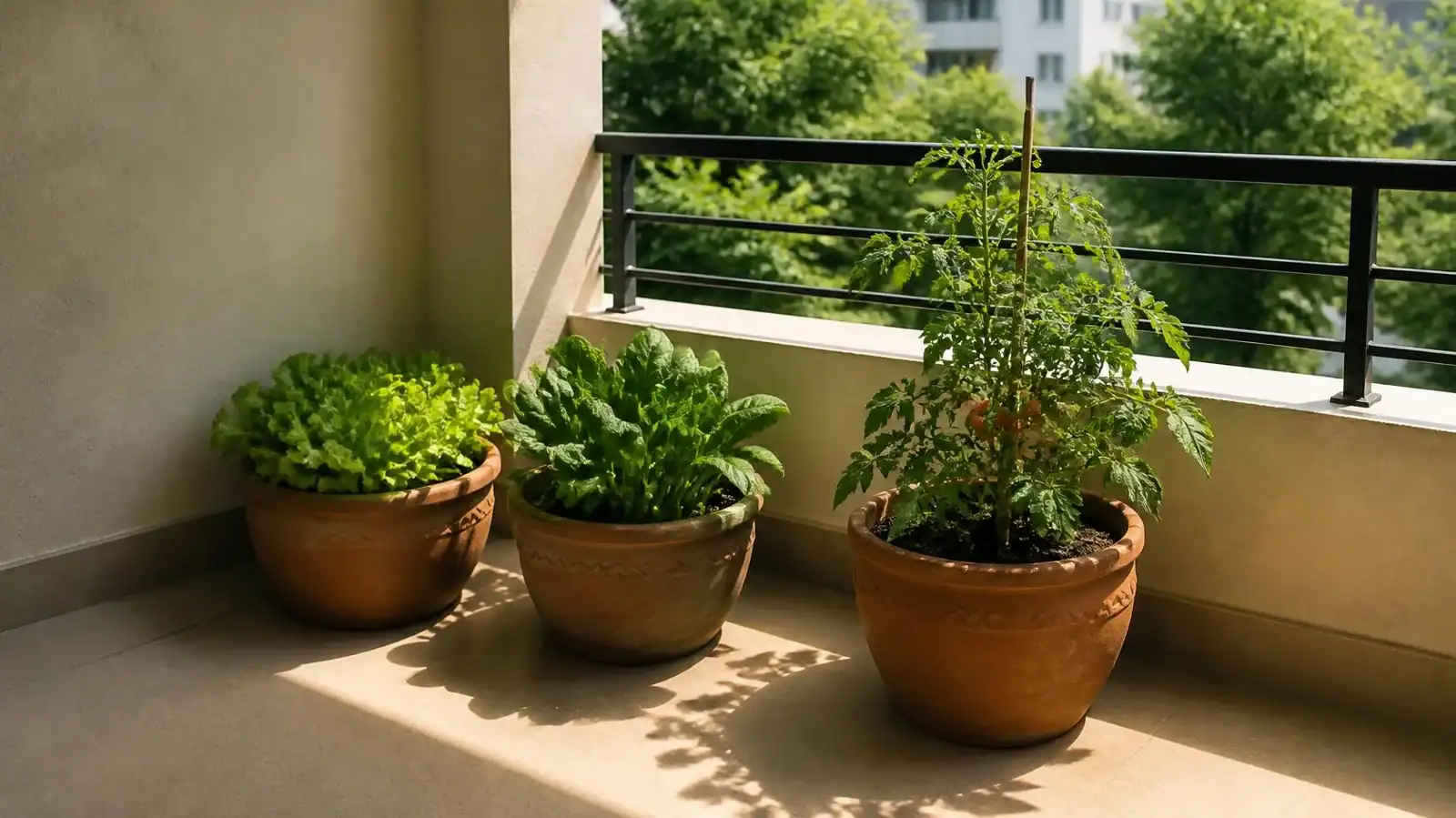
How much sunlight do balcony vegetables need?
Count the time sunlight actually reaches the growing position. A balcony that looks bright from indoors may still be shaded by the floor above, a solid parapet or the next building. Treat the chart below as a starting point for a small trial, rather than a promise that a crop will thrive at the lower limit.
| Direct sun each day | What to consider | What to expect |
|---|---|---|
| 6–8 hours or more | Tomato, chilli and brinjal; suitable leafy greens in their growing season | Use this position for crops you grow for fruit, while managing heat and watering. |
| 4–6 hours | Leaf lettuce, spinach, coriander; radish or beetroot as a small trial | A more limited crop choice. Compare results before increasing the number of pots. |
| 3–4 hours | Leaf lettuce or spinach as a modest experiment | Leaf harvests are a more realistic starting point than tomatoes. Growth can be slower. |
| Under 3 hours, or deep shade | Look for a brighter position before planning a vegetable harvest | Outdoor daylight does not guarantee productive vegetables. Avoid filling a large garden on this assumption. |
The lower-light options are supported by Iowa State’s partial-shade advice. Its edible shade guide also lists coriander, radish and beetroot for lighter shade. These sources describe cultivation principles; their US planting months are not an Indian sowing calendar.
Choose a crop you can harvest for leaves
If you have a modest sunny window, plan a small supply of leaves rather than a heavily fruiting plant. Decide whether a handful of salad leaves is a useful result for your household. A small experiment can answer that question more honestly than a long list of supposedly “no sunlight” vegetables.
Once you choose a crop, use its dedicated instructions: our lettuce in pots guide, palak growing guide and dhaniya guide cover the next steps. This article is about selecting the right light position, rather than repeating those crop guides.
Measure your balcony sunlight before planting
You do not need to start with a light meter. Make a simple record of where the sun falls. The following is a practical observation routine, not a laboratory measurement of plant light.
- Pick two or three possible pot positions. Include the front edge and a position farther back. Mark them A, B and C on a sketch.
- Check from morning until late afternoon on a clear day. Take a quick photograph or note whether direct sunlight reaches each position. Check more frequently around the times the sun enters or leaves.
- Record sunny intervals separately. A spot might receive morning sun, shade at noon, then a short afternoon interval. Do not count the shaded gap.
- Repeat on another clear day. Note any uncertainty. Cloudy weather is also worth recording, but it does not reveal exactly which hours nearby buildings block the sun.
- Repeat when the season changes. Keep the photos so you can compare the same positions later. Recheck after adding a shade screen, tall support or more pots.
Example: Position A receives direct sun from 8:00 to 10:00 and 14:00 to 15:00: three hours in total. Position B receives it continuously from 9:00 to 15:00: six hours. Those observations suggest a leafy-green trial at A and a wider crop choice at B. The times are an illustration, not a claim about any particular city or balcony.
Keep a short record: date → pot position → sunny intervals → total direct sun → crop tried → result. Add an observation after the plant has settled: is new growth compact, is the pot drying too quickly, and are you getting the harvest you wanted?
East, west, south or north: which balcony is best?
Use the compass direction to decide where to look first, then trust your observations. An east-facing balcony may have a morning window; a west-facing one may have afternoon exposure. An overhang or facing building can substantially change either pattern.
Virginia Cooperative Extension recommends observing building shade through the growing season. For balconies in India, measured exposure is more useful than declaring every south-facing balcony suitable and every north-facing one unsuitable.
- East-facing: record when the sun arrives and when it leaves; do not assume it lasts all morning.
- West-facing: record exposure and the condition of the container in the afternoon. A sunny position still needs a workable care routine.
- South-facing: check how much of the pot stays under the roof or parapet shadow.
- North-facing: measure any direct sun that actually reaches the pots. Avoid planning fruiting crops solely because the space is bright.
Adjust the plan for your Indian climate and season
Choose the crop and its sowing season separately from choosing its light position. In India, TNAU’s kitchen-garden guidance prioritises an open, sunny site. ICAR’s coastal kitchen-garden training likewise includes choosing crops for different seasons. A balcony plan needs both decisions.
- Northern plains: cooler-season greens can be useful options as local conditions become suitable. Recheck winter sun at the chosen position. The Indian Horticulture winter-garden article discusses spinach, coriander and other winter crops in a Punjab context; do not apply its dates across all of India.
- Warm coastal and southern lowland homes: assess actual heat, rain and the seed packet’s local sowing advice. Do not assume that October automatically provides cool conditions for lettuce.
- Plateau cities and sheltered urban balconies: compare morning and afternoon positions instead of relying on the city name. The balcony’s own exposure remains the deciding observation.
- Hill locations: check local crop and frost advice before sowing. Adequate sun alone does not make a warm-season vegetable suitable for cold conditions.
Enough light and excessive heat can occur together
A pot next to a warm wall can be a different growing environment from one in an open position. Maryland Extension specifically highlights heat accumulation around masonry and reflective surfaces. Check the growing medium before watering and inspect the plant again after the hottest part of the day.
Use these observations to make a small change, then review it: reposition one movable pot, reconsider the season or reduce crowding. If you add shading for heat, remap the remaining sun. Keep tall plants from blocking the smaller crop’s light. Do not use extra fertiliser as a substitute for an unsuitable position.
Turn your sun map into a small planting plan
Start with fewer containers than you could physically fit. For example:
- One pot with 3–4 hours: try a small leaf-lettuce or palak sowing in an appropriate season and record the result.
- Two pots with 4–6 hours: consider a leafy-green pot and a coriander pot, keeping their sowing and watering instructions separate.
- A position with 6–8 hours: consider one suitable compact tomato or chilli plant if you can provide enough container space and support. Read our tomato guide or chilli guide before planting.
Choose container depth using our grow bag size guide. Use the seedling thinning guide if your first sowing becomes crowded. Keep containers securely within the balcony and avoid moving heavy, wet pots simply to chase a short sun patch.
Ready to start? Compare lettuce seeds, palak seeds or coriander seeds after measuring your position. Check the packet’s variety and sowing directions. Buy for the space you have rather than expecting a product to overcome deep shade.
Frequently asked questions
Can I grow vegetables on a balcony without direct sunlight?
Do not expect a reliable outdoor vegetable harvest in deep shade. Start by finding a brighter position. If there is no suitable position, growing food would require a separate, properly planned lighting setup; ordinary room brightness is not enough evidence that vegetables will crop well. See Iowa State’s guidance on the limits of shade.
Is three hours of sun enough for a balcony vegetable garden?
It can justify a small leafy-green trial in suitable conditions, particularly leaf lettuce or spinach. It is a limited-light position, so start small and judge the actual result. Do not use that trial to assume tomatoes and chillies will perform equally well.
Does morning sunlight count?
Yes. Record the time direct sun reaches the growing position, whether it occurs in the morning or later. Two morning hours do not become a full-sun position because the balcony remains bright for the rest of the day.
Can a self-watering pot solve a lack of sunlight?
No. Water supply and light are separate parts of the planting decision. Select adequate container size and follow the reservoir instructions, while still choosing a position suited to the crop.
Should I shade my vegetables in Indian summer?
Consider the crop, its growing season and the actual conditions around the pot. Shade can reduce exposure, so avoid applying the same screen to every crop without checking the remaining light. Start with a suitable seasonal crop and observe one small adjustment before changing the whole garden.
Your next step: map the sun at two possible pot positions tomorrow, choose one crop for the clearer match, and start a small sowing. Your own light record will be more useful than a generic promise that every balcony can grow every vegetable.
[…] your balcony gets limited sun, our guide on balcony vegetable garden sunlight explains how to judge whether a spot is bright enough for fruiting […]