The best bamboo plant for home in most Indian flats is lucky bamboo, because it lives happily indoors in a vase of water or a small pot and stays compact. If you have a sunny balcony or terrace, a dwarf clumping bamboo in a big container is the real-bamboo option. Bamboo palm and areca palm only look like bamboo, but they make good shade-tolerant floor plants.
Quick answer: pick by the light you have, not by the name on the label. Indoors with bright, indirect light: lucky bamboo (desk or table) or an areca or bamboo palm (floor). Outdoors with three or more hours of sun: hedge bamboo or a Buddha belly bamboo in a container of at least 45 to 60 cm. Skip tall golden bamboo and any running bamboo for balcony pots.
Many shoppers search for a “bamboo plant” and find that three or four quite different plants are sold under that name. Some are not bamboo at all. This guide sorts them out so you can choose the one that suits your room, your sunlight and your pets. If you already own lucky bamboo and want care steps, our lucky bamboo care guide covers water, light and yellow leaves in detail.
Types of bamboo plants for home at a glance
| Plant | Is it a true bamboo? | Best spot at home | Light | Grows in | Pets |
|---|---|---|---|---|---|
| Lucky bamboo (Dracaena sanderiana) | No, a dracaena | Desk, shelf, living room table | Bright, indirect | Water or potting mix | Toxic to cats and dogs |
| Bamboo palm (Chamaedorea seifrizii) | No, a palm | Living room or bedroom floor | Medium; tolerates low | Potting mix | Listed as non-toxic |
| Areca palm (Dypsis lutescens) | No, a palm | Bright corner, near a window | Bright, indirect | Potting mix | Listed as non-toxic |
| Hedge bamboo (Bambusa multiplex) | Yes, clumping | Balcony, terrace, garden edge | Full sun to dappled sun | Large container or ground | See pet section |
| Buddha belly bamboo | Yes, clumping | Terrace or ground-floor garden | Full sun | Large container or ground | See pet section |
Is a bamboo plant good for home?
Yes, as long as you match the plant to the space. A small lucky bamboo arrangement suits almost any room with daylight, needs no soil and is one of the most common gift plants in India. A true bamboo is a fast-growing grass. It wants sun, regular water and room to spread, so it belongs outside on a balcony or terrace, not in a bedroom.
People also ask whether bamboo is a tree or a plant. True bamboo is neither a tree nor a shrub: it is a grass in the Poaceae family, which is why the stems (called culms) are hollow and jointed. UF/IFAS Extension describes it as “a fast-growing grass” that is often compared to trees and shrubs.
Bamboo plants are also popular because of Vastu and Feng Shui beliefs, which link lucky bamboo with good fortune. These are cultural traditions rather than proven effects, and you can read how people place it in our article on lucky bamboo benefits and Vastu meaning and our wider Vastu plants for home guide.
1. Lucky bamboo: the easiest bamboo plant indoor
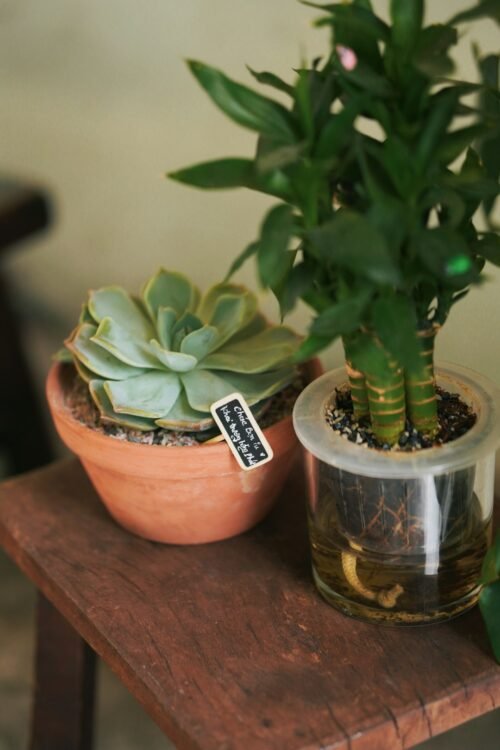
Lucky bamboo is what most nurseries and online shops mean by “bamboo plant”. NC State Extension is blunt about it: lucky bamboo is not a bamboo at all. It is a tropical shrub from West Africa in the asparagus family, with jointed green stems that look like bamboo canes.
Why it suits Indian homes: it grows in chlorine-free water or moist potting mix, it stays small for years, and it does well in bright but indirect light indoors. A dining table near a window, a work desk or a TV unit that gets daylight is usually enough.
Forms you will see for sale:
- Straight stalks in a vase, sold in different counts.
- Layered or tiered arrangements (2, 3 or 5 layers), where stalks of different heights are tied together.
- Spiral or curly stalks, shaped by the grower; new growth will be straight, not curly.
- Braided or woven stems, trained while the stems are young.
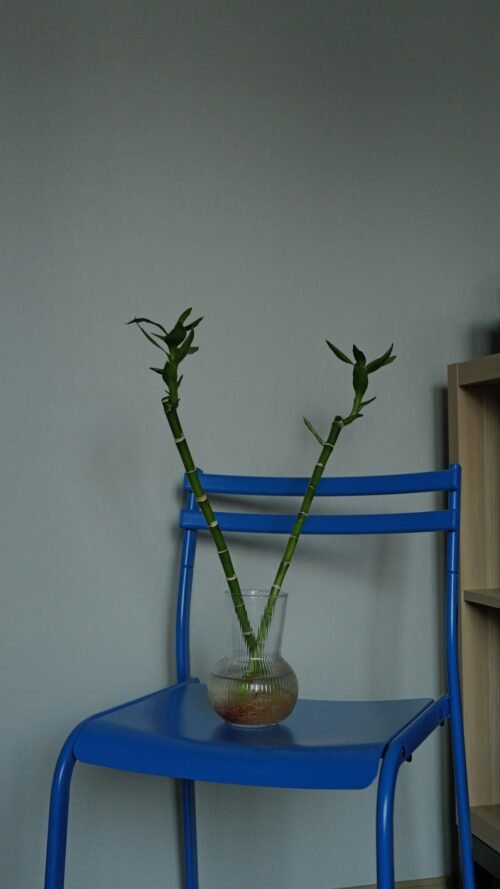
Watch-outs: NC State advises changing the water weekly, partly to stop mosquitoes breeding. In India, where Aedes mosquitoes breed in clean standing water, this is worth treating as a fixed weekly habit. Overwatering a soil-grown plant can yellow the leaves and rot the stems, and dry air can brown the leaf tips.
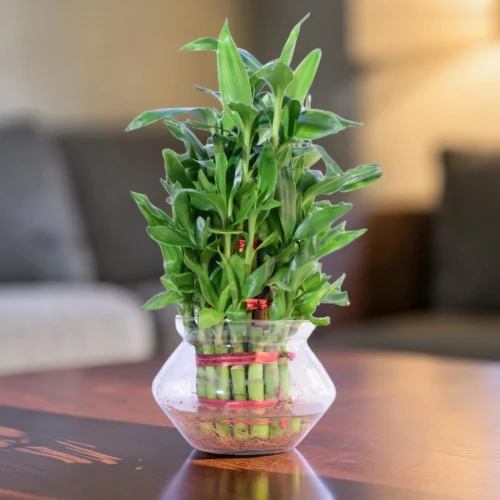
Our 3-layer lucky bamboo comes as a tiered arrangement in a glass vase with water, which is the simplest way to start: top up with clean water, change it once a week and keep it out of hot afternoon sun.
2. Bamboo palm: a shade-tolerant floor plant
The bamboo palm (Chamaedorea seifrizii) is a true palm. It gets its name from clusters of thin, cane-like stems with prominent nodes. NC State Extension notes that it prefers medium light and slightly moist, well-drained potting mix, and that it “will survive in low light conditions”, which makes it one of the better choices for a north-facing living room or a bedroom away from the window.
Indoors it can eventually reach about 2 metres (NC State gives up to 7 feet), with new stems coming from the base so the clump fills out slowly. The main risk is overwatering, which can cause root and stem rot. Indoors, check under the leaves for mealybugs, scale and spider mites; our guide on getting rid of mealybugs walks through the treatment.
The bamboo palm was one of the plants in NASA’s 1989 clean-air study. That study used small sealed chambers, and later research found that potted plants make little measurable difference to air quality in a normal ventilated room. So buy it for its looks and its tolerance of shade, not as an air purifier. We explain the evidence in which plant gives more oxygen.
3. Areca palm: the “bamboo palm” you will find most often in India
In Indian nurseries the areca palm (Dypsis lutescens) is far more common than the true bamboo palm, and it is sometimes sold under bamboo-like names. NC State describes its clustering stems as having “prominent nodes, like bamboo”. The stems and leaf midribs turn yellowish, which is why it is also called golden cane palm.
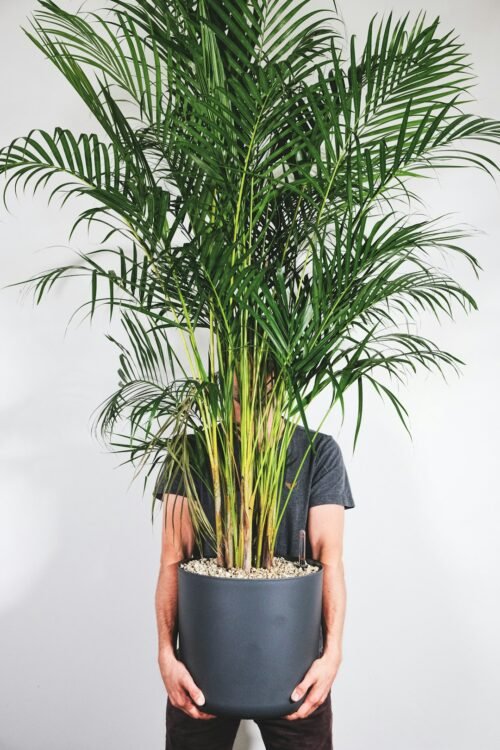
How to tell them apart: an areca palm has thicker, yellow-green stems and long arching fronds whose leaflets form a V along the stalk. A bamboo palm has thinner, darker green stems and a more upright, airy look. Lucky bamboo has no fronds at all, only strap-like leaves growing from the top of each stalk.
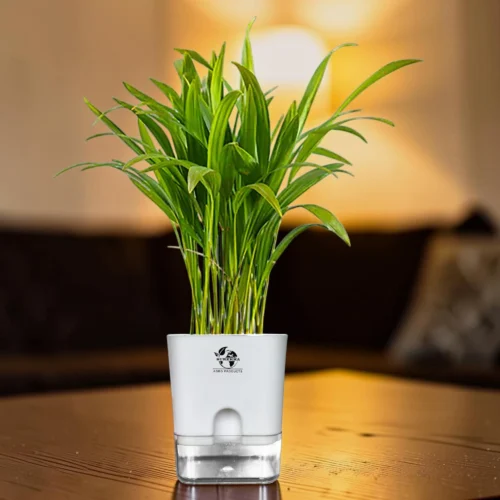
An areca palm wants more light than a bamboo palm: a bright spot near a window without hot direct sun, potting mix that is moist but never soggy, and some humidity. It is a good pick for a living room corner. Our areca palm is supplied in a self-watering pot, which helps if you travel or forget to water; see how to use self-watering pots and our full areca palm care guide.
4. Hedge bamboo: a real bamboo plant in a pot
If you want true bamboo, start with hedge bamboo (Bambusa multiplex). It is a clumping bamboo whose native range includes India and the Eastern Himalayas, according to NParks Singapore’s Flora and Fauna database. Because it clumps rather than runs, NC State Extension notes that it is not considered invasive, and it lists it as suitable for containers.
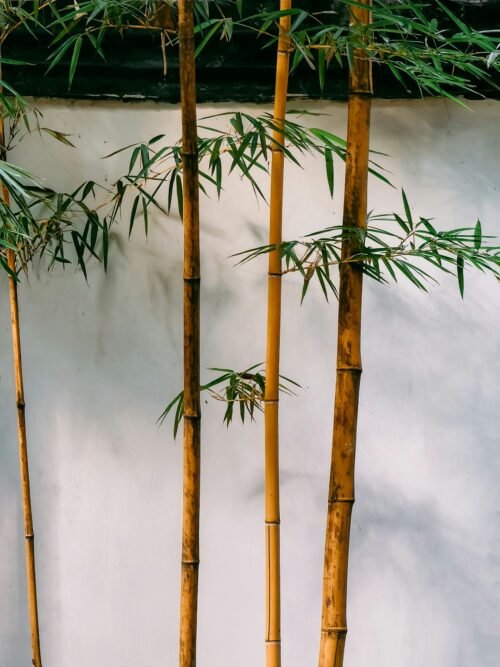
The species itself can grow very tall (NC State gives up to 25 feet), so for a balcony choose a dwarf cultivar if a nursery stocks one. NC State lists ‘Tiny Fern’ (up to about 3 feet) and ‘Golden Goddess’ (up to about 10 feet), plus striped forms such as ‘Alphonse Karr’ with yellow and green stripes. Ask the seller for the cultivar name rather than buying an unnamed “bamboo plant”.
How to grow bamboo plant in a pot on a balcony
- Check the sun. Hedge bamboo prefers full sun to dappled sun. An east- or south-facing balcony with at least three to four hours of direct light works best.
- Choose a big container. Use a pot, grow bag or planter of at least 45 to 60 cm across with drainage holes. Bamboo fills a small pot with roots quickly and then dries out within a day in summer.
- Use a rich, draining mix. NC State recommends moist, fertile soil with plenty of compost. A mix of garden soil, compost and cocopeat with some coarse sand works; our DIY potting mix guide gives proportions.
- Water deeply. Water thoroughly whenever the top few centimetres are dry, and more often in April to June. Leaves that roll inwards on a hot afternoon are a sign the pot is short of water.
- Prune once a year. In late winter or early spring (February to March in most of India), cut out dead and weak culms at the base to open up the clump.
- Divide or repot every few years. When the clump presses against the sides, divide it with a saw or move it to a larger container.
5. Buddha belly bamboo: a terrace or garden feature
Buddha belly bamboo is grown for its swollen, pot-bellied stem sections. NParks Singapore lists Bambusa vulgaris ‘Wamin’ under this name, with a maximum height of about 5 metres. It notes that the stems turn dull yellow at one to two years old and form the characteristic pot-belly shape at around three years, and that the clump needs ample space. So do not expect the pot-belly look on a young nursery plant.
This is a statement plant for a terrace, farmhouse or ground-floor garden with full sun, not a living room plant. If you plant it in a container, use a heavy, wide one so the clump does not tip over in monsoon winds.
Bamboo plants to skip for balconies and flats
- Golden or striped bamboo (Bambusa vulgaris ‘Striata’): beautiful yellow culms with green stripes, but NParks gives a maximum height of about 15 metres and culms 8 to 10 cm thick. NParks notes that it can grow in containers, yet that means a large planter in a courtyard, not a balcony pot.
- Running bamboos (for example Phyllostachys species): these spread through underground stems and can travel far beyond where they were planted. NC State Extension warns against planting non-native runners because of their invasiveness. If someone offers you a running bamboo for a garden bed near a boundary wall, choose a clumping type instead.
Where to place bamboo plant in house
| Room or spot | Best choice | What to check |
|---|---|---|
| Living room table or TV unit | Lucky bamboo (layered or straight) | Daylight from a nearby window; no afternoon sun on the glass vase |
| Living room corner | Areca palm or bamboo palm | Areca needs a brighter corner; bamboo palm copes with less light |
| Bedroom | Bamboo palm or small lucky bamboo | Keep water containers covered or changed weekly |
| Office or study desk | Lucky bamboo | A window within a few metres; AC drafts can brown leaf tips |
| Main entrance | Lucky bamboo indoors, areca palm in a bright lobby | Avoid dark corridors; see our entrance plants guide |
| Sunny balcony or terrace | Hedge bamboo; Buddha belly on a terrace | At least 3 to 4 hours of sun, large container, daily summer watering |
Under Vastu traditions, lucky bamboo is commonly kept in the east or south-east of the home. If you follow Vastu, combine it with the light rules above, because a plant in a dark “correct” corner will decline.
Seasonal tips for Indian homes
- Summer (March to June): move glass vases away from hot windows, where the water warms up and grows algae. Balcony bamboo may need watering every day in north and central India.
- Monsoon (June to September): water less for potted palms and check that drainage holes are clear. Empty saucers and trays so mosquitoes cannot breed.
- Winter (December to February): in the north, keep indoor plants away from cold glass and doors at night. Growth slows, so cut back on feeding. In the south and on the coasts, care stays much the same through the year.
Common problems and quick fixes
| Problem | Likely plant | Likely cause | What to do |
|---|---|---|---|
| Yellow leaves or a yellow stalk | Lucky bamboo | Stale water, too much feed, or rot at the base | Change the water, rinse the vase, remove any soft yellow stalk so it does not spoil the others |
| Green slime in the vase | Lucky bamboo | Algae from light hitting the water | Wash vase and pebbles; move out of direct sun or use an opaque container |
| Brown leaf tips | All indoor types | Dry air, AC drafts, salts in tap water | Use filtered or stored water and move the plant away from the AC vent |
| Rotting stem base, soggy mix | Bamboo palm, areca palm | Overwatering, blocked drainage | Let the mix dry on top before watering; repot into fresh, draining mix if roots are mushy |
| Leaves rolled up in the afternoon | Hedge or Buddha belly bamboo | Pot drying out in heat | Water deeply, mulch the surface and move to a bigger container |
| White cottony clusters | All types | Mealybugs | Wipe off and treat early; see our mealybug guide |
Is bamboo plant safe for pets?
This depends on which “bamboo” you have. The ASPCA lists dracaenas (its “ribbon plant” entry, Dracaena spp.) as toxic to cats and dogs, with signs such as vomiting, drooling and, in cats, dilated pupils. Since lucky bamboo is a dracaena, keep it on a high shelf if you have pets, and keep the vase water out of their reach.
The ASPCA lists the areca palm as non-toxic to cats, dogs and horses, and its “bamboo palm” entry (filed under the closely related Chamaedorea elegans) is also non-toxic. Its entry for true bamboo, the golden bamboo Phyllostachys aurea, is listed as non-toxic too. Non-toxic does not mean a pet can chew a plant freely, so contact a vet if your pet eats a lot of any plant or seems unwell.
Which bamboo plant should you buy?
- First plant, small flat, little time: lucky bamboo in water. Try our 3-layer lucky bamboo, or the Lucky Plants Combo if you also want a jade and a money plant.
- Floor plant for a bright living room, cats or dogs at home: areca palm.
- Floor plant for a shadier room: bamboo palm, if you can find it.
- Sunny balcony and you want real bamboo: a named dwarf hedge bamboo cultivar in a large container.
- Big terrace or garden: Buddha belly bamboo or a full-size clumping hedge bamboo for a screen.
Frequently asked questions
Which bamboo plant is best for home?
For indoors, lucky bamboo is the easiest because it grows in water and stays small. For a bright corner where you want a larger plant, an areca palm is a common choice. For a sunny balcony, a dwarf clumping hedge bamboo in a big pot is the best true bamboo.
Where should I place a bamboo plant in my house?
Put lucky bamboo or a bamboo palm where it gets bright, indirect daylight, such as near an east-facing window or a few metres from a larger window. Keep true bamboo outdoors on a balcony or terrace with at least three to four hours of sun.
Can bamboo plant grow in soil?
Yes. Lucky bamboo grows in water or in moist, well-drained potting mix, and it is simplest to keep a plant in the medium it is already rooted in. True bamboos and both palms are always grown in soil.
Do bamboo plants need sunlight?
Lucky bamboo and the palms need daylight but not hot direct sun, which can scorch the leaves. True bamboos such as hedge bamboo need full sun to dappled sun to grow well.
Is bamboo a tree or a plant?
True bamboo is a plant in the grass family (Poaceae), not a tree, even though some species grow as tall as trees. Lucky bamboo is not a bamboo at all; it is a dracaena.
How fast does a bamboo plant grow indoors?
Lucky bamboo and bamboo palms grow slowly indoors and can stay on a desk or in a corner for years. True bamboos grow fast outdoors in warm weather and need regular pruning and repotting.
Conclusion
The right bamboo plant for home depends on light and space. Lucky bamboo is the simple indoor choice, areca and bamboo palms give you a bigger, softer green look, and a dwarf clumping bamboo brings the real thing to a sunny balcony. Check the botanical name, match the plant to your brightest spot, and change any vase water weekly.
Written by the Surekha Agro Products plant care team. Last updated 26 November 2026.
Sources
- NC State Extension Gardener Plant Toolbox: Dracaena sanderiana, Chamaedorea seifrizii, Dypsis lutescens, Bambusa multiplex
- N.C. Cooperative Extension, Craven County: Clumping Bamboos
- UF/IFAS Gardening Solutions: Clumping Bamboo
- NParks Singapore Flora and Fauna Web: Bambusa multiplex, Bambusa vulgaris ‘Wamin’, Bambusa vulgaris ‘Striata’
- ASPCA Animal Poison Control: Ribbon plant (Dracaena), Areca palm, Bamboo palm, Bamboo
- Wolverton, Johnson and Bounds (1989), Interior Landscape Plants for Indoor Air Pollution Abatement, NASA
- Cummings and Waring (2019), Potted plants do not improve indoor air quality, Journal of Exposure Science and Environmental Epidemiology