
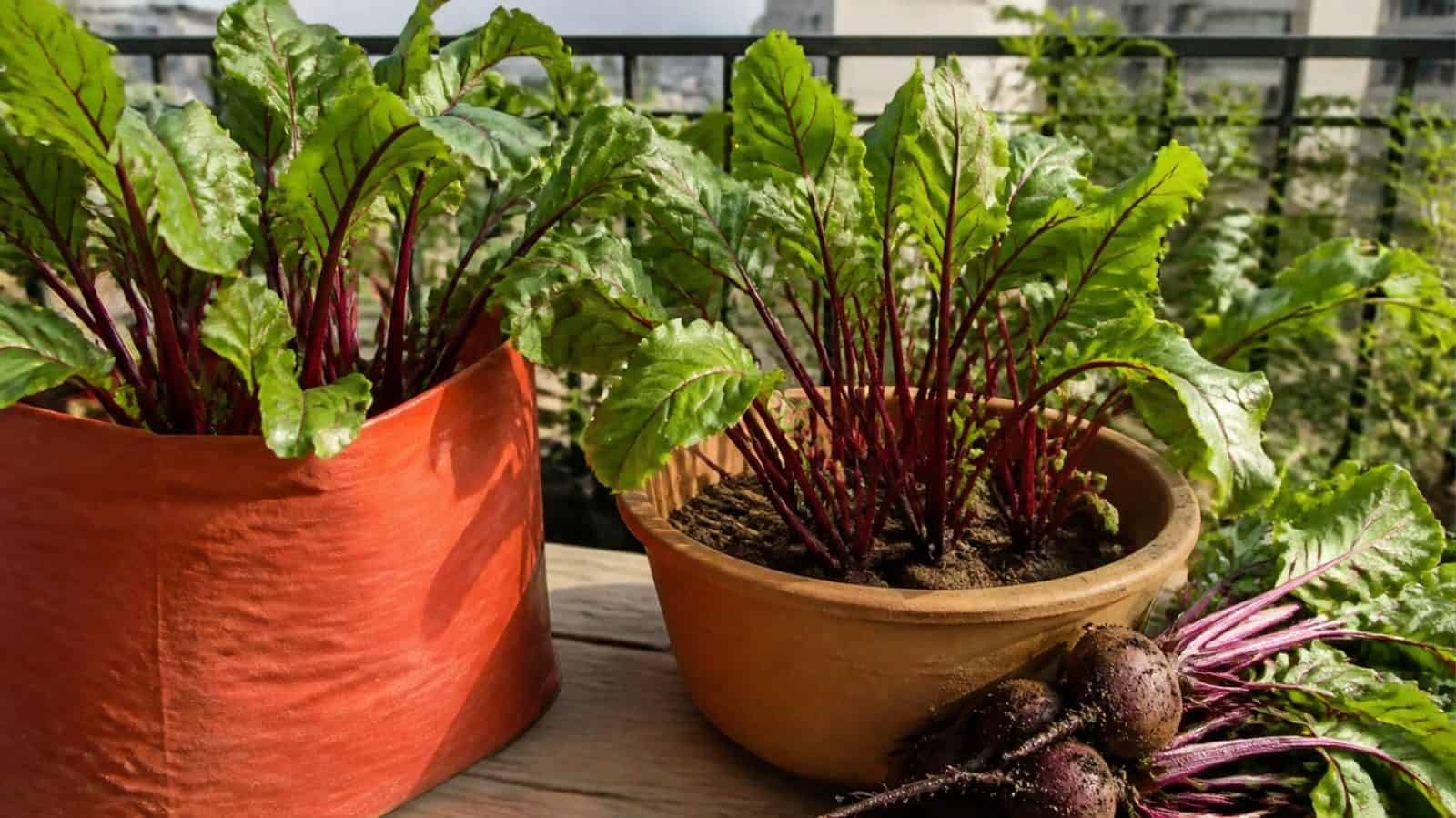
Beetroot, or chukandar, is one of the easiest root vegetables to fit into a balcony garden. It is sown straight into the pot, needs no staking, and gives you two harvests from the same plant: the deep red root and the tender leaves. If you have been looking up how to grow beetroot at home, the cool months after the monsoon are the right time to start.
Quick answer: Sow beetroot seeds directly into a pot or grow bag at least 25–30 cm deep, filled with loose, crumbly, compost-rich soil. Space the seeds about 10 cm apart and keep the soil evenly moist. Thin each cluster to one seedling about three weeks after sowing. Pull the roots once they are roughly 3–5 cm across, which is usually around two to two-and-a-half months after sowing.
This guide explains when to sow in your part of India, how to set up the container, why every beetroot “seed” sprouts more than one plant, how to care for the crop and how to sort out common problems.
Beetroot at a glance
| Point | What works in a pot |
|---|---|
| Climate | Cool weather; colour and sweetness develop best when nights are mild |
| Container depth | 25–30 cm or more, with drainage holes |
| Sowing method | Direct sowing only; beetroot dislikes being transplanted |
| Spacing | About 10 cm between plants |
| Soil | Loose, friable and well drained; pH about 6.0–7.0 |
| Thinning | Leave one seedling per spot, about 20–21 days after sowing |
| Harvest | Roots 3–5 cm wide, roughly 8–10 weeks from sowing |
When to sow beetroot in India
Beetroot is a cool-season crop. The Vegetable and Fruit Promotion Council Keralam (VFPCK) notes that it needs cool weather to develop good colour, texture and sugar content. Roots that swell during hot weather tend to be paler and less sweet.
The right month depends on where you live. The Tamil Nadu Agricultural University (TNAU) Agritech Portal gives July–August as the planting season for Tamil Nadu, while VFPCK lists a longer August–January season for Kerala. In the northern, central and eastern plains, where summers are harsh, the practical window opens once the monsoon has ended and the days start to cool.
| Region | Sowing window for containers | Tip |
|---|---|---|
| North and Central plains | October to November, as the weather cools | Sow a few seeds every two to three weeks for a longer supply |
| East India (West Bengal, Odisha, Bihar, Assam) | October to November, after the rains | Make sure pots drain fast during late showers |
| West India (Maharashtra, Gujarat) | October to December | Harvest before the spring heat sets in |
| Tamil Nadu | July to August (TNAU) | Hill districts such as the Nilgiris grow beetroot widely |
| Kerala | August to January (VFPCK) | Use the drier months for the best roots |
| Hill regions | Spring and summer | Avoid sowing into very cold, wet soil |
For a wider list of what else to sow this season, see our guide to the best winter vegetables to grow in pots in India.
Choosing a container and soil
Pot or grow bag size
A beetroot root grows mostly near the surface, but the taproot below it goes deeper, so give it a container at least 25–30 cm deep. Width decides how many plants you can grow. With 10 cm between plants, a 30 cm wide pot holds about five to seven beetroots, and a rectangular trough or a large grow bag holds a full row. Our article on grow bag sizes for vegetables lists common sizes.
Potting mix
TNAU says beetroot comes up well in all types of friable soil with a pH of 6.0–7.0. VFPCK adds that well-drained sandy loam suits it best and that the crop is sensitive to acidity. In a pot, the aim is a mix that stays crumbly and never forms a hard crust:
- Sieve out stones and lumps from the garden soil, because they push roots out of shape.
- Blend in plenty of well-rotted compost or vermicompost.
- Lighten the mix with cocopeat or coarse sand so water drains freely.
- Avoid fresh, unrotted manure, which can scorch young roots.
Our DIY potting mix guide gives simple recipes you can adapt.
Sunlight
Choose a spot with at least five to six hours of direct sun. Beetroot tolerates a little afternoon shade better than fruiting crops do, but roots stay small in a dim corner. If you are unsure about your balcony, read our guide on balcony vegetable garden sunlight.
How to grow beetroot at home from seed
Why one seed gives several seedlings
What looks like a single beetroot seed is actually a small corky cluster, often called a seed ball, that holds more than one seed. That is why two, three or even four seedlings often come up from one spot. It is normal, and the fix is simple thinning, covered below.
Sowing steps
- Soak the seeds (optional). Many gardeners soak the seed balls in water for a few hours before sowing, which softens the hard outer coat.
- Prepare the pot. Fill it to about 2–3 cm below the rim and water the mix until it is evenly damp.
- Sow at the right spacing. Press each seed ball about 1–2 cm into the soil, roughly 10 cm apart. TNAU recommends a 10 cm spacing within the row for field crops, which works well in containers too.
- Cover and water gently. Cover the seeds with fine mix and water with a rose or sprinkler so they are not washed out. TNAU advises irrigating thoroughly right after sowing.
- Keep the surface moist. Do not let the top layer dry out until seedlings appear. A dry crust can stop the shoots from breaking through.
Do not raise beetroot in a nursery tray for transplanting. Moving the seedling disturbs the young taproot and can lead to forked or stunted roots.
Thinning the seedlings
TNAU recommends thinning about 20 days after sowing so that a single seedling remains per spot, and VFPCK gives the same advice at three weeks. Keep the strongest seedling and snip the others at soil level with scissors. Pulling them can loosen the one you want to keep. The thinned seedlings make good microgreens for salads. Our guide on thinning vegetable seedlings in pots shows the technique step by step.
Caring for beetroot in pots
Watering
VFPCK stresses keeping enough moisture in the soil. Water when the top 2–3 cm of soil feels dry, and water deeply so the whole root zone is wet. Irregular watering, where the pot dries out and is then soaked, is a common cause of cracked or woody roots.
Feeding
Both TNAU and VFPCK recommend applying organic manure before sowing, then a second dose of nitrogen partway through the crop: TNAU at 30 days, and VFPCK when the plants are growing vigorously. For a home pot, mix compost into the soil before sowing and add a thin layer of compost or vermicompost around the plants about a month later. Do not overfeed with nitrogen, which gives large leaves and small roots.
Covering the shoulders
VFPCK lists shallow hoeing and earthing up among the essential care steps. In a pot, gently loosen the surface and add a little fresh mix if the top of a root (the shoulder) pushes well above the soil. This keeps the root tender and evenly coloured.
Picking leaves
Beetroot leaves are edible and can be cooked like spinach. Take only one or two outer leaves from each plant at a time, because the leaves feed the root.
When and how to harvest beetroot
VFPCK advises harvesting when the roots reach 3–5 cm in diameter, which it gives as 8–10 weeks after sowing. TNAU gives a crop duration of about 120 days for field crops, so some varieties and cooler regions take longer. Check the shoulders peeping above the soil to judge size.
- Water the pot an hour before harvesting so the roots slide out easily.
- Hold the leaves close to the crown and pull straight up.
- Twist off the leaves, leaving 2–3 cm of stalk, so the root does not “bleed” its colour.
- Pick in stages, starting with the largest roots, to give the rest more room.
- Do not leave roots in the pot for too long, as they can turn woody and fibrous.
TNAU lists Ooty 1, Crimson Globe, Detroit Dark Red and Red Ball as popular varieties. VFPCK describes Crimson Globe as a short-duration type with round to flat-round roots.
Beetroot problems and how to solve them
TNAU and VFPCK name leaf miner and flea beetle as the main pests, with VFPCK adding webworm. For diseases, both list Cercospora leaf spot, TNAU names Rhizoctonia root rot and VFPCK mentions downy mildew. In containers, many problems trace back to spacing, soil and water.
| Symptom | Likely cause | What to do |
|---|---|---|
| Lots of leaves, tiny roots | Seedlings not thinned, too much nitrogen or too little sun | Thin to one plant per spot, move to a sunnier place and go easy on feeding |
| Forked, lumpy or twisted roots | Stones, hard lumps or a compacted mix; or seedlings transplanted | Use a sieved, loose mix and always sow directly |
| Cracked or woody roots | Uneven watering or roots left too long | Water steadily and harvest at 3–5 cm |
| Pale roots with weak colour | Roots swelling in warm weather | Sow in the cool season for your region |
| Wavy pale trails inside leaves | Leaf miner larvae | Remove affected leaves early |
| Many tiny round holes in leaves | Flea beetle | Check plants often and remove badly damaged leaves |
| Round spots with grey centres and reddish edges on leaves | Cercospora leaf spot | Remove spotted leaves, water at soil level and avoid crowding |
| Root rots or plant wilts in wet soil | Root rot from waterlogging | Improve drainage and let the surface dry slightly between waterings |
Before using any spray, get advice from your local Krishi Vigyan Kendra or agriculture office on what is suitable for an edible crop at home.
Seeds and related guides
Beetroot seeds are part of our Winter Kitchen Garden Vegetable Seeds Combo, along with French beans, red radish, white radish and knol-khol. Beetroot shares its season and container setup with other root crops, so our guides to growing carrots in pots and growing radish in pots are useful next reads.
Frequently asked questions
How many days does beetroot take to grow?
VFPCK gives 8–10 weeks from sowing to harvest, when roots are 3–5 cm across. TNAU gives about 120 days for the full field crop. In pots, most gardeners start pulling roots at around two to two-and-a-half months.
Can I grow beetroot from a beetroot bought in the market?
Not a new root. If you place the top of a market beetroot in water or soil, it can sprout fresh leaves that you can eat, but it will not form a new root. For roots, sow seed.
How deep should a pot be for beetroot?
At least 25–30 cm. A deeper container holds moisture longer and gives the taproot room, which helps the root swell evenly.
Why do several seedlings come up from one beetroot seed?
Each beetroot “seed” is usually a cluster that contains more than one seed. Thin to the strongest seedling about three weeks after sowing.
Can beetroot be grown in summer?
It can grow in mild summers in the hills, but in the hot plains, summer roots tend to be pale and less sweet. VFPCK notes that cool weather is needed for good colour, texture and sugar.
Are beetroot leaves edible?
Yes. Young beetroot leaves can be cooked like spinach. Pick only a few outer leaves per plant so the root keeps growing.
Sow a pot of beetroot this season
A deep pot, a loose and stone-free mix, careful thinning and steady watering are all beetroot really asks for. Sow a fresh batch every few weeks through the cool months and you can keep pulling sweet, home-grown chukandar for salads, juice and sabzi well into winter.