
To grow marigolds in pots in India, choose a variety that fits your space, provide a sunny outdoor position and use a container that drains freely. Sow according to the seed packet, give seedlings room to develop, and remove fading blooms as part of routine care. Match the growing window to your local weather rather than following one calendar for the whole country.
A balcony display starts with a useful question: are you growing a compact French marigold or a larger African marigold? Both are commonly called genda, but their mature size can change the pot, spacing and support you need.
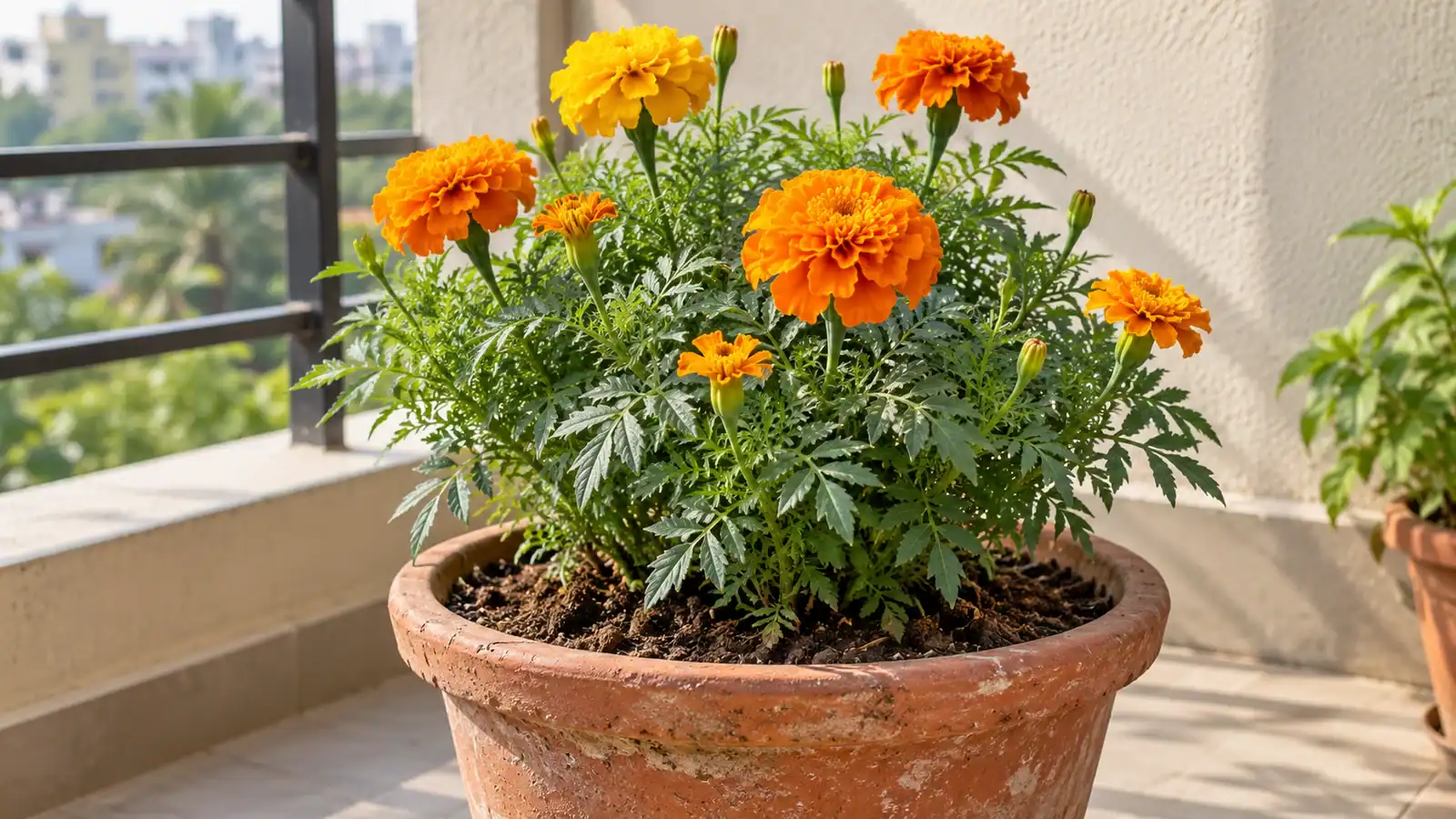
Which marigold should you choose for a pot?
For a small first project, look for a named compact or dwarf variety and check its expected height and spread. NC State Extension identifies French marigold, Tagetes patula, as a bushy annual suitable for containers. Larger-growing types need a different setup; the word “marigold” alone does not tell you the mature size. Source: NC State French marigold profile.
| Packet description | What to check | Container decision |
|---|---|---|
| French marigold, Tagetes patula | Whether the specific cultivar is compact and how wide it grows. | A manageable choice for a small display when the variety suits it. |
| African marigold, Tagetes erecta | Mature height, flower size and whether staking will be needed. | Allow more growing space and stability for larger plants. |
| Pot marigold, Calendula | The botanical name: this is a different genus. | Use Calendula-specific growing advice. |
| Marigold, type unspecified | Ask the seller for the type or mature size. | Do not assume it will stay dwarf. |
Despite its common name, “pot marigold” means Calendula, not simply a Tagetes plant grown in a pot. The RHS treats Calendula separately. Source: RHS Calendula guide. Keep that distinction in mind when comparing seed packets or searching for care instructions.
When can you grow marigolds in India?
Start with the variety’s local recommendation. Tamil Nadu Agricultural University’s African marigold field guide describes sowing throughout the year in its production context. It also stresses avoiding standing water. That regional field recommendation is not a nationwide promise that every balcony is suitable in every month. Source: TNAU African marigold guidance.
- Frost-prone northern plains and hill locations: check the local planting window and cold forecast before moving young plants outside. Do not import a warm-region year-round schedule.
- Mild plains conditions: compare the packet’s season with the actual light and temperatures at your balcony, including the conditions expected after transplanting.
- Hot coastal or southern balconies: assess reflected heat from walls and floors as well as sunlight. Very hot conditions call for closer observation, not automatically more fertiliser.
- Rain-exposed locations: choose a position where water can leave the pot freely and flowers can dry between wet periods.
Marigolds are outdoor sun-loving flowers. NC State defines full sun as at least six hours of direct sunlight per day. Use that as a starting light check for your display and assess the cultivar and local conditions. Source: NC State. A bright room or shaded corridor can look welcoming to us while supplying much less direct sun. Our balcony sunlight guide explains how to observe the light reaching the plant position.
What size pot does a marigold need?
Container size should follow the cultivar. ScottsMiracle-Gro’s growing guide distinguishes dwarf French types that can grow in a 6-inch container from African and larger French types for which it recommends at least a 10-inch-wide pot. These are type-dependent examples, not one size for every seed packet. Source: ScottsMiracle-Gro marigold container guidance.
For an uncomplicated first trial, a single known compact plant in a roughly 25–30cm-wide pot is a practical starting setup, with depth and root volume appropriate to that cultivar. This is a conservative planning suggestion, not a botanical minimum or a rule for a tall African variety. Avoid squeezing several unknown seedlings into a tiny decorative planter.
Choose drainage outlets that remain clear after the pot is placed. Check the usable space inside tapered pots and remove standing drainage water from decorative outer containers. Set a heavy pot in its intended position before filling it.
Use a suitable container potting mix rather than simply packing the pot with dense garden soil. University of Minnesota Extension explains that container mixes balance moisture retention and drainage and are lighter than garden soil. Source: Minnesota container gardening guidance. Our potting mix guide covers the physical checks; adapt the nutrition to your flowering plant instead of treating every mix as an identical recipe.
How do you grow marigolds from seed?
- Read and label. Record the variety and sowing date, keeping the original packet for depth, spacing and season instructions.
- Prepare a small sowing container. Use clean equipment and a seed-starting medium. Moisten it before sowing so you do not need to flood newly placed seeds.
- Sow lightly. Follow the packet’s depth. As a general reference, Minnesota Extension uses about ¼ inch, roughly 6mm, and keeps the seed medium moist during germination. This is not a guaranteed germination schedule for an unknown seed lot. Source: Minnesota marigold seed-starting guidance.
- Make space after emergence. Keep enough seedlings for the final pots. If several emerge together, use the principles in our seedling thinning guide rather than keeping every plant in a crowded clump.
- Acclimatise sheltered seedlings. Gradually introduce outdoor conditions. The method in our hardening-off guide applies to planning the transition, although it was written around vegetable seedlings.
- Transplant carefully. Keep the root ball together, place the seedling at its existing growing depth and water it into the prepared pot. Leave space for the mature canopy.
A seed packet sown today will not become a flowering decoration immediately. If you need flowers for a particular occasion, allow for the variety’s development time and local conditions; an established flowering plant may suit an imminent date better than starting from seed.
How should you water and feed potted marigolds?
Check moisture instead of using a fixed calendar
Feel the growing mix before watering and observe whether the pot is draining normally. Small pots, dry wind and a hot exposed surface can change the rate of drying. Maryland Extension notes that container moisture needs depend on factors including weather, location, container size and plant maturity. Source: Maryland container-growing guidance.
Water the root zone thoroughly when it needs water, then let excess drain. Kew’s French marigold guide recommends watering the growing medium rather than the flowers or foliage. Source: Kew French marigold guide. After rain, check before adding more water; a roofed balcony and an open terrace may need different routines on the same day.
Do not feed automatically to force flowers
Check whether the mix already contains fertiliser, then follow a suitable container-flower feed’s label if additional nutrition is needed. Minnesota Extension warns that too much fertiliser can favour foliage over flowering in marigolds. Source: Minnesota marigold guidance. Do not stack several products or convert a field dose per hectare into an improvised spoonful for a pot.
Remove spent flower heads
Snip off fading blooms, including the developing seed head, while preserving healthy stems and buds. Kew recommends removing dead flowers to encourage more flowering. Source: Kew. Minnesota also notes that flower heads can rot in humid conditions, so remove deteriorating blooms rather than leaving a wet mass on the plant. Source: Minnesota Extension.
Why is a marigold growing leaves but few flowers?
| Observation | Check first | Next step |
|---|---|---|
| Lots of leaves, few buds | Direct sun, plant age and recent feeding. | Correct the limiting condition before adding more feed. |
| Wilting | Moisture below the surface and whether outlets are blocked. | Distinguish dry mix from persistently wet roots before watering. |
| Damaged or rotting blooms | Recent rain, humid conditions and dead flowers left in the canopy. | Remove damaged heads and keep the plant uncrowded. |
| Spots, distorted growth or visible pests | Leaf undersides, buds and how widely the problem occurs. | Take clear photos and get a crop-specific diagnosis before treatment. |
NC State lists several possible marigold problems, including rots, leaf spots, thrips and spider mites. Source: NC State. That range is a reason to inspect the plant, not a reason to apply every available spray.
Start a small balcony flower display
Surekha Agro’s Premium Balcony Flower Seeds Combo lists marigold, petunia, zinnia and butterfly pea in separate packets. Confirm the marigold type and mature size on the current packet or with the seller before selecting its final container. The listing does not establish that the marigold is the compact French type illustrated here.
Plan each flower separately: a combo is a selection of seeds, not an instruction to grow all four in one small pot. Start with a manageable marigold trial, keep notes and expand when the light and space prove suitable.
Frequently asked questions
Can marigolds grow indoors?
For the setup in this guide, choose an outdoor balcony, patio or terrace with suitable direct sun. A bright-looking indoor corner is not enough evidence of the light needed for a flowering display.
How many marigold plants can I put in one pot?
It depends on mature spread and usable container volume. One known compact plant is an easier first trial than a crowded group. Use packet spacing when planning a larger shared planter.
Will marigolds keep all pests away from vegetables?
No pest-free result should be assumed from placing one flower pot beside vegetables. Marigolds can have pest problems of their own. Continue inspecting both crops and treat an identified problem appropriately.
Can I use a festival flower head instead of seeds?
For a predictable first attempt, use labelled seed. A flower head is not proof of mature, viable seed, a known cultivar or known handling history. Keep any seed-saving experiment separate from the labelled batch so you can compare what actually emerges.
Your starting checklist: identify the marigold type, check your local growing window, measure the container and observe direct sun. Then sow a small batch and build the care routine around what the plant and growing mix show you.