
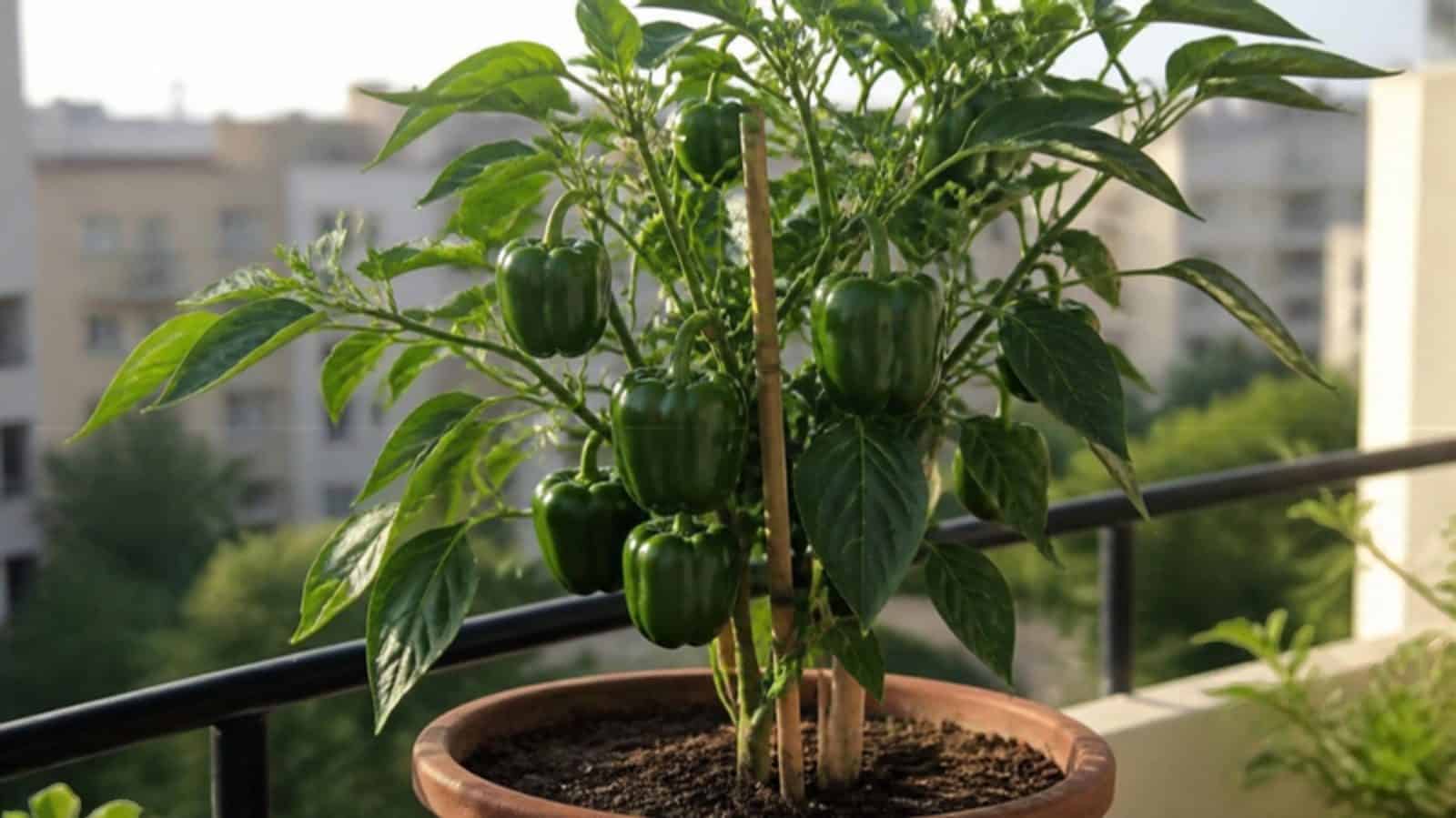
Shimla mirch costs more than most everyday vegetables, which makes it a satisfying crop to raise yourself. If you have been wondering how to grow capsicum at home, the good news is that one plant fits comfortably in a single large pot, and a sunny balcony is enough to bring it to harvest.
Quick answer: Start seeds in a nursery tray, then shift one sturdy seedling into each 30–40 cm pot or grow bag when it is about six weeks old. Keep it in bright sun, water whenever the top layer of soil dries, support the stem once fruits form and cut the peppers while they are firm and glossy green. A plant usually crops over several months.
Below you will find when to sow in different parts of India, how to raise healthy seedlings, how to look after the plant in a container, when to pick, and what to do when flowers drop or leaves curl.
Capsicum in pots: key facts
| What you need to know | Guideline for home growers |
|---|---|
| Weather it prefers | Mild, sunny days; struggles in frost and in harsh summer heat |
| Pot size | A single plant per 30–40 cm pot or grow bag |
| Light | Six hours or more of direct sun |
| Soil | Loamy, free-draining and rich in organic matter |
| Seedling stage | Raised in a tray; moved to pots at roughly 40–45 days |
| Support | A stake once the plant starts carrying fruit |
| Picking | Green fruit when full-sized and firm; colour develops if left longer |
| Crop life | Around 150 days for many varieties |
When should you sow capsicum in India?
Capsicum is happiest in mild weather. Seedlings set back by frost recover slowly, and plants that flower during a heatwave tend to drop their blossoms. That is why the cool, dry months after the monsoon are the main season across most of the plains.
For Tamil Nadu, the Tamil Nadu Agricultural University (TNAU) Agritech Portal gives a long sowing window from September to February. Elsewhere, adjust the timing to your local winter.
| Region | When to start seeds for pots | Watch out for |
|---|---|---|
| North and Central plains | September–October, so plants establish before the coldest weeks; or late winter for a spring crop | Frost nights in December–January; shelter pots against a wall |
| East India (West Bengal, Odisha, Bihar, Assam) | October–November, after the rains stop | Damp spells that encourage fruit rot |
| West India (Maharashtra, Gujarat) | September–November | Hot, dry spring weather that causes flower drop |
| South India and coastal cities | September–February, following TNAU’s window | Strong afternoon sun; light shade helps in hot spells |
| Hills | Spring to early summer, after frost | Cold nights early in the season |
If your balcony gets limited sun, our guide on balcony vegetable garden sunlight explains how to judge whether a spot is bright enough for fruiting crops.
Green, red or yellow: which capsicum should you grow?
Coloured capsicum is not a separate vegetable. Most varieties start green and change colour as the fruit ripens on the plant. ICAR-Indian Institute of Horticultural Research (IIHR) describes its Arka Mohini variety as having green, blocky fruits that turn orange-yellow on ripening, while Arka Basant bears cream-coloured conical fruits that turn orange-red.
For a pot on a balcony, the practical choice is between picking early for a steady supply of green capsicum, or leaving a few fruits longer for colour and sweetness. Leaving fruit to colour takes extra weeks and slows new fruit set, so most home growers pick mainly green.
How to grow capsicum at home: raising seedlings
Capsicum seedlings grow slowly at first, so a tray gives you better control than sowing straight into a big pot.
- Prepare a fine mix. Fill a seedling tray or a few paper cups with fine, moist cocopeat or a light seed-starting mix.
- Sow shallow. Press one or two seeds into each cell, about half a centimetre deep, and cover lightly.
- Hold in moisture until sprouting. TNAU’s nursery method keeps trays covered with a polythene sheet until germination begins, which it notes takes about six days. At home, a plastic bag loosely draped over the tray works; take it off as soon as shoots appear.
- Give strong light. Move the tray into bright light straight away so seedlings stay compact.
- Keep the best seedling. Where two come up together, cut the weaker one at soil level. Our guide on thinning vegetable seedlings covers this step.
- Transplant at the right size. TNAU transplants capsicum seedlings at 40–45 days. By then they should have several true leaves and a firm stem.
Planting and caring for capsicum in a pot
Container and potting mix
Use one pot or grow bag of about 30–40 cm for each plant, with good drainage holes. A capsicum plant carrying fruit is top-heavy, so a wide, stable base helps. TNAU recommends loamy, well-drained soil rich in organic matter. In a container, that means mixing good garden soil generously with compost or vermicompost and lightening it with cocopeat or sand so water never pools. For help picking a container, see our comparison of grow bag sizes for vegetables.
Light and position
Give the pot the sunniest place you have. Plants short of light grow leggy, flower sparsely and produce small fruit. In very hot weather, a little afternoon shade protects flowers and prevents sunscald on the peppers.
Watering
TNAU irrigates field crops at intervals of about a week to ten days, but a pot dries much faster. Push a finger into the soil and water thoroughly when the top few centimetres feel dry, then let the excess drain. Steady moisture during flowering and fruiting matters most; a pot that swings between bone-dry and soaked is a common reason for dropped flowers.
Feeding
TNAU’s schedule adds nitrogen in three instalments, at 30, 60 and 90 days after planting. For a pot, the home equivalent is a handful of compost or vermicompost around the plant about once a month. Once flowering starts, avoid heavy nitrogen, which pushes leaves rather than fruit. If you use a potassium feed such as our water-soluble potash, stick to the label dose.
Support and tidying
Push a bamboo stake into the pot early and tie the main stem loosely as fruits begin to swell. TNAU recommends weeding and earthing up around the 30th day; in a container, simply clear any weeds and top up the soil around the stem base.
When and how to harvest capsicum
TNAU advises harvesting fully matured green fruits before they start to ripen, and gives a crop duration of about 150–160 days. IIHR lists 150 days for both Arka Mohini and Arka Basant.
- Pick when the fruit has reached full size, feels firm and has a glossy skin.
- Cut the stalk with a knife or scissors. Pulling can snap the brittle branches.
- Check the plant every few days once fruiting begins, because regular picking encourages more flowers.
- To get coloured capsicum, leave one or two fruits on the plant until they change colour completely.
Capsicum problems and fixes
TNAU names powdery mildew, die-back and fruit rot among the diseases that affect capsicum. Most of the trouble in pots, though, comes from weather and watering.
| What you see | Probable reason | What helps |
|---|---|---|
| Flowers fall before setting fruit | Heat, cold nights, too little sun or uneven watering | Grow in the mild season, give full sun and water evenly |
| White powder on leaves | Powdery mildew | Remove affected leaves and give the plant more air flow |
| Branch tips dry from the top down; fruits rot | Die-back and fruit rot | Cut out affected parts and avoid wetting the foliage |
| Pale, papery patches on the side of fruits | Sunscald from harsh direct sun | Provide light afternoon shade; healthy leaf cover protects fruit |
| Upward-curling, stiff leaves | Thrips or mites feeding on the leaves | Check the undersides; hose off pests and remove badly damaged leaves |
| Small, misshapen fruit | Poor pollination in extreme temperatures, or a hungry plant | Top-dress with compost; fruit set improves when weather turns milder |
| Plant collapses though soil is wet | Root rot from waterlogging | Improve drainage and water less often |
When a problem keeps coming back, ask your nearest Krishi Vigyan Kendra for a locally suited remedy.
Seeds and related guides
Our Capsicum (Hari Shimla Mirch) F1 Hybrid Seeds are packed for home gardeners, and capsicum is also part of the Indian Kitchen Garden 5 Vegetable Seeds Combo. Capsicum is a close relative of chilli and tomato, so our guides on growing chilli in pots and growing tomatoes in pots follow a similar routine.
Frequently asked questions
How long does capsicum take to grow from seed?
Seedlings spend about 40–45 days in the tray before transplanting, according to TNAU. The crop then runs for several months, with TNAU giving a total duration of about 150–160 days. Picking continues through much of that period.
Can capsicum be grown in a 12-inch pot?
Yes. A 12-inch pot is about 30 cm, which suits one capsicum plant. Larger containers dry out more slowly and support a bigger plant, so go up in size if you can.
Why do capsicum flowers fall off?
Blossom drop is usually caused by temperature stress, too little light or irregular watering. Plants recover and set fruit again once conditions improve.
Are red and green capsicum different plants?
Usually not. Green capsicum is picked before it ripens. Left on the plant, many varieties turn yellow, orange or red, as IIHR’s variety descriptions show.
Can I grow capsicum from the seeds of a shop-bought capsicum?
Seeds from a market fruit may germinate, but if that fruit came from a hybrid, the new plants may differ from the parent. Fresh packed seed gives more dependable results.
Does capsicum need a lot of water?
It needs steady moisture rather than a lot of water. Water deeply when the top layer of soil dries out, and never leave the pot standing in water.
Your first capsicum plant
Raise a few seedlings in a tray this season, keep the strongest one per pot and give it your sunniest spot. With even watering, a monthly helping of compost and a stake for support, one plant can keep your kitchen supplied with fresh shimla mirch for weeks on end.