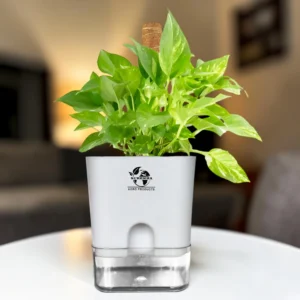
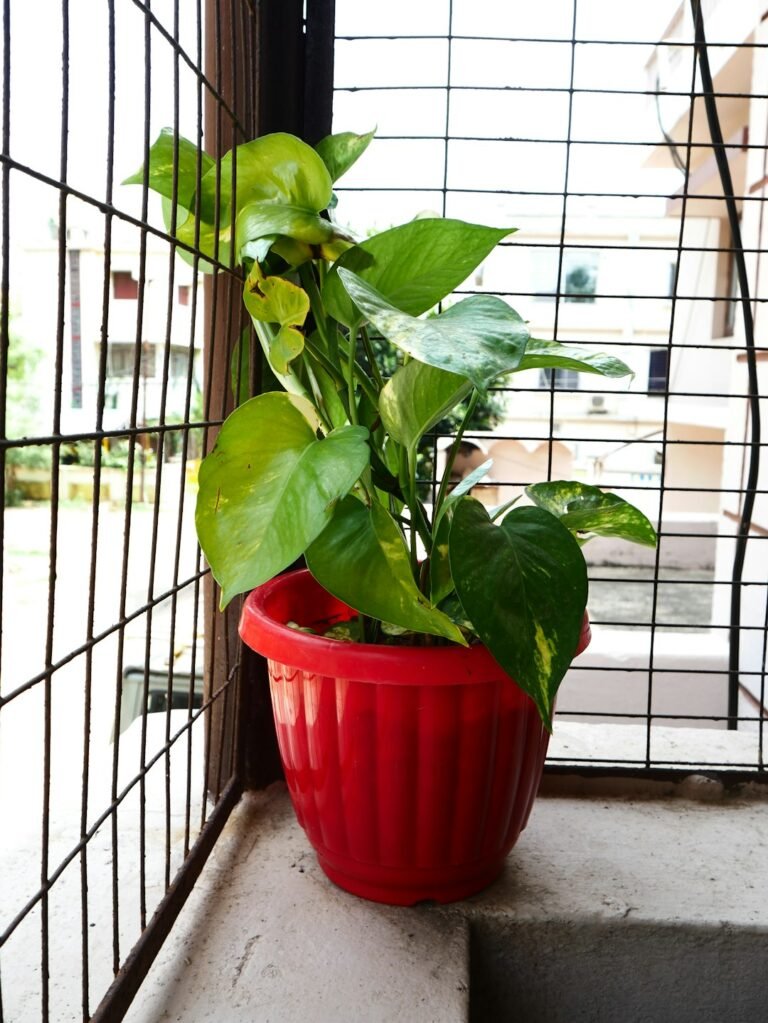
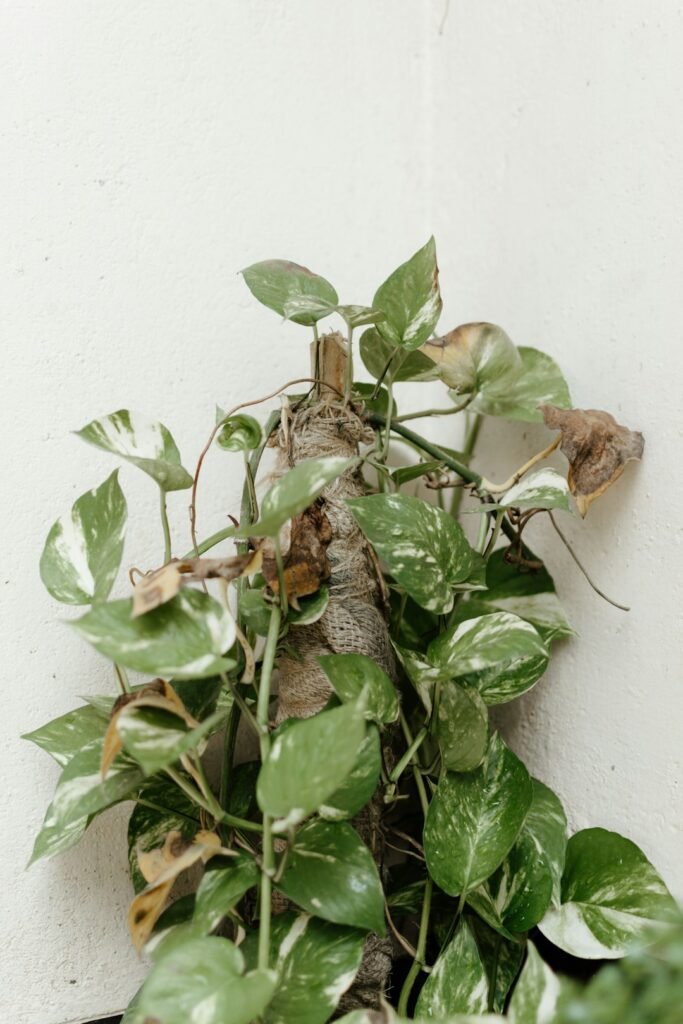
The golden money plant is the classic money plant most Indian homes start with: a trailing vine with glossy, heart-shaped green leaves splashed and streaked with yellow. Botanists call it Epipremnum aureum, and the rest of the world knows it as golden pothos. It is forgiving, but the yellow colour is not guaranteed. Kept too dark, a golden money plant slowly turns plain green and grows long, bare stems. This guide explains how to recognise a true golden variety, what keeps its colour bright, and how to care for it through Indian summers, monsoons and winters.
Quick answer: Give a golden money plant bright, indirect light (near a window but out of harsh afternoon sun), let the top few centimetres of soil dry before watering, feed it lightly during the warm growing months, and give it a moss stick or support if you want bigger leaves. Low light is the most common reason the yellow streaks fade. The plant is toxic to cats and dogs if chewed, so keep it out of their reach.
Golden money plant at a glance
| Feature | What to know |
|---|---|
| Botanical name | Epipremnum aureum (earlier sold as Scindapsus aureus); “aureum” means golden |
| Common names | Golden money plant, golden pothos, devil’s ivy |
| Leaf look | Glossy, heart-shaped, green with irregular yellow streaks and splashes |
| Light | Bright, indirect light for the best colour; tolerates low light but loses variegation |
| Watering | When the top 2 to 3 cm of soil feel dry; less in winter |
| Soil | Light, well-drained potting mix; pot with a drainage hole |
| Feeding | Light feed about every other month in the warm season; pause in winter |
| Growth habit | Trails from shelves and baskets, or climbs a moss stick using aerial roots |
| Pets | Toxic to cats and dogs (insoluble calcium oxalates) |
How to identify a golden money plant
Many plants are sold in India under the “money plant” name, so it helps to know what you are looking at. A golden money plant has:
- Yellow, not white, variegation. The streaks are butter-yellow to golden. If the marbling is creamy white, you probably have a Marble Queen or a similar white-variegated type.
- Glossy, slightly thick, heart-shaped leaves that sit on grooved leaf stalks.
- Brown aerial roots at the nodes along the stem, which the vine uses to grip a support.
- Irregular colour. No two leaves are painted the same; some may be mostly green and others heavily streaked.
NC State Extension’s plant toolbox notes that pothos can be told apart from the look-alike heartleaf philodendron by its grooved leaf stalks and the absence of obvious free stipules on new growth. In everyday terms, philodendron leaves are usually thinner and softer, while pothos leaves feel waxier and a little stiffer.
Golden vs other money plant varieties
| Variety | Leaf colour | Light it prefers |
|---|---|---|
| Golden | Green with yellow streaks | Bright indirect light keeps the gold visible |
| Marble Queen | Green heavily marbled with white | Needs good light; grows slower because it has less green |
| N’Joy (often sold as “Enjoy” money plant) | Smaller leaves with crisp cream-white patches | Bright indirect light; compact grower |
| Neon | Solid bright yellow-lime | Bright indirect light; colour dulls in shade |
| Jade | Solid dark green | Copes best in low light |
Golden money plant care: the essentials
Light: the key to keeping the gold
The yellow parts of a leaf contain little or no chlorophyll, so they do not feed the plant. When light is scarce, the vine responds by making greener leaves that can capture more energy. NC State Extension lists low light as a cause of lost variegation. That is why a golden money plant that looked bright at the nursery can turn plain green after a few months in a dim corridor.
- Best spot: within a metre or two of an east- or north-facing window, or a bright room where it gets plenty of daylight but no harsh midday sun on the leaves.
- On a balcony, keep it under the overhang or behind a grille or net where it gets filtered light. Direct afternoon sun in April to June can bleach and scorch leaves.
- If the plant must live in a dim room, rotate it to a brighter spot for a few weeks at a time, or accept that new leaves will be greener.
Older green leaves will not turn yellow again once the light improves. Look at the new leaves to judge whether the change is working.
Watering
Overwatering kills far more money plants than underwatering. NC State Extension links root rot and blackened leaf edges to too much water and recommends letting the potting medium dry out between waterings.
- Push a finger into the soil. If the top 2 to 3 cm are dry, water.
- Water slowly until a little drains out of the bottom hole.
- Empty the saucer after 15 to 20 minutes so the roots do not sit in water.
- Check again in a few days rather than watering on a fixed calendar.
Slight drooping is a gentle “I am thirsty” signal and the leaves usually perk up within hours of watering. Yellowing, soft stems and a sour smell from the soil point the other way, towards too much water. Our guide to money plant yellow leaves walks through how to tell the two apart.
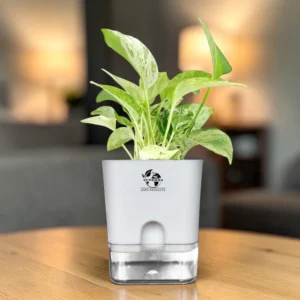
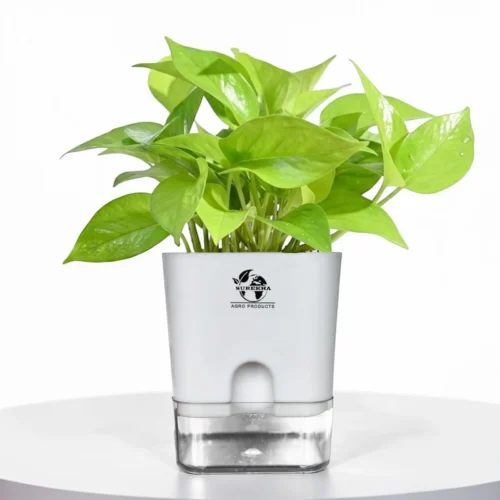
A self-watering pot can take some of the guesswork out of this, because the plant draws water up from a reservoir. Fill the reservoir, let it run nearly empty, and then refill it. See how to use self-watering pots for the details.
Soil and pot
Use a light, airy potting mix that drains quickly. A simple homemade blend is equal parts garden soil or compost, cocopeat, and perlite or coarse sand. Avoid heavy clay soil straight from the ground; it stays wet and squeezes out the air that roots need. Always use a pot with a drainage hole. A golden money plant does not need a big pot, so move up only one size (about 2 to 5 cm wider) when roots fill the current one. Our beginner’s repotting guide covers the steps.
Feeding
NC State Extension suggests fertilising pothos every other month, except when growth slows in winter. A balanced liquid fertiliser at half the label strength, or a small amount of vermicompost mixed into the top layer of soil, is enough. More fertiliser will not bring back the yellow colour; only better light does that. Too much feed can burn roots and leave crusty white salts on the soil surface.
Humidity and cleaning
Golden money plants handle ordinary Indian room humidity well. In very dry winter air in the north, or in a room with an air conditioner running all day, leaf tips may brown. Grouping plants together or setting the pot on a tray of wet pebbles helps. Wipe dusty leaves now and then with a soft damp cloth so they can catch more light; our leaf-cleaning routine shows how.
Season-by-season care in India
| Season | What to do |
|---|---|
| Summer (March to June) | Fast growth. Water more often, but still check the soil first. Keep it out of direct afternoon sun, especially on west-facing balconies in the north and centre of the country. Feed lightly. |
| Monsoon (June to September) | Humid air means soil dries slowly. Cut back watering, move balcony plants out of driving rain, and make sure the drainage hole is not blocked. Watch for fungus gnats and soft stems. |
| Post-monsoon (October to November) | A good time to prune, take cuttings and repot before growth slows. |
| Winter (December to February) | Growth slows, especially in north India where nights get cold. Water sparingly, stop feeding, and keep the plant away from cold windows and doors at night. In south India and coastal cities the plant may keep growing slowly; adjust watering to what the soil tells you. |
How to get bigger, more golden leaves with a moss stick
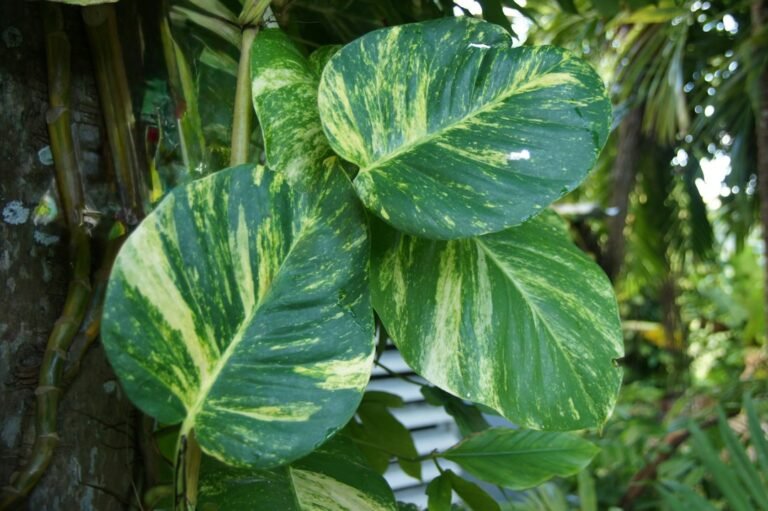
Left to trail from a shelf, a golden money plant keeps small, juvenile leaves. NC State Extension notes that when the vine has a support to climb and enough light, it begins to produce larger, mature leaves. In the wild and in gardens it climbs tree trunks and its leaves can become very large.
- Push a moss stick or coir pole firmly into the pot, close to the base of the stems, ideally when repotting so you do not damage roots.
- Guide the longest stems towards the pole, with the aerial roots facing it.
- Tie them loosely with soft twine or plant clips. Do not use wire.
- Mist or wet the moss stick every few days so the aerial roots have something moist to grip.
- Keep adding ties as the vine grows. Over months, new leaves on the pole often come in larger.
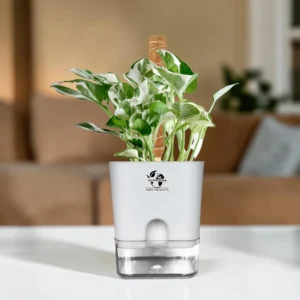
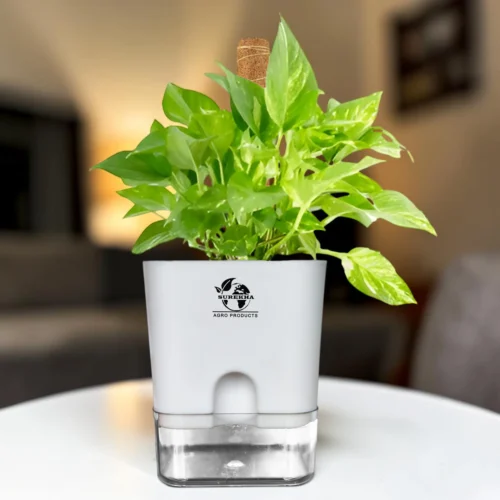
If you would rather start with a plant that already has a support, our Money Plant with Moss Stick comes trained on a coir pole in a self-watering pot.
Pruning and propagation
Over time, older leaves yellow and drop, so the leaves bunch up at the ends of long, bare stems. NC State Extension recommends pruning stems back to keep the plant bushy. Here is how:
- Choose the longest or barest stems.
- Cut just above a node (the bump where a leaf meets the stem) with clean scissors.
- The plant will usually push new growth from the node below the cut.
- Keep the cut pieces. Each piece with two or three nodes can become a new plant.
Iowa State University Extension lists pothos among the houseplants that grow well from stem cuttings: take a piece with at least two nodes, strip the lower leaves, and push a node into moist rooting mix with no leaves buried. NC State Extension adds that the vines root easily in water too. Our step-by-step guide on how to grow money plant in water covers bottles, water changes and moving cuttings into soil. Plant several rooted cuttings back into the mother pot to make it fuller.
Common golden money plant problems
| Problem | Likely cause | What to do |
|---|---|---|
| New leaves are plain green | Too little light | Move to a brighter spot with indirect light; judge by new growth |
| Long bare stems, small leaves | Low light, no pruning | More light, cut stems back above a node, replant cuttings |
| Yellow leaves, wet soil | Overwatering, poor drainage | Let soil dry, empty saucers, check drainage hole and roots |
| Blackened leaf edges, soft stems | Root rot from overwatering | Trim rotten roots, repot in fresh, drier mix |
| Pale, washed-out or scorched patches | Harsh direct sun | Move out of afternoon sun or behind a net or curtain |
| Brown crispy tips | Very dry air or irregular watering | Water more evenly; raise humidity in dry winter or AC rooms |
| White cottony clumps or brown bumps on stems | Mealybugs or scale insects | Wipe off with a cotton bud dipped in rubbing alcohol, isolate the plant, repeat weekly |
NC State Extension specifically mentions mealybugs and scale as pests to watch on pothos. Check the undersides of leaves and the joints of stems whenever you water.
Is the golden money plant safe for pets?
No. The ASPCA lists golden pothos as toxic to dogs and cats. The plant contains insoluble calcium oxalates, and chewing it can cause intense mouth irritation, drooling, vomiting and difficulty swallowing. NC State Extension also rates it as having medium-severity poison characteristics. Hang it in a basket, train it up high, or keep it in a room pets cannot reach. If you think a pet or child has chewed the leaves, contact a veterinarian or doctor.
Golden money plant and Vastu
In many Indian homes the money plant is kept for good luck, and Vastu traditions often suggest placing it in the south-east. These are cultural beliefs rather than proven effects. For the plant itself, the best place is wherever it gets bright, indirect light and steady care. We cover the traditions and the evidence in our post on money plant benefits.
Frequently asked questions
What is a golden money plant?
It is Epipremnum aureum, the golden pothos: a trailing vine with glossy heart-shaped green leaves streaked with yellow. It is the most common type of money plant grown indoors in India.
Why is my golden money plant turning green?
Usually because it is not getting enough light. The plant makes greener leaves to capture more energy. Move it to a brighter spot with indirect light. New leaves should show more yellow, but old leaves will stay green.
How often should I water a golden money plant?
There is no fixed schedule. Water when the top 2 to 3 cm of soil are dry. In Indian summers that may be every few days; in winter or during the monsoon it may be once a week or less.
Can a golden money plant grow in low light?
It can survive in low light for a long time, but it grows slowly, gets leggy and loses much of its yellow colour. If your room is dim, a solid green variety such as Jade copes better.
What is the difference between golden and marble queen money plant?
Golden money plant has yellow streaks on green leaves. Marble Queen has creamy white marbling and usually more variegation, so it grows more slowly and needs good light.
How do I make my golden money plant leaves bigger?
Give it a moss stick or coir pole to climb, plus bright indirect light. Climbing vines with good light tend to produce larger, more mature leaves over time.
Is golden money plant poisonous?
Yes, to cats and dogs, and it can irritate the mouth of anyone who chews it. Keep it out of reach of pets and small children.
Conclusion
A golden money plant rewards a few simple habits: bright but indirect light to keep the yellow streaks, water only when the topsoil is dry, a light feed in the warm months, and a trim when the stems get bare. Add a moss stick if you want bigger leaves, and keep it away from curious pets. For a broader beginner’s view of every money plant type, see our money plant care guide for first-time owners, or browse low light indoor plants if your room is on the dim side.
Sources
- NC State Extension Gardener Plant Toolbox: Epipremnum aureum (Pothos)
- ASPCA Animal Poison Control: Golden Pothos
- Iowa State University Extension and Outreach: How to propagate houseplants by stem tip cuttings