
Money plant care is one of the easiest things you can learn as a new plant parent — and it starts right here.
If you’ve ever bought a plant with the best intentions, only to watch it slowly wilt into a sad brown memory — this guide is for you. The money plant is not just forgiving; it practically wants you to succeed. Whether you live in a tiny apartment in Mumbai or a sunlit flat in Delhi, money plant indoor care fits every lifestyle, every schedule, and every level of experience.
Before we dive in, if you’re still figuring out which plant to bring home first, check out our guide on How to Choose Your First Indoor Plant (Simple Guide) — it’ll help you make a confident choice.
Meet the Money Plant — What Exactly Is It (And Why Everyone’s Talking About It)
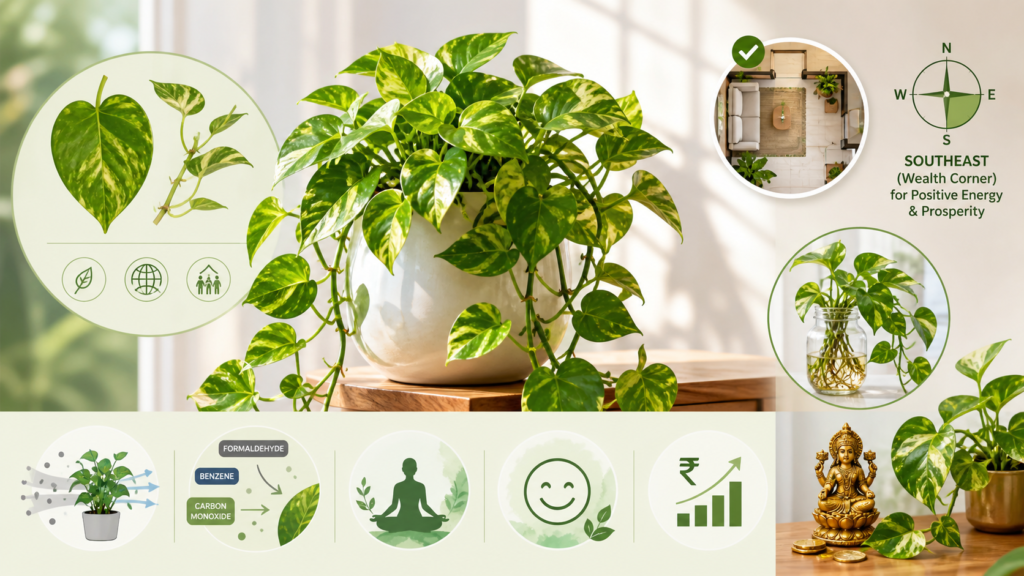
The money plant (Epipremnum aureum), also known as Pothos or Devil’s Ivy, is a tropical vine native to Southeast Asia. It belongs to the Araceae family and has been a staple of Indian homes for decades. The name “money plant” is rooted in folklore — it’s believed to attract wealth, prosperity, and good fortune when kept indoors.
From a money plant vastu perspective, it holds significant importance. Vastu Shastra recommends placing the money plant in the southeast direction of your home, which is governed by Venus, the planet associated with wealth and luxury. Many families keep it near the entrance or in the living room to invite positive energy and financial prosperity.
Beyond superstition, money plant benefits are very real. NASA’s Clean Air Study has highlighted how Pothos effectively filters toxins like formaldehyde, benzene, and carbon monoxide from indoor air. It also reduces stress, boosts mood, and creates a calming atmosphere — all while asking very little in return.
Not All Money Plants Are the Same — Know Your Variety
One of the most exciting parts of money plant care is discovering how many gorgeous money plant variety options exist. Here’s a quick look at the most popular ones:
- Golden Pothos (Epipremnum aureum) — The classic. Heart-shaped money plant leaves with golden-yellow variegation. Perfect for beginners.
- Marble Queen Pothos — White and green marbled money plant leaves; slightly slower-growing but stunning.
- Jade Pothos — All-green, solid leaves; the most low-light-tolerant variety.
- Neon Pothos — Bright chartreuse leaves that pop in any room.
- Chinese Money Plant (Pilea peperomioides) — Round, coin-shaped leaves; great for gifting.
- Money Tree (Pachira aquatica) — The braided trunk variety often seen in offices and feng shui decor.
- Jade Plant (Crassula ovata) — Thick, succulent-like leaves; extremely drought-tolerant.
Each variety has its own charm, but all share the same easy-going temperament that makes money plant care so beginner-friendly.
The Laziest Gardener’s Dream — Why Money Plant Is Ridiculously Easy to Grow
Here’s the honest truth: money plants thrive on a little bit of neglect. They don’t need daily attention, they won’t throw a fit if you miss a watering, and they’ll grow in conditions that would kill most other houseplants.
What makes money plant care so accessible?
- It tolerates low light — no south-facing window required
- It survives irregular watering — once a week is usually enough
- It adapts to Indian climates — both dry summers and humid monsoons
- It grows in soil and water — offering maximum flexibility
- It bounces back quickly — even from neglect
This is exactly why it tops the list of money plants for indoor growing recommendations across India. For more easy-care options like this one, explore our curated list of 10 Best Indoor Plants for Beginners in India (Low Maintenance & Easy to Grow).
Money Plant Care 101 — Give Your Plant What It Needs (It’s Less Than You Think)
The foundation of healthy money plant care lies in getting the five basics right. Let’s break them down:
🌰 Soil
Use a well-draining potting mix — ideally a combination of regular garden soil, cocopeat, and perlite (1:1:1 ratio). Heavy, waterlogged soil is the number one killer of money plants. Fair—let’s make it more original and natural: Put a small layer of pebbles at the base so water doesn’t get trapped in the soil.
☀️ Light
Money plant indoor placement works best in bright, indirect sunlight. A place near a window with soft, filtered light works best. However, it handles low-light corners better than almost any other plant. Avoid direct, harsh sunlight, which can scorch the money plant’s leaves and bleach the variegation.
💧 Watering
Give it water once the top layer of soil feels dry to the touch. —During warmer months, expect to water around once a week; as temperatures drop, extend the gap to about 10–14 days. The golden rule of money plant care: it’s always better to underwater than overwater. Yellowing on the money plant leaves is the first sign of overwatering.
🌡️ Temperature & Humidity
Money plants thrive between 15°C and 30°C — perfectly suited to most Indian homes year-round. They enjoy moderate humidity; occasional misting of the money plant leaves during dry winters helps them stay perky.
🌱 Fertilizer
Give your money plant a monthly dose of fertilizer during its active growing period. (March to September) with a balanced liquid fertilizer (NPK 20:20:20). Skip fertilizing in winter when growth naturally slows.
🍲 Pot & Repotting
Choose a pot with drainage holes — always. Terracotta pots are excellent as they allow soil to breathe. Repot every 1–2 years when you notice roots circling the bottom or poking out of drainage holes.
Your Week-by-Week Money Plant Care Routine for Absolute Beginners
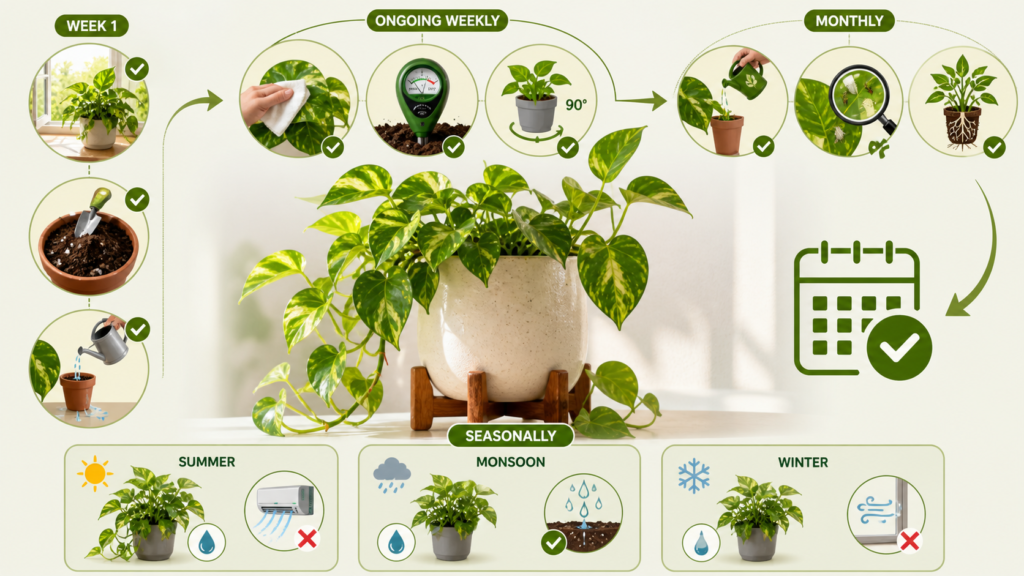
Week 1: Choose a bright, indirect-light spot. Plant in well-draining soil. Water thoroughly and let excess drain completely.
Ongoing Weekly: Check soil moisture before watering. Alright, let’s make it feel completely fresh: Lightly wipe the foliage with a moist cloth to remove dust, so the plant can take in light more efficiently. Rotate the pot 90° weekly for even, balanced growth.
Monthly: Apply liquid fertilizer (only during the growing season). Inspect for pests. Check if the pot needs an upgrade.
Seasonally:
- Summer: Water more frequently; move away from air conditioner vents.
- Monsoon: Reduce watering; ensure excellent drainage to prevent root rot.
- Winter: Cut back watering; avoid cold draughts.
One Plant, Endless Plants — The Magic of Money Plant Propagation
One of the most rewarding parts of money plant care is propagation. You can multiply one plant into dozens — completely free.
Water Propagation (Easiest Method):
- Identify a healthy stem with at least 2–3 nodes (the small brown bumps where leaves attach)
- Trim the stem slightly below a node with clean, sharp scissors.
- Remove lower leaves, leaving 1–2 at the top
- Place the cutting in a clean glass of water; ensure nodes are submerged
- Keep in bright indirect light and change water every 3–4 days
- Roots appear in 2–3 weeks; transplant to soil once roots are 3–5 cm long
Soil Propagation:
Carry out steps 1–3, then plant the cutting in lightly moist soil. Create a mini greenhouse by covering it with a plastic bag, and remove the cover once new leaves start forming (around 3–4 weeks).
Common mistakes: Using stems without nodes, overwatering freshly propagated cuttings, and exposing new cuttings to direct sunlight.
More Than Just a Pretty Leaf — How Money Plants Transform Your Living Space
A thriving money plant doesn’t just clean your air — it completely changes the energy of a room. Research consistently shows that money plant indoor greenery reduces cortisol levels, improves focus, and boosts overall well-being.
From a money plant vastu standpoint, placement matters deeply. Here’s a quick guide:
- Southeast corner — best for attracting wealth (Venus direction)
- East direction — promotes health and harmony
- Avoid the northeast and bathroom — considered inauspicious in Vastu
Money plant benefits extend to the workspace, too. Studies show indoor plants improve concentration by up to 15% — making the money plant an excellent desk companion.
From Boring Corner to Botanical Showstopper — Styling Money Plants in Modern Indian Homes
Money plant care becomes even more rewarding when the plant doubles as décor. Here’s how to style it beautifully:
- Trailing shelves: Let long vines cascade down bookshelf edges for a lush, layered look
- Hanging planters: Macramé holders work beautifully for money plant for indoor balcony or bedroom spaces
- Moss poles: Train climbing varieties upward for a dramatic vertical display
- TV unit styling: Drape vines along entertainment units for a natural, organic feel
- Bathroom corners: Money plants love the humidity near showers — great for low-light bathrooms
- Office desks: A small pot on the desk is both vastu-friendly and productivity-boosting
Ditch the Plain Pot — 7 Creative Ways to Display Your Money Plant
- Repurposed glass bottles — Water-propagated cuttings look stunning in coloured glass jars
- Wall-mounted pots — Create a vertical green wall with hanging ceramic planters
- Trailing bookshelves — Long vines draped over books create an effortless, earthy aesthetic
- Painted terracotta DIY — Personalise plain pots with acrylic paint for a unique touch
- Jungle corner grouping — Cluster 3–5 different money plant variety pots for a bold statement
- Balcony railing display — Hang planters along railings for an outdoor green curtain
- Gift in a cute pot — Propagated cuttings in hand-painted pots make thoughtful, meaningful gifts
Yellow Leaves? Droopy Stems? What Your Money Plant Is Trying to Tell You
Even with the best money plant care, problems can arise. Here’s how to diagnose and fix the most common ones:
| Problem | Likely Cause | Quick Fix |
| Yellow money plant leaves | Overwatering | Let soil dry; improve drainage |
| Brown leaf tips | Low humidity or direct sun | Mist leaves; reposition plant |
| Leggy, sparse growth | Insufficient light | Move to brighter indirect light |
| Wilting despite watering | Root rot | Repot in fresh, dry mix; trim rotted roots |
| Pale or washed-out leaves | Too much direct sun | Move away from window |
| White cottony patches | Mealybugs | Wipe with neem oil + water solution |
| Tiny webbing under leaves | Spider mites | Spray neem oil; increase humidity |
Most problems in money plant care stem from two causes: too much water or too little light. When in doubt, ease up on watering first.
What Experienced Plant Parents Know That Beginners Don’t — Secrets of Growing a Lush Money Plant
These pro tips will take your money plant care to the next level:
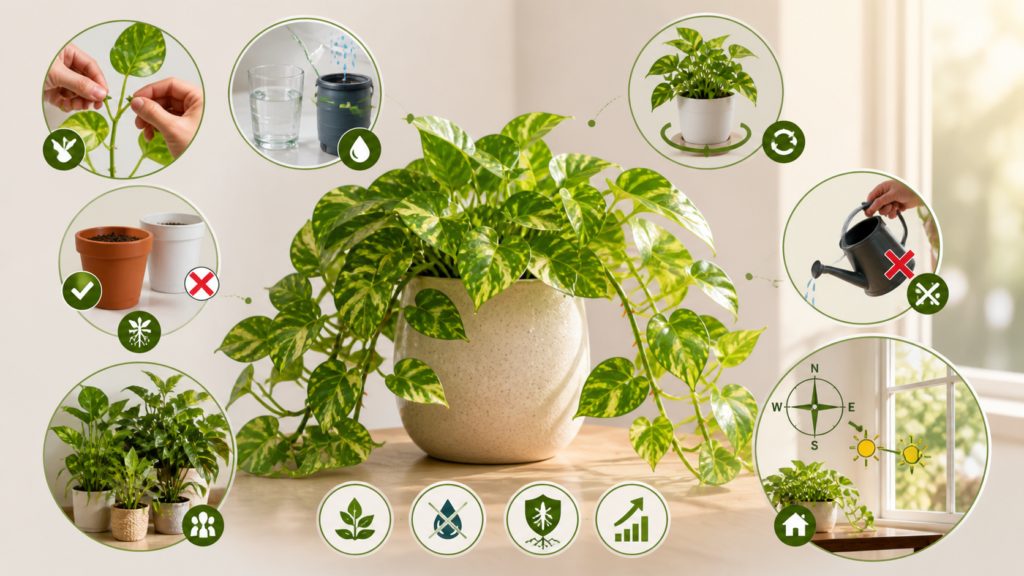
- Pinch the tips: Regularly pinch growing tips to encourage bushier, fuller growth instead of long, spindly vines
- Use filtered or rainwater: Tap water with high chlorine or fluoride can cause brown money plant leaf tips over time; let tap water sit overnight before use
- Rotate weekly: Quarter-turn the pot each week so all sides receive equal light and growth stays balanced
- The ‘ignore it’ method: Once established, money plants actually grow better with less fussing — resist the urge to water daily
- Terracotta over plastic: Terracotta pots allow air circulation to roots, dramatically reducing root rot risk
- Group with other plants: Clustering plants together raises local humidity, benefiting everyone in the group
- Vastu + window alignment: For maximum money plant vastu benefit, place the pot so it faces southeast, ideally near a window that receives morning light
Your Green Journey Starts Here — One Plant, One Pot, A Lifetime of Joy
Money plant care is one of the most rewarding places to begin your journey as a plant parent. It’s resilient, beautiful, fast-growing, and endlessly versatile. Whether you’re growing it in a bottle on your kitchen shelf, trailing it down your bookcase, or gifting propagated cuttings to friends, this humble plant brings real joy to everyday spaces.
Start with one cutting. Follow the simple care routine. Watch it grow. And before you know it, you’ll have a home full of green — and the confidence to try something new.
Ready to grow your indoor garden further? Read our guide on How to Choose Your First Indoor Plant (Simple Guide) and explore the full 10 Best Indoor Plants for Beginners in India to find your next favourite plant.
Frequently Asked Questions (FAQs)
Q1. How often should I water my money plant?
Water your money plant once every 7–10 days in summer and every 10–14 days in winter. Always check the top inch of soil — if it feels dry, it’s time to water. Money plant care is much easier when you follow the rule: less is more when it comes to watering.
Q2. Can money plants grow in water permanently?
Yes! One of the best money plant for indoor growing tricks is keeping it in water long-term. Simply change the water every 5–7 days, add a few drops of liquid fertiliser monthly, and keep it in bright indirect light. Water-grown money plants can thrive for years with minimal effort.
Q3. Which direction should I place my money plant according to Vastu?
According to money plant vastu principles, the southeast corner of your home is the most auspicious placement. This direction is governed by Venus and associated with prosperity. Avoid placing the money plant in the northeast corner or inside bathrooms, as this is considered inauspicious.
Q4. Why are my money plant leaves turning yellow?
Yellow money plant leaves are almost always a sign of overwatering. Water less often, check that excess water can drain easily, and wait until the soil has partially dried before watering again. If the leaves keep turning yellow, carefully lift the plant from its pot and inspect the roots for signs of rot.
Q5. What are the main benefits of the money plant for the home?
Money plant benefits include air purification (it filters formaldehyde and benzene), reduced stress and anxiety, improved indoor humidity, and, according to Vastu and Feng Shui, attraction of wealth and positive energy. It also improves focus, making it a great desk plant.
Q6. Which is the best money plant variety for beginners?
Golden Pothos is hands down the best money plant for beginners. It tolerates low light, irregular watering, and a wide range of temperatures. Its heart-shaped, golden-green leaves are beautiful and grow quickly, giving new plant parents a rewarding experience right from the start.
Q7. How do I make my money plant grow faster and bushier?
To encourage bushy growth in your indoor money plant setup: regularly pinch growing tips, keep the plant in bright, indirect light, fertilise monthly during the growing season, and use a moss pole to support upward growth. Pruning leggy vines also redirects energy into fuller, denser growth.
Q8. Is the money plant safe for pets and children?
Money plant (Pothos) contains calcium oxalate crystals, which can cause mild irritation if ingested by pets or children. It’s advisable to keep the plant out of reach of small children and pets, or choose a pet-safe alternative if you have curious cats or dogs at home.