The red edges or pale speckles are usually what make an aglaonema catch your eye. Then comes the practical question: will it be happy on the desk you have in mind? Give that spot a quick light check before you settle the pot there. A good position makes the rest of its care much easier.
For aglaonema plant care in Indian homes, choose indirect light, keep the plant comfortably warm and water after the top layer of potting mix has dried. Let excess water drain. Check more carefully during cool weather instead of watering on a fixed weekly schedule. These are the core growing conditions described by Clemson Extension and UF/IFAS.
Where should you keep an aglaonema?
Start beside a window where the plant receives indirect daylight, with protection from a strong beam of sun. Check the spot at different times: the pleasant light you see at breakfast may become hot afternoon sun on the same table.
Aglaonemas are also called Chinese evergreens. Solid-green kinds can cope with lower light; colourful and variegated kinds generally need a brighter indirect position. Clemson’s guidance distinguishes those groups and advises against direct sun on the foliage. Source: Chinese evergreen growing guide.
Arrange for the actual light in your room; there is no fixed distance that suits every window.
Put the plant where you can see its leaves and reach the pot, rather than squeezing it onto a deep shelf. A curtain is useful when it filters harsh light, but the plant still needs daylight behind it. Watch the leaves and new growth as you settle on a position. Keep it away from the direct blast of an air conditioner or a cold, draughty doorway.
How often should you water it?
Check the mix before reaching for the jug. UF/IFAS recommends watering when the top inch, about 2.5 cm, feels dry. The aim is an evenly moist root area with air in the mix, rather than a pot that stays saturated. A small pot by a bright window and a larger pot in a cooler room will not dry at the same speed. Source: UF/IFAS aglaonema care.
- Feel below the surface. If the upper layer is still damp, leave the jug down and check again later.
- When it needs water, wet the mix evenly. In an ordinary drainage pot, allow excess water to run out, then empty the saucer or outer cover pot.
- Notice the weight. Lifting the pot gently before and after watering helps you learn its change from wet to drying.
The RHS houseplant guide supports checking moisture and pot weight, watering thoroughly and emptying collected drainage water. Use water at room temperature rather than very hot or cold water.
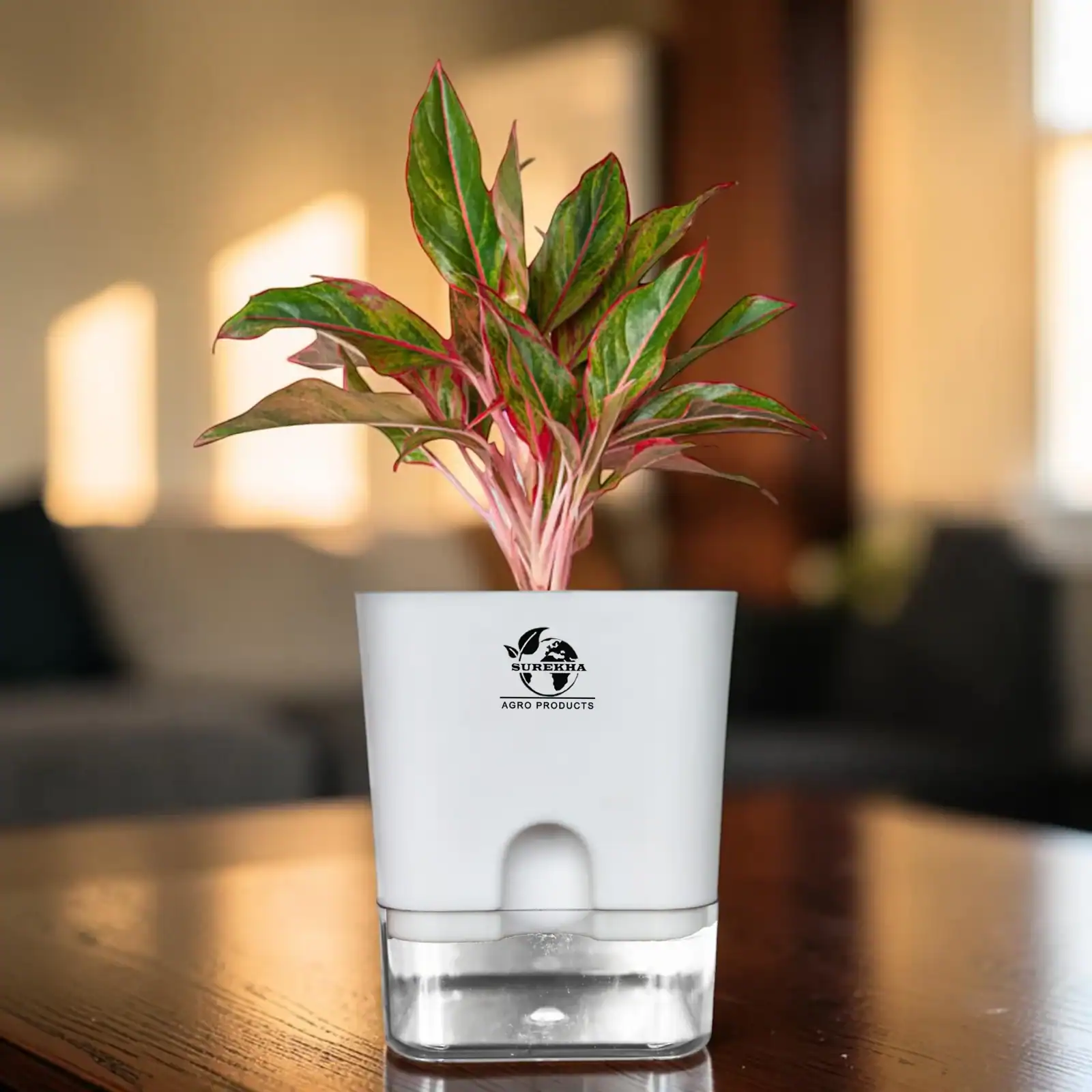
If your aglaonema is in a reservoir planter, check both the mix and the reservoir before refilling. An empty reservoir does not automatically mean the roots are dry. Our self-watering pot guide explains the setup and refill checks for that container type.

What changes with Indian weather?
Aglaonema likes warmth. Clemson gives a preferred range of about 20–27°C and advises avoiding temperatures below roughly 13°C. Treat a chilly balcony as a different environment from a sheltered room, even when both feel pleasant in the afternoon. Source: Clemson temperature guidance.
| Home conditions | What to change |
|---|---|
| Cool northern plains winters or hill-station nights | Bring the plant into a warm, bright room. Keep it away from cold glass and draughts; check the mix before each watering. |
| Warm coastal or southern homes | Continue moisture checks rather than applying an automatic “winter rest.” Watch how quickly this particular pot dries. |
| Monsoon rain or a wet spell on a sheltered balcony | Keep rain out of the pot when it is already moist. Check drainage and avoid topping up a wet reservoir. |
| Hot, dry weather or a room with strong air-conditioning | Protect foliage from harsh sun and direct air blasts. Check the pot more often, then water according to moisture. |
These are practical adaptations to the growing conditions, rather than a city-by-city timetable. North Carolina Extension recommends reducing watering in winter; in an Indian home, relate that advice to a cooler, slower-drying pot rather than the month alone. Source: NC State Plant Toolbox.
Keep the rest of the routine small
Feed during active growth. Choose a suitable houseplant fertiliser and follow its label, taking account of any feed already in the potting mix. Adding several supplements at once makes the routine harder to judge. The RHS links feeding to the growing season; Clemson notes that excessive fertiliser can burn aglaonema leaf edges.
Clean when dust builds up. A soft, damp cloth is enough for normal leaf dust. Our leaf-cleaning tutorial shows gentle handling and explains which marks need a closer look.
Repot when there is a reason. Check whether roots are crowded or the mix no longer drains well. Use a houseplant potting mix and a container with drainage; choose a sensible increase in size rather than an oversized decorative pot. UF/IFAS describes moving an aglaonema into a larger pot or dividing it when needed. The RHS recommends repotting during active spring growth in its climate; for Indian homes, choose a suitable warm growing period. UF/IFAS · RHS.
When a leaf changes, check the surroundings first
A yellow leaf is a prompt to look, not an instruction to feed. Feel the mix, check that water can escape and recall any recent move into stronger sun or colder air. Take a photograph so you can compare the plant over time instead of relying on memory.
- Yellowing with a persistently wet pot: investigate drainage and watering before adding more water.
- Brown tips or edges: check for dry air, draughts and excessive feeding, alongside the moisture in the pot.
- Cottony patches, small bumps or webbing: inspect leaf undersides and stem joints for pests before choosing a treatment.
NC State lists root rot from excess watering, browning in dry or draughty conditions, and pests including mealybugs, scale and mites. These signs can have more than one cause; a clear whole-plant photo and a close-up help with a closer assessment. Source: NC State aglaonema profile.
A few questions before you choose yours
Can an aglaonema grow in a room without windows?
Low light still means some usable light. Choose an indirectly lit position or provide suitable grow lighting. A dark shelf chosen purely for decoration is a poor starting point.
Does it need to flower to be healthy?
No. Aglaonema is mainly grown for its foliage, and flowers are less conspicuous than its patterned leaves. Enjoy the foliage without trying to force flowering with extra fertiliser. UF/IFAS describes its foliage and flowers.
Is aglaonema safe around pets?
Keep it where pets cannot chew it; aglaonema is toxic to cats and dogs. Choose a different plant if you cannot keep it out of reach. Source: Clemson.
For a warm, indirectly lit spot, compare Surekha’s red aglaonema with the green-and-white Chinese evergreen pictured here. Choose the foliage you enjoy, check the current pot details, and begin with one manageable place to care for it.