A money plant in an old glass bottle is one of the most common sights in Indian homes, from kitchen windows in Kolkata to office desks in Bengaluru. If you want to know how to grow money plant in water, the good news is that it really is one of the easiest plants to start this way. What decides whether your bottle stays green for years or turns into a jar of slimy stems is a handful of small habits: where you cut, how deep the stem sits, how often you change the water and where you keep the bottle.
This guide walks through each of those habits, adds the India-specific bits most guides skip (monsoon mosquitoes, hard tap water, harsh summer sun), and explains when it makes sense to move the plant into soil.
Quick answer
Cut a 15–20 cm piece of healthy money plant vine with at least two or three nodes (the small bumps where leaves and aerial roots grow). Remove any leaf that would sit under water, stand the cutting in a clean glass bottle so one or two nodes are submerged, and keep it in bright, indirect light. Roots usually appear within two to four weeks, faster in warm months. Top up the water as it drops, replace it fully once a week, and feed only with a very weak liquid fertilizer once roots are established.
Money plant in water at a glance
| What | What works in Indian homes |
|---|---|
| Plant | Golden, Marble Queen, N’Joy or Neon money plant (Epipremnum aureum) |
| Cutting length | 15–20 cm with 2–3 nodes and 3–5 leaves above water |
| Container | Clear or lightly tinted glass bottle, jar or vase with a narrow neck |
| Water level | 1–2 nodes under water; no leaves under water |
| Light | Bright, indirect light; no direct afternoon sun on the glass |
| Water change | Full change once a week; top up in between |
| Rooting time | Roughly 2–4 weeks in warm weather, longer in a cold North Indian winter |
| Feeding | Very dilute liquid fertilizer every 4–6 weeks, only once roots are a few cm long |
| Pet safety | Toxic to cats and dogs if chewed; keep bottles out of reach |
Can a money plant really live in water?
Yes. The plant sold in India as “money plant” is golden pothos, Epipremnum aureum. North Carolina State University’s Extension plant database describes it as very easy to grow and notes that its vines root readily in water. Its stems carry nodes that can turn into roots wherever they touch moisture, which is why a cutting dropped in a glass sprouts roots so quickly.
Roots that form in water are not quite the same as soil roots. Iowa State University Extension points out that water-grown roots tend to be coarser, and that cuttings moved from water into soil often go through a short period of stress. That does not mean water is a bad home. It simply means a plant grown in water is best left in water, or moved to soil early, rather than switched back and forth.
If you are new to this plant, our money plant care guide for first-time owners covers varieties and soil care, and money plant benefits explains what the plant can and cannot do for a home.
What you need
- A healthy money plant, either your own or a friend’s, with firm green stems and no soft brown patches.
- Clean, sharp scissors or secateurs. Wipe the blades with a little soap and water or rubbing alcohol first.
- A glass bottle, jar or vase. A narrow neck holds the cutting upright; clear glass lets you watch the roots and the water.
- Water at room temperature. Filtered, RO or boiled-and-cooled water all work. Tap water is fine in most cities if it is not heavily salty.
- Optional: a few washed pebbles to steady the stem, and a mild liquid fertilizer for later.
How to grow money plant in water: step by step
Step 1: Choose and cut the vine
- Pick a vine that is actively growing, with leaves that are evenly coloured. Avoid pale, stretched stems from a dark corner.
- Find the nodes. Each node is a slightly thicker ring on the stem, usually with a leaf and a small brown nub (an aerial root) on the opposite side.
- Cut about 1–2 cm below a node, so you have a piece 15–20 cm long with at least two or three nodes.
- Long vines can be cut into several pieces. Each piece needs at least one node and one leaf to root.
Step 2: Prepare the cutting
- Pull off any leaf that would sit below the water line. Leaves under water rot quickly and foul the water.
- Keep three to five leaves on the upper part. More leaves mean more water loss before the cutting has roots.
- If the cut end looks crushed, trim it again with a clean cut.
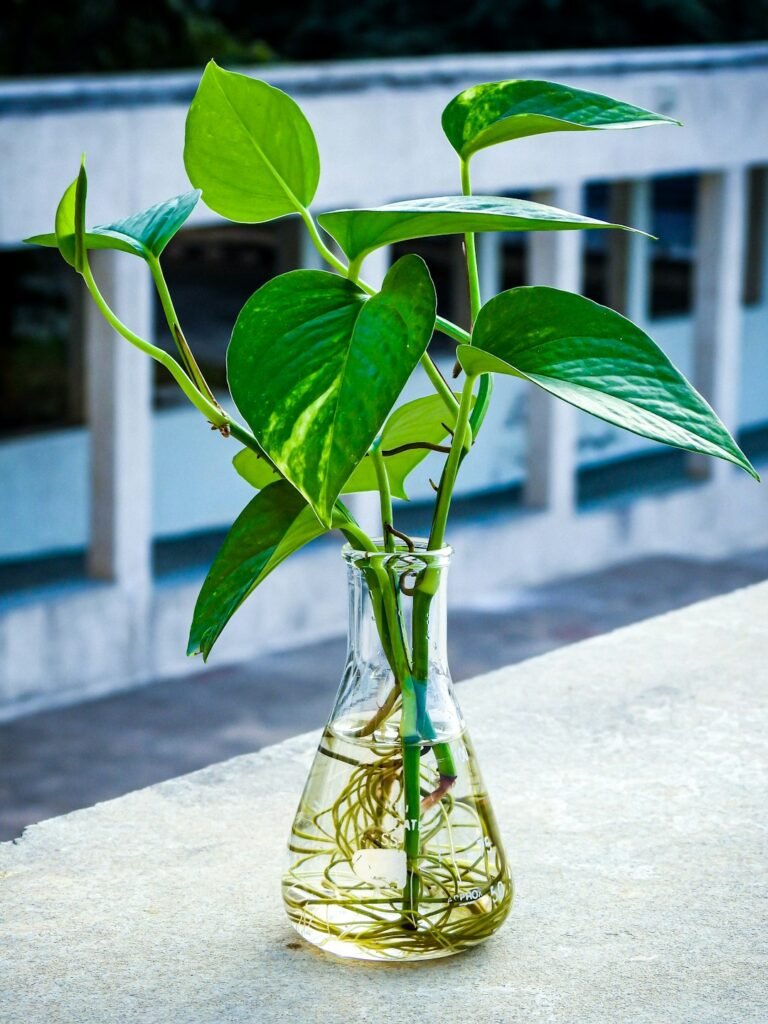
Step 3: Set it in the bottle
- Fill the bottle with room-temperature water.
- Place the cutting so that one or two nodes are under water and every leaf stays above it.
- Several cuttings can share one wide jar; the plant looks fuller this way.
- If the cutting keeps tipping over, add a few washed pebbles or rest the vine against the neck of the bottle.
Step 4: Find the right spot
Keep the bottle near a window that gets bright, indirect light, such as an east-facing sill or a spot a metre or two back from a south or west window. NC State notes that pothos survives long periods in low light, but in very dim corners growth slows and variegated types lose their yellow or white streaks. Avoid direct afternoon sun on the glass: the water warms up, roots cook, and algae grows fast. For more on fitting plants into darker rooms, see our guide to low-light indoor plants for Indian homes.
Step 5: Wait for roots
Small white roots usually appear from the submerged nodes within two to four weeks. NC State’s photo gallery for Epipremnum aureum includes cuttings with visible roots after about two weeks in water. In a Delhi or Lucknow winter, when indoor temperatures drop, expect it to take longer. Do not pull the cutting out to check every few days; you can see the roots through clear glass.
How often should you change the water?
Top up the water whenever the level drops, and replace it completely once a week. Iowa State Extension recommends changing water for rooting cuttings once or twice a week and never letting the level fall so far that developing roots are exposed to air.
In India there is a second, more serious reason to stick to a weekly change: mosquitoes. The Aedes mosquito that spreads dengue breeds in small containers of clean, still water. India’s National Center for Vector Borne Diseases Control (NCVBDC) lists money plants kept in water among indoor breeding sites, and its guidance for schools asks people to change the water in flower vases and plant pots every week. Its documents note that the mosquito can go from egg to adult in about a week, which is why the weekly habit matters, especially from June to November.
When you change the water:
- Lift the plant out gently, holding it at the stems rather than the roots.
- Pour out the old water and rinse the bottle. If the glass feels slimy, scrub it with a bottle brush and plain water.
- Rinse the roots under room-temperature water and remove any that are brown and mushy.
- Refill and return the plant at the same depth.
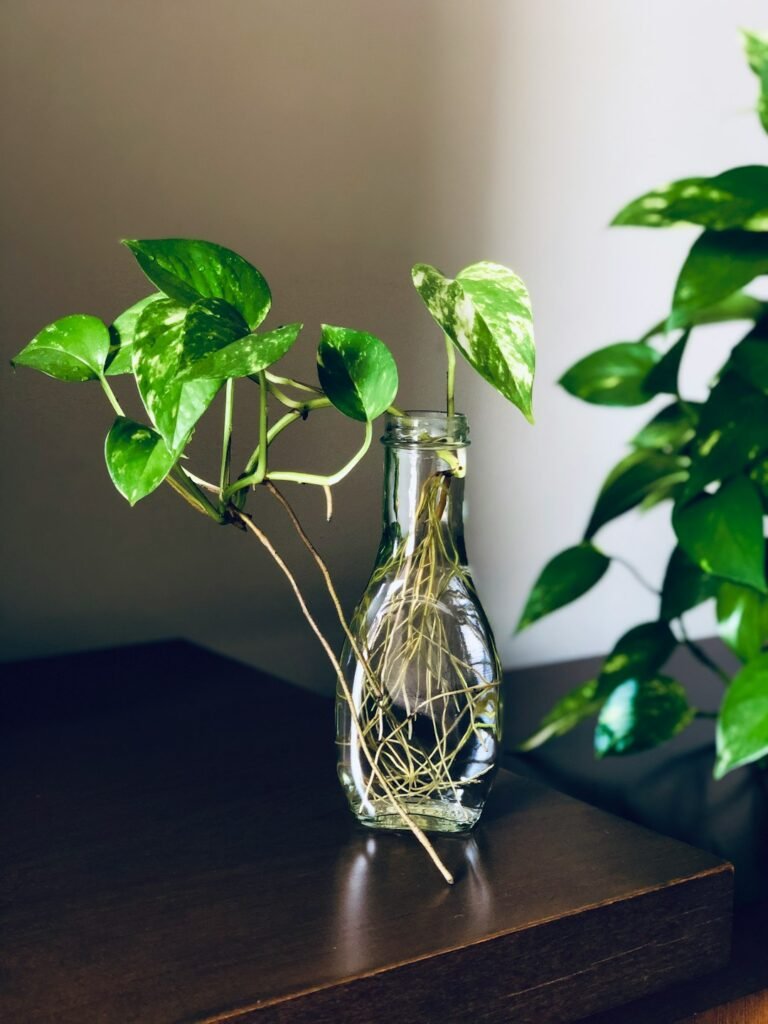
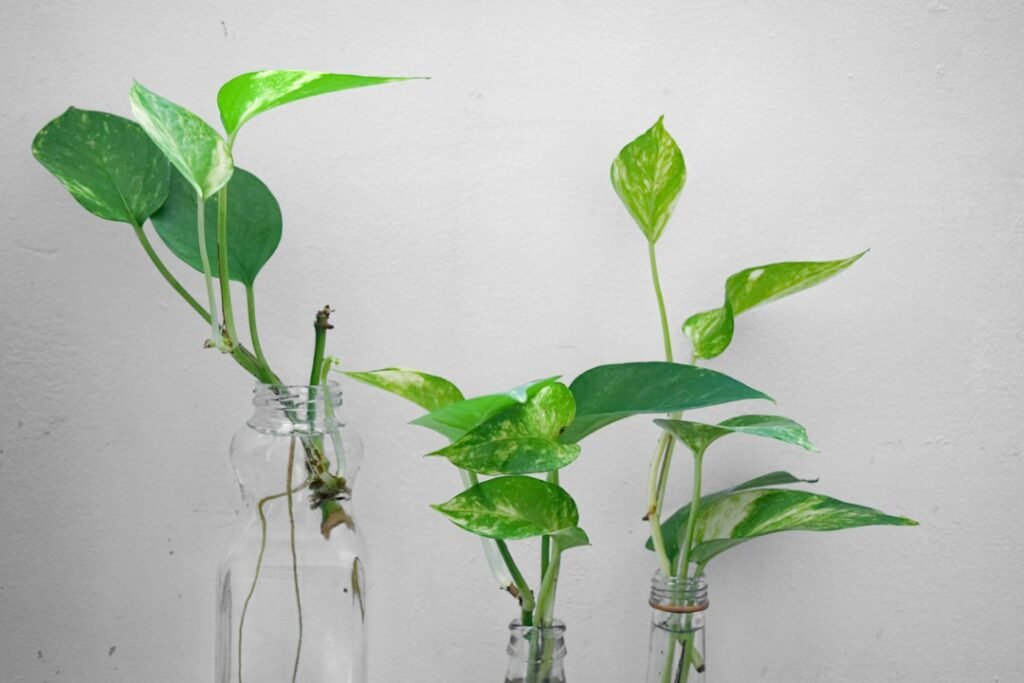
Healthy water roots look like the ones above: white to cream, firm and branching. Brown, soft or smelly roots are a sign the water has gone stale or the bottle is sitting in heat.
Which water is best for money plant in a bottle?
Clean water at room temperature is the main requirement. A few practical points for Indian homes:
- Tap water: fine in most places. Letting it stand for a few hours brings it to room temperature, which is kinder to roots than ice-cold or sun-heated water.
- Hard or salty borewell water: leaves a white crust on the glass and can build up salts over time. If you see this, switch to filtered or RO water, or collected rainwater.
- RO or boiled-and-cooled water: works well, but it contains almost no minerals, so occasional dilute feeding becomes more important.
- Avoid: water from a cooler tank, soapy water and water left in a hot balcony bucket.
Should you add fertilizer to a money plant in water?
A cutting does not need any feeding until it has roots a few centimetres long; it lives on what is stored in the stem. After that, a plant kept in plain water for months will slowly run short of nutrients, and new leaves come out smaller and paler.
Once roots are established, add a few drops of a balanced liquid houseplant fertilizer, at a quarter of the strength printed on the label, to the fresh water every four to six weeks during spring, summer and the monsoon. Skip feeding in the coolest months, when growth slows. Too much fertilizer in a small volume of water burns roots and feeds algae, so err on the weak side. Our guide to fertilizer for indoor plants explains the label numbers if you are choosing a product.
Seasonal care across India
| Season | What happens | What to do |
|---|---|---|
| Summer (March–June) | Fast growth; water warms and evaporates quickly, especially in North and Central India | Move bottles out of direct sun, top up every few days, change water weekly without fail |
| Monsoon (June–September) | Peak mosquito season; high humidity; algae grows faster | Weekly full water change and bottle scrub; never leave water standing in saucers |
| Post-monsoon (October–November) | Good rooting weather in most regions; dengue cases can still be high | Best time to start new cuttings; keep up the weekly change |
| Winter (December–February) | Growth slows in the North; little change in Kerala, Tamil Nadu and coastal cities | Keep away from cold windows at night in the North, stop feeding, expect slower rooting |
Choosing a bottle and keeping it clean
Clear glass is the easiest to manage because you can see the water level, the roots and any cloudiness at a glance. Green or brown bottles cut down light reaching the water, which slows algae, but they also hide problems, so make a point of checking the roots during each water change.
Algae, the green film that builds up on the inside of the glass, does not harm the plant directly, but it competes for nutrients and makes the bottle look dirty. Moving the bottle out of direct sun and scrubbing it during the weekly change keeps it under control.
When roots fill the bottle
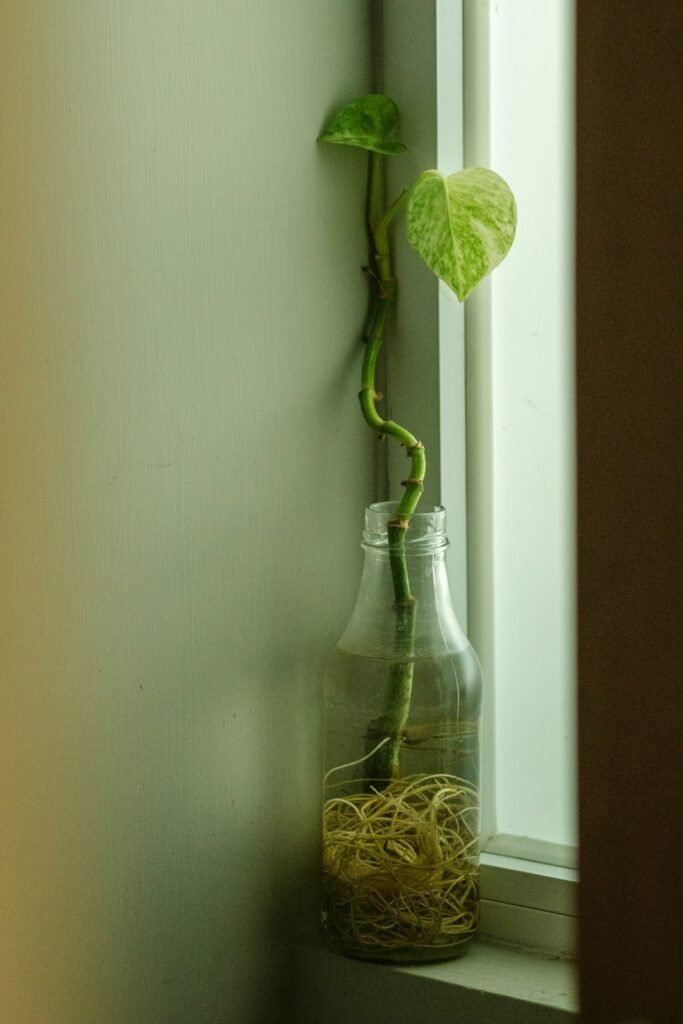
After several months, roots can coil around the bottom of a narrow bottle like the one above. A packed bottle holds less water, goes stale faster and is hard to clean. You have three options:
- Trim: cut back about a third of the oldest roots with clean scissors. The plant will grow fresh ones.
- Divide: separate the stems into two or more bottles.
- Upgrade: move the plant into a wider jar or vase.
Long, leggy vines can also be pinched back just above a node. The cut pieces become your next batch of cuttings.
Moving a money plant from water to soil
If you would rather have a bushy potted plant, the easiest time to switch is early. Iowa State Extension suggests transplanting cuttings when roots are about 2–3 cm (an inch) long, and warns that plants moved from water can wilt, drop leaves or show browning while they adjust.
- Use a small pot with drainage holes and a light, airy potting mix.
- Plant the rooted cutting at the same depth it sat in the water.
- Water well and keep the mix lightly moist, not soggy, for the first two to three weeks.
- Keep it in bright, indirect light and expect a pause in growth before new leaves come.
Our step-by-step guide to repotting your first indoor plant covers pot size and mix in more detail.
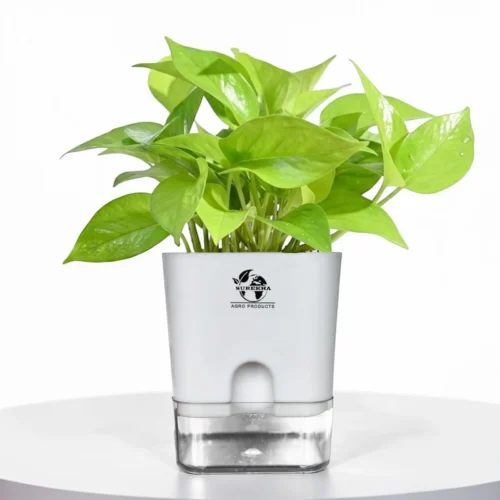
If weekly water changes do not suit your routine, a self-watering pot is a middle path: the plant grows in soil and draws water from a reservoir, so you refill it less often. The Golden Money Plant in a Self-Watering Pot comes already rooted in soil, and our guide on how to use self-watering pots explains how to fill and check the reservoir.
Common problems and quick fixes
| Problem | Likely cause | Fix |
|---|---|---|
| Cutting rots at the base, no roots | No node under water, stale water, or leaves rotting below the water line | Re-cut just below a healthy node, remove submerged leaves, use fresh water |
| No roots after 5–6 weeks | Cold room, very low light, or a cutting without a node | Move to a brighter, warmer spot; take a fresh cutting with 2–3 nodes |
| Yellow lower leaves | Old leaves ageing, stale water, or lack of nutrients after months in water | Change water, remove yellow leaves, start very dilute feeding; see our money plant yellow leaves guide |
| Brown, mushy, smelly roots | Warm, stagnant water or a dirty bottle | Trim bad roots, scrub the bottle, refill, move out of direct sun |
| Green slime on glass | Algae from light plus nutrients | Scrub weekly, shift to indirect light, or use a tinted bottle |
| Small leaves, long gaps between them | Too little light | Move closer to a bright window, out of direct sun |
| Variegation fading to plain green | Low light | Give brighter indirect light; new leaves should colour up |
| Wiggling larvae in the water | Mosquitoes breeding | Pour out the water immediately, scrub the bottle and change water weekly from now on |
Is money plant in water safe for pets and children?
The ASPCA lists golden pothos as toxic to cats and dogs. It contains insoluble calcium oxalate crystals, and chewing the leaves can cause mouth irritation, drooling, vomiting and difficulty swallowing. Keep bottles on high shelves or in rooms pets cannot reach, and do not let small children drink from or play with the bottle. If a pet chews the plant and shows symptoms, contact a vet.
Water or soil: which is better for a money plant?
Both work. Water suits small spaces, kitchen windows and office desks, needs no soil mess, and lets you enjoy the roots. Soil generally gives bigger leaves and a fuller plant, and it is the better choice if you want a vine to climb a moss stick. Many people keep both: a mother plant in a pot and a few cuttings in bottles around the house.
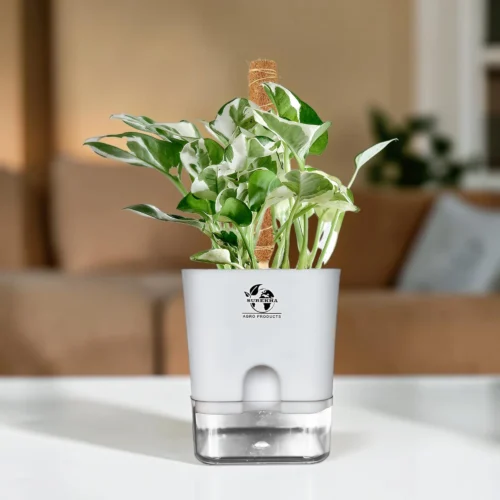
If you would like a ready-grown plant to start your own cuttings from, the Surekha Variegated Money Plant and the Money Plant with Moss Stick both come in self-watering pots, and the Lucky Plants Combo pairs a money plant with lucky bamboo and jade.
Money plant is often kept in a bottle for Vastu reasons, usually in the south-east corner of a home. That is a cultural belief rather than something horticulture can measure, but if it matters to you, the same care rules apply wherever the bottle sits. Lucky bamboo is another plant that is commonly grown in water; see our lucky bamboo care guide for how its needs differ.
Frequently asked questions
How long does money plant take to root in water?
Usually two to four weeks in warm weather. In cooler rooms, particularly during a North Indian winter, it can take five or six weeks. Cuttings with two or three nodes under water root faster than single-node pieces.
Can money plant grow in water without soil forever?
It can live in water for years if you change the water weekly, keep the bottle clean and add a very weak liquid fertilizer every month or so during the growing season. Without any feeding, growth eventually slows and new leaves get smaller.
How often should I change the water for money plant in a bottle?
Replace it fully once a week and top it up in between. A weekly change also stops dengue mosquitoes from breeding in the bottle, which India’s NCVBDC specifically recommends for plant containers and vases.
Why is my money plant in water turning yellow?
The usual causes are stale water, too little light, a lack of nutrients after many months in plain water, or simply old lower leaves dying back. Change the water, move the bottle to brighter indirect light and remove yellow leaves.
Can I grow money plant in water from a single leaf?
A leaf alone will not grow into a new plant. The cutting needs at least one node, the point on the stem where the leaf joins, because that is where roots and new shoots form.
Should I put money plant water in sunlight?
Bright light, yes; direct sun, no. Direct sun on a glass bottle heats the water, damages roots and encourages algae. A bright window without afternoon sun is ideal.
Which money plant variety grows best in water?
All common types of Epipremnum aureum root in water, including Golden, Marble Queen, N’Joy and Neon. The plain green and golden forms grow fastest; heavily white-variegated types grow more slowly and need brighter light.
Conclusion
Growing a money plant in water comes down to a cutting with nodes under water, leaves kept above it, bright but indirect light and a weekly water change. That last habit keeps the roots healthy and, in Indian homes, keeps mosquitoes out of the bottle too. Start two or three cuttings at once, watch the roots form through the glass, and you will have a supply of new plants for every windowsill and to give away.
Sources
- North Carolina State University Extension, Plant Toolbox: Epipremnum aureum
- Iowa State University Extension and Outreach: How to Propagate Houseplants by Stem Tip Cuttings
- National Center for Vector Borne Diseases Control, Government of India: Operational Guidelines for Hospitals to Control Aedes Breeding (2022)
- National Center for Vector Borne Diseases Control, Government of India: Guidelines for Prevention and Control of Dengue in Schools (2019)
- ASPCA Animal Poison Control: Golden Pothos