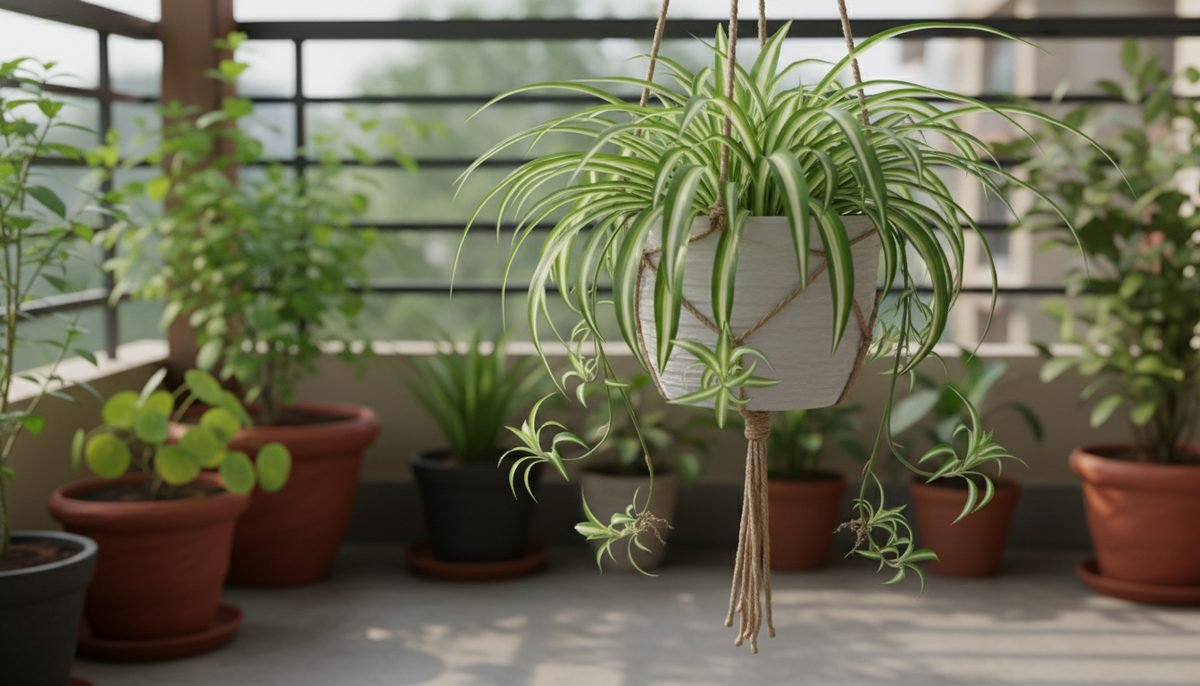
Spider plant (Chlorophytum comosum) is the houseplant many Indian families end up sharing with neighbours, because one healthy pot soon dangles a dozen babies. Good spider plant care is mostly about four things: bright light without harsh sun, water only when the top of the mix has dried, a light hand with fertilizer, and clean water for the leaf tips. Get those right and this plant forgives almost everything else.
This guide adapts that care to Indian conditions: hot pre-monsoon balconies, soggy July pots, chilly December nights in the north and the hard, salty tap water many cities supply.
Quick answer
Keep a spider plant in bright, indirect light (an east-facing window or a shaded balcony is ideal), water thoroughly when the top 2–3 cm of soil feels dry, and let the excess drain away. Feed lightly every few months in the growing season, not every week. Brown tips usually point to salts, fluoride or chlorine in the water, or a dried-out root ball, so flush the pot now and then and use filtered water or collected rain water when you can (never RO reject water, which is salty). Pot up the baby plantlets once they show roots. Spider plant is listed as non-toxic to cats and dogs by the ASPCA.
Spider plant at a glance
| Need | What works in Indian homes |
|---|---|
| Light | Medium to bright indirect light; morning sun is fine, afternoon summer sun scorches leaves |
| Water | Soak, drain, then wait until the top layer dries; less in monsoon and winter |
| Temperature | Comfortable in normal room temperatures; keep it above about 7 °C |
| Soil | Any loose, well-drained potting mix with a drainage hole in the pot |
| Fertilizer | Every 3–4 months, or a half-strength liquid feed more often in the growing season |
| Pot size | Slightly snug; move up one size when roots start lifting the plant |
| Propagation | Plantlets (“babies”) or division of a big clump |
| Pets | Non-toxic to cats and dogs (ASPCA) |
| Common issues | Brown tips, root rot from soggy soil, mealybugs and scale |
Why spider plants suit beginners
The plant grows from thick, fleshy, almost tuber-like roots. According to the University of Wisconsin–Madison Extension, those roots evolved to store water, which is why a spider plant shrugs off a missed watering during a busy week or a short trip. The same extension page describes it as one of the easiest houseplants to grow and multiply.
It is native to parts of tropical and southern Africa, so typical Indian room temperatures suit it well. The leaves can be plain green or striped. ‘Vittatum’ has a broad cream band down the centre of a green leaf, ‘Variegatum’ has cream edges, and ‘Bonnie’ has leaves that curl and twist. If you are still deciding what to buy, our guide to low-maintenance indoor plants for bedrooms compares it with other easy options.
Choosing a healthy plant and the right pot
Look for firm, upright leaves with clean colour and no mealy white cotton at the base. A few brown tips on a nursery plant are not a deal-breaker; they can be trimmed, and new growth will show whether the problem has been fixed.
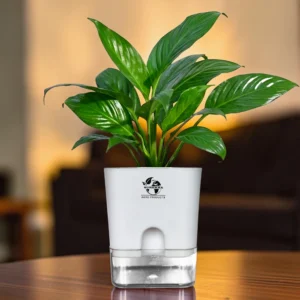
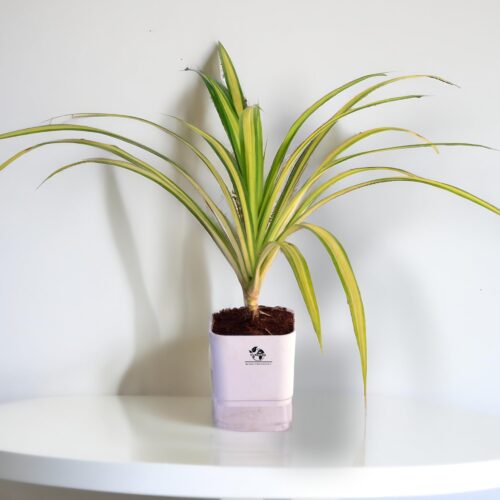
The pot matters more than most people think. It must drain. A spider plant’s roots fill a container quickly, and plants actually make more babies when they are slightly root-bound, but a crowded pot also dries out faster and can push the plant upwards. Our spider plant in a self-watering pot comes potted with a water reservoir, which helps on hot days if you remember not to keep the reservoir topped up through the monsoon.
New to reservoir pots? Read how to use self-watering pots before the first fill, because the wick and the reservoir change how often you should water.
Light: bright, but not the afternoon sun
The NC State Extension Gardener Plant Toolbox notes that spider plant prefers medium light, tolerates deep shade and does not tolerate direct sunlight well. In practice:
- Best spots: near an east window, a few feet back from a south or west window, under a balcony roof or on a north-facing balcony.
- Too dark: leaves turn a duller green, stripes fade and the plant stops producing runners.
- Too much sun: pale, bleached patches and crisp brown edges, especially from March to June on west-facing balconies.
Variegated types need a little more light than plain green ones to keep their stripes bright. If your flat is dim, see our list of low-light indoor plants for Indian homes to compare options.
Watering a spider plant through the Indian year
UW–Madison Extension advises letting the soil dry slightly between thorough waterings, and it lists overwatering and poorly drained soil as the route to root rot. NC State adds that watering should be reduced in winter. Here is how that translates to our seasons:
- Check first. Push a finger 2–3 cm into the mix. Water only if it feels dry at that depth.
- Water deeply. Pour slowly until water runs from the drainage hole, so the whole root ball is wetted.
- Empty the saucer. Never leave the pot standing in water for hours.
- Adjust to the season. Watering every few days may be needed in May on a warm balcony; once a week or less is often enough in monsoon and winter.
- Watch the roots, not the calendar. Pale, limp leaves with wet soil mean too much water. Limp leaves with bone-dry soil mean too little.
For a broader routine that covers other houseplants too, see our guide on how to water indoor plants in India.
Seasonal checklist
| Season | What changes | What to do |
|---|---|---|
| Summer (March–June) | Fast drying, hot winds, harsh afternoon sun | Shift away from west light, water more often, group pots together for humidity |
| Monsoon (June–September) | Slow drying, high humidity, fungus gnats | Water less, empty reservoirs and saucers, keep pots out of driving rain |
| Post-monsoon and winter (October–February) | Shorter days, cooler nights | Expect runners and small white flowers; reduce watering; bring pots indoors on cold nights in North India |
Soil, repotting and fertilizer
Any good general-purpose potting mix works. A home mix of garden soil, cocopeat and compost in roughly equal parts, with a handful of coarse sand or perlite, drains well enough. Avoid heavy clay that stays wet for days after watering.
Repot when roots circle the bottom, poke out of the drainage hole or start lifting the plant above the rim. That may be every year for a vigorous plant. Move up only one pot size, or divide a large clump into two or three pieces, each with its own roots and leaves. Our step-by-step guide on how to repot an indoor plant walks through the process.
Go easy on feeding. UW–Madison Extension says fertilizing every 3–4 months is usually enough, or more often at half strength, and warns that heavily fed plants may form fewer plantlets and that excessive fertilizer can cause tip browning. A spoon of well-rotted compost or vermicompost on the surface in spring and again after the monsoon is plenty for most pots. For product choices, see our fertilizer guide for indoor plants.
How to propagate spider plant babies
The “spiders” form at the ends of long, wiry runners. NC State explains that these runners and plantlets are triggered by short days, when the plant gets less than 12 hours of light a day for at least three weeks. Across most of India, days are shorter than 12 hours from late September to March, which is why many home growers notice a flush of runners in winter. A room light left on late into the night can interrupt that signal.
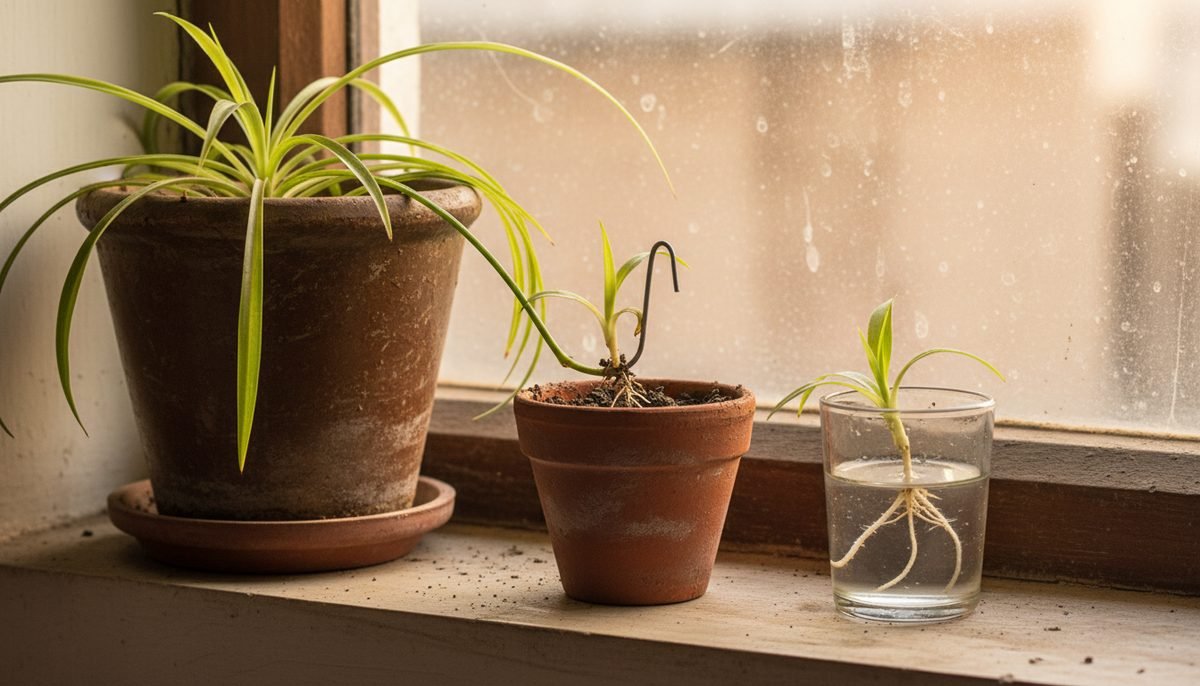
Method 1: Root it while still attached (most reliable)
- Fill a small pot with moist potting mix and place it next to the mother plant.
- Rest a plantlet on the surface without cutting its runner.
- Hold it in contact with the mix using a bent paper clip or a U-shaped piece of wire.
- Keep the mix lightly moist. Within a few weeks, a gentle tug will meet resistance, which means roots have formed.
- Snip the runner. The baby is now an independent plant.
Method 2: Pot up a baby that already has roots
Many plantlets develop small root nubs while still hanging. Cut these off and plant them directly, about 1 cm deep, in a small pot of moist mix. Keep them out of direct sun for the first two weeks.
Method 3: Water rooting
You can also stand a plantlet in a glass of water, with only the base submerged, until the roots are a few centimetres long, then move it to soil. Change the water every few days. Plants rooted this way sometimes sulk briefly after the move, so keep the soil evenly moist for the first fortnight.
Seeds are possible too, but UW–Madison notes that seedlings may not keep the parent’s leaf colouring, so plantlets are the better route if you want the same striped look.
Common spider plant problems and fixes
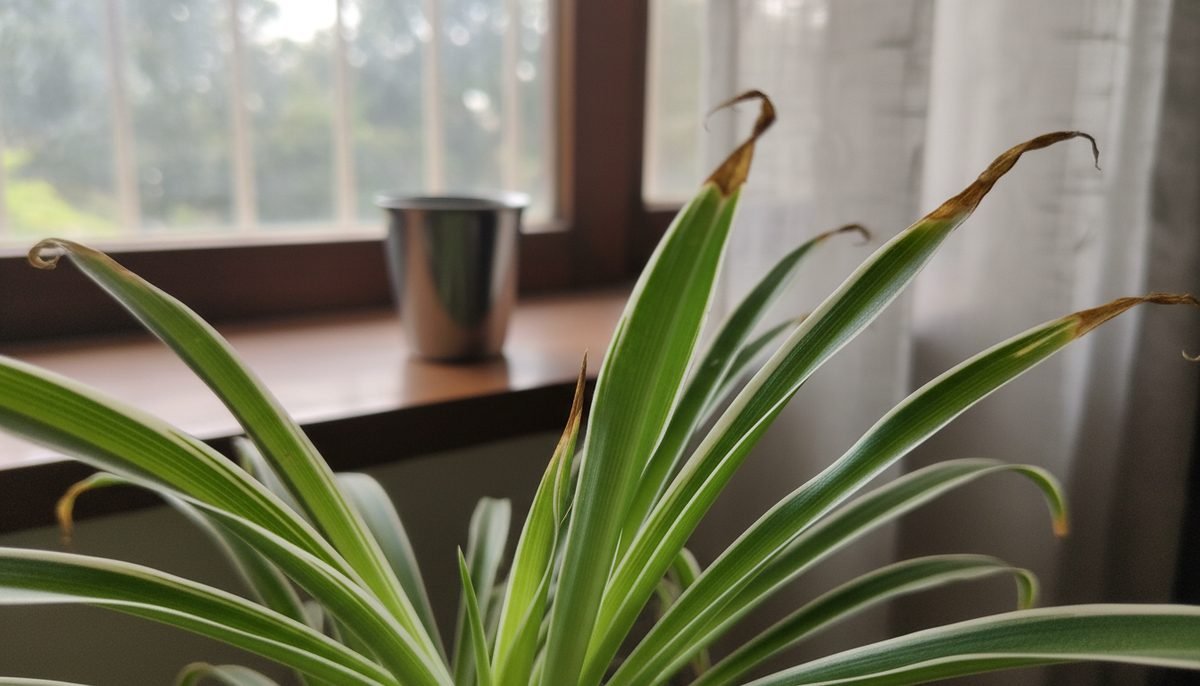
Brown tips deserve special attention. A University of Arkansas extension horticulturist explains that tip burn on spider plants comes from fluoride slowly building up in the leaf tissue, and lists low-grade fertilizer, some vermiculite and fluoridated tap water as possible sources. UW–Madison adds low humidity, very dry soil, salt build-up and chlorine as other causes. Many Indian homes use bore-well or tanker water that is high in dissolved salts, so this problem is common here.
| Symptom | Likely cause | Fix |
|---|---|---|
| Brown, crispy leaf tips | Salts, fluoride or chlorine in water; dry root ball; overfeeding | Flush the pot with plenty of clean water every month or two; switch to rainwater or filtered water; trim tips at an angle with clean scissors |
| Yellowing, soft leaves at the base; sour smell | Overwatering, poor drainage, root rot | Let the mix dry, check roots, cut away mushy brown roots and repot into fresh, airy mix |
| Pale, washed-out or scorched patches | Direct afternoon sun | Move to bright shade or behind a sheer curtain |
| Dull leaves, faded stripes, no babies | Too little light, or too much fertilizer | Move closer to a window; cut back on feeding |
| White cotton tufts or brown bumps on leaves | Mealybugs or scale insects | Wipe off with cotton dipped in soapy water; repeat weekly; isolate the plant |
| Plant pushing out of the pot | Root-bound | Divide or move up one pot size |
Trimmed tips will not turn green again, but if the new leaves come out clean, your fix is working. Dusty leaves also look tired; our gentle leaf-cleaning routine works well on spider plants too.
Is spider plant safe for cats and dogs?
The ASPCA plant database lists spider plant as non-toxic to both dogs and cats, and NC State tags it as non-toxic for cats, dogs and horses. That makes it one of the safer choices for a pet household. Cats do love to chew the arching leaves, though, so a hanging basket keeps the plant looking good. Any plant can upset a pet’s stomach if a lot is eaten, so call your vet if your pet seems unwell.
Does a spider plant clean indoor air?
Spider plant is often sold as an “air-purifying” plant, and UW–Madison notes that it absorbed chemicals such as formaldehyde and benzene in studies. Those results came from small sealed test chambers. A 2019 review in the Journal of Exposure Science & Environmental Epidemiology found that, in a normal home, you would need somewhere between 10 and 1,000 potted plants per square metre to match what ordinary ventilation already does. So open the windows for fresh air, and keep a spider plant because it is green, cheerful and easy. We cover the same point for snake plants in our article on snake plant benefits.
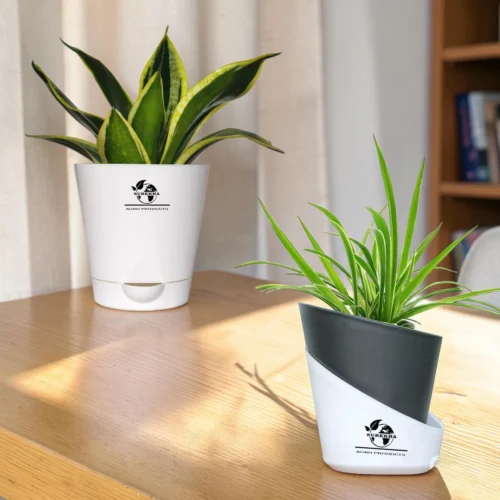
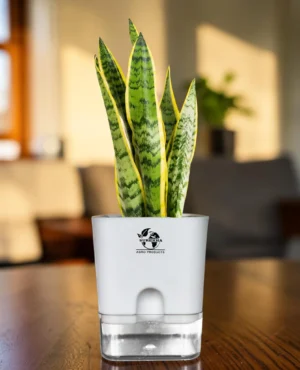
Spider plants pair well with snake plants, because both are easy-going and like similar light. Our spider plant and Golden Hahnii snake plant duo is a simple starter set, and our snake plant care guide covers its partner. If you already have plants and only need containers, the self-watering oval pots (pack of 2) suit spider plant babies well.
Frequently asked questions
How often should I water a spider plant in India?
There is no fixed schedule. Water when the top 2–3 cm of mix is dry. That can mean every two or three days on a hot summer balcony and once a week or less during the monsoon and winter.
Can a spider plant grow in direct sunlight?
Gentle morning sun is fine, but strong afternoon sun, especially from March to June, bleaches and scorches the leaves. Bright shade or indirect light gives the best colour.
Why are my spider plant’s leaf tips turning brown?
The usual causes are salts, fluoride or chlorine building up from tap water, letting the pot dry out completely, or too much fertilizer. Flush the pot with plenty of water, use rainwater or filtered water where possible, and trim the brown ends.
Why is my spider plant not producing babies?
Plantlets form after a few weeks of short days, so they usually appear from autumn to early spring in India. Too little light, too much fertilizer, a very young plant or a pot that is far too big can all delay them.
Can I grow a spider plant in water only?
Plantlets root easily in water, but for long-term growth, move them into potting mix once the roots are a few centimetres long. Soil gives the fleshy roots the nutrients and support they need.
Is spider plant good for the bedroom?
Yes. It tolerates moderate light, stays compact, is listed as non-toxic to cats and dogs and needs little care. Just do not expect it to replace ventilation as an air cleaner.
Should I cut the spider plant runners?
You can. Cutting runners sends more energy into the main clump, while leaving them gives the classic cascading look. Either way, use the babies to start new plants.
Final thoughts
Spider plant care in India comes down to a short list: bright shade, water when the top layer is dry, little fertilizer, clean water and a pot that drains. Follow the season, watering more in summer and less in monsoon and winter, and enjoy the babies when the short days arrive. Before long, one pot will give you babies to share.
Sources: University of Wisconsin–Madison Extension, “Spider plant, Chlorophytum comosum” (revised January 2025); NC State Extension Gardener Plant Toolbox, “Chlorophytum comosum”; University of Arkansas Division of Agriculture, “Plant of the Week: Spider Plant (Airplane Plant)”; ASPCA Animal Poison Control, “Spider Plant”; Cummings & Waring (2019), Journal of Exposure Science & Environmental Epidemiology.